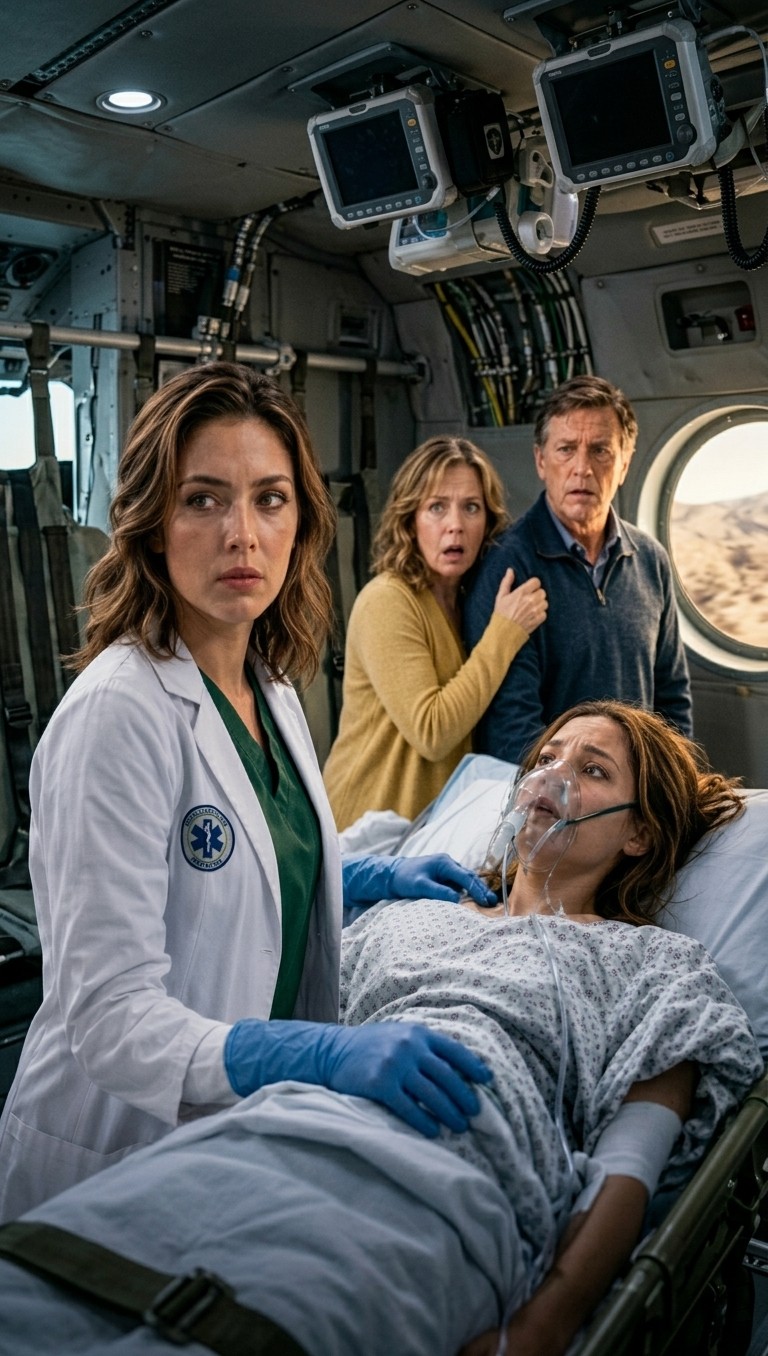
PART 2
The ultrasound confirmed it in under ninety seconds.
Ruptured ectopic. Internal ble:eding. Claire needed surgery immediately or she would d!e on that stretcher.
I turned to the trauma nurse. “Page Dr. Alvarez. Prep OR three. I want two units of blood typed and crossed before she rolls in.”
My mother stepped forward. “Emily, wait—”
“Not now,” I said, without looking at her.
“Emily, please, I need to understand what’s happening—”
I turned around.
Five years of silence stood between us in that fluorescent corridor. Five years of returned letters, blocked phone numbers, empty chairs at my wedding, and a mother who chose to believe her golden child over her own eyes.
“What’s happening,” I said, “is that your daughter is ble:eding internally and I am the doctor who is going to save her life. You can sit in the waiting room or you can stand in my hallway, but you cannot be in my operating space. Those are your options.”
My father hadn’t spoken yet. He stood behind my mother with the particular stillness of a man watching something he had been wrong about for a very long time finally become undeniable.
“She’s really a doctor,” he said. Not to me. Not to my mother. To himself. Like he was trying to fit the sentence into the shape of the last five years and it wouldn’t go.
“Attending physician,” the nurse corrected, because nurses protect their doctors and mine had been protecting me since my first week on staff. “She runs this department three nights a week.”
My mother made a sound I hadn’t heard before. Not a cry exactly. The sound a person makes when the ground they built their certainty on shifts underneath them and they realize they’ve been standing on nothing.
I walked away.
Claire went into surgery at 11:47 PM. Dr. Alvarez performed the procedure. I assisted for the first forty minutes, then stepped out because my hands had started trembling, not from medical uncertainty but from the simple biological reality that you cannot operate on your own sister without something inside you shaking loose.
I stood in the scrub room with my back against the tile wall and my surgical cap still on and breathed until the trembling stopped.
Daniel called at midnight. He already knew.
“Are you okay?” he asked.
“She’s in surgery,” I said. “She’ll survive.”
“I didn’t ask about her,” he said quietly. “I asked about you.”
I closed my eyes.
“I’ll be okay,” I said. “But the forensic accountant — can you call him first thing tomorrow?”
A pause.
“You sure?” Daniel asked. “Tonight might not be the night to—”
“Tonight is exactly the night,” I said. “Because by morning they’re going to try to pretend the last five years didn’t happen. And I need them to understand that I have receipts for every single one of them.”
“I’ll make the call,” Daniel said.
Claire was out of surgery by 1:15 AM. Stable. Alive. Because the doctor she had tried to erase from existence five years earlier happened to be the one on duty the night her body tried to k!ll her.
I checked her vitals personally at 2 AM.
She was awake. Groggy. The oxygen mask was off, replaced by a nasal cannula. Her eyes found me immediately.
“Emily,” she said. Her voice was raw and thin. “You saved my life.”
“Dr. Alvarez saved your life,” I said, checking her IV line. “I assisted.”
“You know what I mean.”
I set the chart down.
“Claire,” I said. “We are going to have a conversation. But not tonight. Tonight you are my patient. Tomorrow you are my sister. And those are two very different conversations.”
She looked at me with an expression I had never seen on her face before. Not charm. Not manipulation. Not the practiced fragility she used to control every room she entered.
Fear.
The fear of a woman who has just realized that the person she destroyed is now the person she owes her life to, and there is no script for what comes next.
“Get some rest,” I said. “I’ll check on you at six.”
I walked out.
My parents were in the waiting room.
My mother stood when she saw me. Her eyes were swollen. My father’s arm, where she had gripped it in the ER, was already showing purple.
“She’s stable,” I said. “She’ll recover fully.”
“Emily—” my mother started.
“Not tonight,” I said. “Tomorrow. All of us. Including Daniel.”
“Who is Daniel?” my father asked.
“My husband,” I said. “The one you didn’t come to the wedding of.”
I walked past them.
Out the automatic doors.
Into the parking lot.
I sat in my car for eleven minutes before I drove home.
THE FINAL CHAPTER
The conversation happened three days later in the hospital conference room I had reserved specifically because it had no windows, no distractions, and a long table that put exactly the right amount of distance between the people who owed me an explanation and the woman who had spent five years earning the right to demand one.
Claire was in a wheelchair. Still recovering. Still pale. Still wearing a hospital gown because she wasn’t being discharged until the following morning.
My parents sat across from me. My mother had dressed carefully, as if appearance could substitute for accountability. My father wore the expression of a man who had been reviewing five years of decisions in his head and couldn’t find a single one that held up.
Daniel sat beside me. His briefcase was on the table. Inside it was everything.
“Before we start,” I said, “I want to make something clear. I am not here to yell. I am not here to cry. I spent five years doing both of those things alone, and I’m finished with them.”
Nobody spoke.
“Claire,” I said. “Tell them.”
Claire’s fingers tightened on the armrests of her wheelchair.
“Tell them what?” she said, and even now, even after everything, there was a flicker of the old Claire in her voice, testing whether there was still a way to manage this.
“Tell them what you told me at two in the morning while you were still on painkillers and thought I might not remember,” I said.
The room went very still.
Claire had spoken to me that night in the post-op haze, the way people speak when the walls they’ve built are chemically dissolved and the truth leaks out through the cracks. She had told me she lied because she was terrified. Because I was succeeding at something she had never attempted. Because our parents praised her for being charming and pretty and fragile, and the moment I started becoming something on my own, she felt the attention shifting and couldn’t bear it.
“I was jealous,” she whispered now, looking at the table.
My mother flinched.
“I told them you dropped out because I couldn’t stand that you were going to be a doctor and I was going to be the sister of a doctor,” Claire continued. “I told them about the gambling debts because I needed them to be angry enough to stop asking questions. And I intercepted the transcripts because if they saw your grades they would have known immediately that I was lying.”
My father’s hand was flat on the table, pressing down hard, the way you press down on something to keep it from shaking.
“And the trust fund,” I said.
Claire closed her eyes.
“Daniel,” I said.
My husband opened his briefcase. He placed three documents on the table with the quiet precision of an attorney who has spent fourteen months assembling a case and is now presenting it without commentary.
“Mr. and Mrs. Bennett,” he said. “Your father created equal education trust funds for both of your daughters. Emily’s fund showed withdrawals totaling $127,000 over a period of eighteen months. Emily did not authorize or receive any of those withdrawals.”
My mother looked at Claire.
“The withdrawals were made using Emily’s personal information,” Daniel continued. “Social security number, date of birth, security questions. Information that would have been readily available to an immediate family member.”
“Claire,” my father said. One word. Her name. But the way he said it carried the weight of a man who had just realized he had punished the wrong daughter for five years.
Claire was crying now. Real tears, not performed ones. I had spent enough years watching her perform to know the difference.
“I used the money to pay off credit cards,” she said. “And a lease on an apartment I told you guys my job was covering. And—” She stopped.
“And the down payment on the car you told them your boyfriend bought you,” I finished.
My mother pressed both hands over her face.
“You stole from your sister,” my father said, his voice shaking in a way I had never heard from him. “You stole her money. You stole her family. You stole five years of her life. And you let us help you do it.”
“I’m sorry,” Claire whispered.
“I know you are,” I said. “You’re sorry because you’re sitting in a wheelchair in a hospital where I’m the attending physician, and a forensic accountant has documented every dollar you took, and my husband is a civil rights attorney who has been waiting very patiently for this conversation.” I paused. “You are sorry because you got caught. That is different from being sorry because you understand what you did.”
The conference room was completely silent.
“Emily,” my mother said, lowering her hands. Her face was wrecked. “What can we do?”
“You can start,” I said, “by saying one sentence. The sentence I asked you to say five years ago, before you cut off my rent and my insurance and my tuition in the same phone call.”
She looked at me.
“Say it,” I said.
My mother’s chin trembled.
“I should have called the dean,” she whispered.
“Yes,” I said. “You should have.”
I stood up.
“Daniel will be in touch regarding the trust fund,” I said. “Claire, you’re being discharged tomorrow. I’ve arranged for Dr. Alvarez to handle your follow-up care so there’s no conflict of interest.”
I buttoned my white coat.
“Mom. Dad.” I looked at them across the table. “If you want to be in my life again, that door is not closed. But it opens on my terms, on my timeline, and it starts with actions, not apologies. I have a husband you’ve never met properly. You have a daughter-in-law you’ve never spoken to. There are years of work ahead, and I need you to understand that showing up is the minimum, not the gesture.”
My mother nodded, tears streaming.
My father said nothing. But he stood, slowly, and he looked at me the way he used to look at me when I was eight years old and brought home a perfect report card, like he was seeing something he had always known was there but had somehow, catastrophically, allowed himself to forget.
I walked out of the conference room, down the corridor, past the nurses’ station where my team was pretending very hard not to have been listening through the thin wall.
The charge nurse, Maria, handed me a coffee without a word.
“Thank you,” I said.
“You’re a hell of a doctor, Bennett,” she said quietly.
I took the coffee to my office. Sat in the chair. Looked at the diploma on the wall that nobody in my family had watched me receive.
Daniel texted: How did it go?
I typed back: They heard everything. Claire confessed. We’ll see what happens next.
He replied: Whatever happens, I’m proud of you. So is the empty chair at our wedding that should have had your mom in it.
I stared at that message for a long time.
Then I put my phone down, finished my coffee, and went back to work.
Because that is what I have always done.
Alone or not.
Believed or not.
I went back to work.
Share this for every person who succeeded without the people who should have been cheering the loudest, and for every family that learned, too late, exactly who they had been wrong about. ❤️👇
— Update: My parents came to dinner last Sunday. First time in five years. My mother brought flowers. My father shook Daniel’s hand and held it for a long time without saying anything. Noah — wait, wrong story. My mother sat at my kitchen table and looked at the wedding photo on the wall and said, “I should have been there.” I said, “Yes.” We ate. It was awkward and quiet and imperfect. It was also the best dinner I’ve had in five years. Claire has entered a repayment plan for the trust fund. We don’t speak often yet. But she sent me a card last week. It said simply: “Thank you for saving my life. Both times.” I put it in a drawer. Not because I don’t care. Because I’m not ready to frame it yet. Someday, maybe.
