PART 2->The End
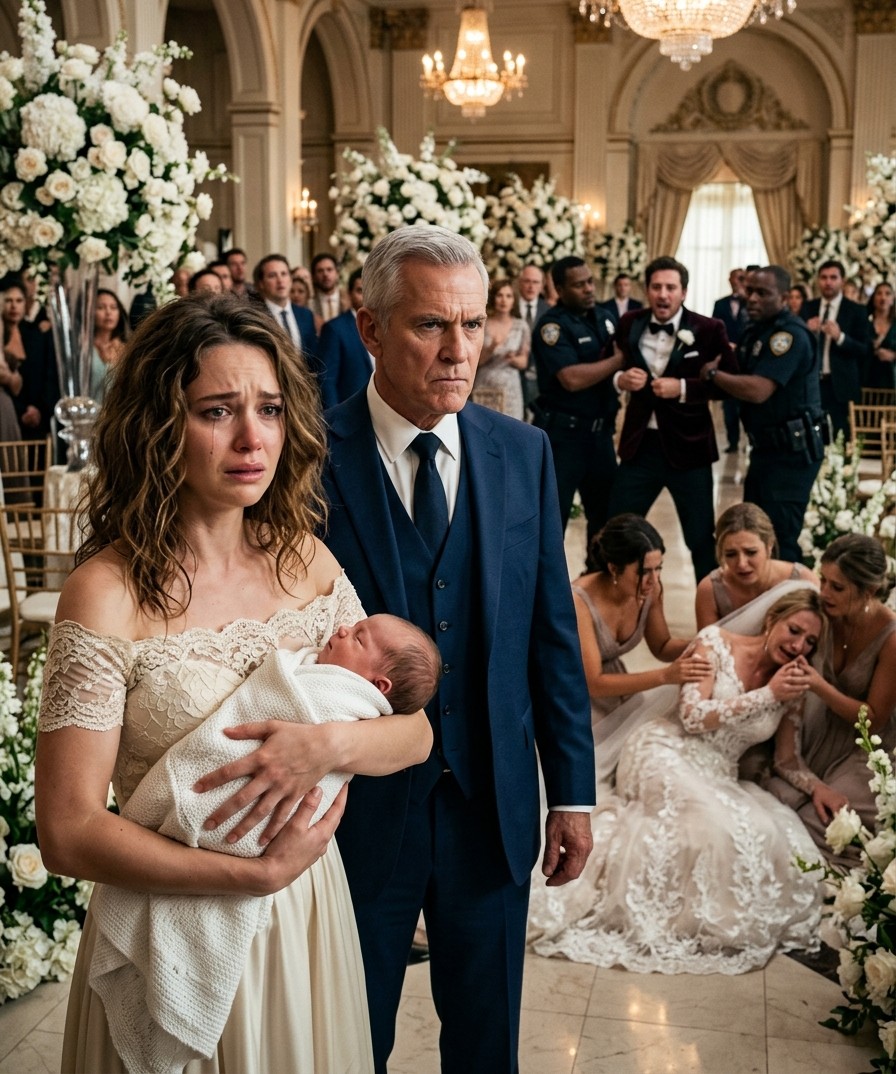
The ballroom doors opened wider than they needed to.
Not because anyone pushed them hard. But because the Imperial Grand had those enormous gilded double doors designed to make an entrance feel like an event, and when three people walk through them during a groom’s speech, every head in the room turns whether they want to or not.
Two hundred guests.
Every single one of them turned.
Derek was still holding his champagne glass in the air, still smiling, still basking in the laughter his little joke about his “weak wife and troublesome child” had produced. The microphone was still live. The private orchestra had paused between movements. The timing was, if I’m being honest, more perfect than anything I could have planned.
Noah held my hand tightly. His other hand gripped the strap of his small backpack, the one with the rocket ship patch his grandmother had sewn on before she d!ed.
Dad walked beside me. Not ahead of me. Beside me. He had insisted on that.
“This is your moment,” he had said in the corridor. “I’m just the context.”
Derek saw me first.
His smile didn’t disappear immediately. It flickered, the way a light does before the power cuts. Confusion first. Then irritation. Then something colder when he realized I was not alone.
“What is this?” he said, still holding the microphone. “Someone want to tell security there’s an uninvited—”
Then he saw Dad.
The champagne glass lowered slowly.
“Mr. Vale?” Derek said.
The room shifted. Two hundred guests who had been laughing three seconds earlier were now watching their host’s face drain of color in real time.
“Arthur?” Vanessa’s mother whispered loudly from the head table. “Arthur Vale? What is he doing here?”
Dad didn’t speak yet. He simply stood beside me with his hands folded in front of him, the way he stood in boardrooms when he wanted everyone else to fill the silence with their own panic.
Derek stepped away from the microphone stand.
“Mr. Vale, I’m — I didn’t expect — this is an honor, sir. I didn’t realize you were—”
“She’s my daughter,” Dad said.
Three words.
The room didn’t gasp the way rooms gasp in movies. It was quieter than that. More like the sound of two hundred people inhaling at the same time and forgetting to exhale.
Derek looked at me. Then at Dad. Then back at me.
“That’s impossible,” he said. “Your father was — you told me your father was—”
“D!ed before I was born,” I said. “That’s what my mother told me. She was wrong.”
“Or more precisely,” Dad said, “she kept it from both of us. I only learned I had a daughter eighteen months ago. I’ve been making up for lost time.”
Derek set down his glass. His hand was trembling but he was working very hard to keep his voice steady, the way he always did when he was calculating how to survive a situation he hadn’t prepared for.
“Well,” he said, forcing a smile that looked physically painful. “This is — this is wonderful. Arthur, please, sit down. Join us. I had no idea Claire was—”
“Claire and I have spent the last year getting to know each other,” Dad said. “Wonderful woman. Brilliant accountant. Meticulous researcher.” He paused. “Very thorough with numbers.”
Something moved across Derek’s face.
Not panic yet.
But the beginning of it.
Vanessa stood from the head table, her designer gown rustling, her smile locked in place with the determination of a woman who had spent six months planning a wedding and was not about to let it be interrupted by whatever this was.
“Derek, honey, maybe we should—”
“Sit down, Vanessa,” Derek said sharply. Then he caught himself and softened his voice. “Please. Just — let me handle this.”
Noah tugged my hand.
“Mommy,” he whispered. “Why does he look scared?”
I crouched down. “Because he’s remembering something he forgot, sweetheart.”
“What did he forget?”
I straightened his tie one more time.
“That numbers don’t lie.”
The ballroom door behind us opened again.
This time it was the security director. He walked straight to Derek and placed a sealed envelope on the nearest table.
“Mr. Parker,” he said professionally. “This is from Vale Meridian’s human resources division.”
Derek stared at the envelope.
“And these gentlemen,” the security director continued, stepping aside, “are from the Denver Police Department.”
Two plainclothes detectives walked in.
Vanessa’s smile finally broke.
THE FINAL CHAPTER
Derek did what Derek always does when he’s cornered.
He performed.
“Officers, this is clearly some kind of misunderstanding,” he said, his voice shifting into the smooth, reasonable tone he had used on clients, colleagues, and me for over a decade. “I’m in the middle of my wedding reception. Whatever this is about, I’m sure it can wait until Monday—”
“It cannot wait until Monday,” the first detective said. He was older, calm, clearly experienced in situations where wealthy men tried to reschedule their own consequences. “Mr. Parker, we have a warrant related to fraudulent billing, embezzlement, and falsification of corporate records. We can discuss this here, or we can discuss it outside. Your choice.”
Two hundred guests were no longer pretending not to watch.
Phones were out. Not filming yet, but ready. The particular alertness of a room full of people who have just realized they are witnesses to something that will be discussed for years.
Vanessa’s brother, the one whose company had been used to launder the shell invoices, stood up so fast his chair fell backward.
“I need to make a phone call,” he said.
“I’d recommend speaking with an attorney first,” the second detective said pleasantly.
Derek turned to Dad.
“Arthur, please,” he said. The performance was gone now. Underneath it was something rawer and more familiar — the particular desperation of a man who has always believed he could talk his way out of anything and has just hit the first wall that doesn’t respond to charm. “I have given eight years to your company. Whatever discrepancies exist in the books, I can explain every single one of them.”
Dad looked at him for a long moment.
“You embezzled four hundred and twelve thousand dollars over three years,” Dad said, his voice carrying across the silent ballroom with the calm of a man who has built and run companies for four decades and does not raise his voice because he has never needed to. “You routed payments through fourteen shell invoices. You used Vanessa’s brother’s consulting firm as a pass-through. And you funded this wedding, this venue, that orchestra, those flowers, and that dress with money stolen from a company that trusted you.”
The room was so quiet I could hear the ice melting in someone’s water glass.
“And the thing that disappoints me most,” Dad continued, “is not the theft. I’ve dealt with theft before. It’s that you stood at that microphone five minutes ago and called my grandson a mistake.”
He looked down at Noah, who was watching everything with the wide, serious eyes of a six-year-old who understood more than anyone in the room expected him to.
“That boy,” Dad said, “had heart surgery at age three. His mother left her career to care for him. You emptied their savings and left them with nothing. And tonight you called him a troublesome child in front of two hundred people so they would laugh with you.”
Dad’s voice didn’t crack. But something in it hardened.
“Nobody in this room is laughing now.”
Derek looked at Vanessa.
Vanessa looked at the floor.
Her mother was already gathering her purse.
“Mr. Parker,” the first detective said. “We need to step outside.”
Derek straightened his tuxedo jacket — the tuxedo paid for with stolen money — and walked toward the detectives. At the door, he stopped and turned back.
He looked at me.
For one second, I saw every version of the man I had married. The version who had been charming at twenty-four. The version who had held Noah in the hospital and cried. The version who had slowly, methodically, become someone I no longer recognized, someone who measured people by what they could do for him and discarded them the moment they couldn’t.
“You planned this,” he said.
“No,” I said. “You planned this. The wedding. The speech. The audience. I just adjusted the guest list.”
The detectives walked him out.
The ballroom stayed frozen for a long moment after the doors closed.
Then Noah tugged my hand again.
“Mommy,” he said. “Can we get cake?”
I looked at Dad.
Dad looked at Noah.
“I think,” Dad said, crouching down to Noah’s level with the careful gentleness of a man who had missed thirty-four years of being a father and was determined not to miss a single moment of being a grandfather, “that we can absolutely get cake.”
The three of us walked to the dessert table of a wedding that no longer had a groom.
Noah chose chocolate.
Dad chose lemon.
I chose nothing because I was too busy watching a seventy-one-year-old billionaire sit at a table with frosting on his thumb, listening intently while a six-year-old explained why rocket ships were better than airplanes.
That was the moment I understood that revenge was never actually the point.
The point was the two people sitting across from me who had both arrived in my life late, unexpectedly, and exactly when I needed them most.
Derek was formally charged eleven days later. Vanessa filed for annulment within the month. Her brother cooperated with investigators in exchange for reduced charges.
The wedding venue sent me a bill for the dessert table. Dad paid it without being asked. I told him he didn’t need to. He said, “The boy wanted chocolate cake. That’s a non-negotiable expense.”
Noah started first grade that fall. On his emergency contact form, under “additional family,” he carefully wrote two names.
Mommy.
And Grandpa Arthur.
He spelled Arthur wrong.
Dad framed it anyway.
Share this for every mother who was called weak by a man who never understood what strength actually looked like. ❤️👇
— Update: Derek’s sentencing is scheduled for next month. Noah asked me last week if his dad was ever going to say sorry. I told him I didn’t know. He thought about it for a moment, then said, “That’s okay. Grandpa Arthur says sorry people just need time.” He’s six years old. He understands grace better than most adults I’ve ever met. I’m keeping that.
