At fourteen, Ethan Carter became a parent overnight. Not because he chose to. Because one rainy October night in a run-down apartment complex on the south side of Chicago, his mother vanished without warning, leaving behind two boys, an unplugged refrigerator, and a six-year-old child crying himself to sleep asking why Mommy wasn’t coming home.
Ethan still remembered that night with painful clarity.
The apartment smelled like cigarette smoke and burnt ramen noodles. Wind leaked through the cracked kitchen window while sirens echoed somewhere far away in the city. His little brother Noah sat curled on the stained couch hugging a stuffed dinosaur missing one eye.
“Maybe Mom got lost,” Noah whispered, voice trembling.
Ethan swallowed the terror clawing at his throat.
“Yeah,” he lied softly. “She’ll come back.”
But she didn’t.
Not the next morning.
Not the next week.
Not even after the landlord nailed an eviction warning to their door.
At fourteen years old, Ethan learned that hunger could feel like knives twisting inside your stomach. He learned how to stretch one loaf of bread for four days. He learned how to fake confidence while telling a terrified little boy everything would somehow be okay.
Every night Noah cried himself to sleep.
Every night Ethan sat beside him whispering promises he prayed weren’t lies.
“I’m here,” he’d say, brushing Noah’s hair back gently. “I’ll never leave you.”
But the system came anyway.
Three months later, Child Protective Services showed up after neighbors reported the boys had been living alone.
Ethan fought like an animal.
He clung to the social worker’s car while Noah screamed from the back seat, reaching both arms toward his brother.
“ETHAN!”
The sound destroyed him.
Ethan ran after the vehicle barefoot down the freezing street until his lungs gave out.
“This isn’t forever!” he screamed through tears. “I swear to God, Noah! I’ll get you back!”
That promise became the center of his entire existence.
But the family court system didn’t care about promises.
It cared about age.
Income.
Stability.
And fourteen-year-old boys with bruised knuckles and failing school records didn’t qualify as legal guardians.
So the brothers were separated.
Over the next four years, Noah was moved through eight foster homes across Illinois.
Some were decent.
Some were nightmares.
One family locked the pantry at night.
Another treated foster children like government paychecks with shoes.
Meanwhile Ethan destroyed his own youth trying to become someone the court would finally take seriously.
At 4:30 every morning, he unloaded produce trucks at a wholesale market near Fulton Market.
By noon he washed cars at a downtown garage under brutal summer heat.
At night he attended GED classes, fighting exhaustion while trying not to fall asleep over textbooks.
Every dollar he earned went into an old metal coffee tin hidden beneath loose floorboards in his tiny rented attic room.
That room became his obsession.
His dream.
His proof.
Mrs. Rodriguez, the elderly Puerto Rican landlady downstairs, charged him almost nothing because she knew why he was fighting so hard.
Together they painted the tiny room blue.
Ethan bought secondhand dinosaur sheets from a thrift store because Noah used to love dinosaurs.
He repaired a broken lamp with electrical tape.
He placed Noah’s old stuffed dinosaur carefully on the pillow every single night.
Waiting.
Hoping.
Praying.
During supervised visits at the CPS office, Noah always asked the same question.
“When can I come home with you?”
The words crushed Ethan every time.
“Soon, buddy,” he’d answer with a smile so forced it hurt his face. “Almost.”
Then he’d go cry alone in the bus station bathroom afterward because he wasn’t sure if “soon” would ever come.
Finally, after years of petitions, hearings, background checks, rejected paperwork, and endless bureaucracy, the final custody hearing arrived.
It was Ethan’s last chance.
The family courthouse in downtown Chicago smelled like dust, old paper, and desperation.
Noah sat silently on a wooden bench clutching his own knees, terrified he’d be sent to a permanent group home.
Ethan wore the only dress shirt he owned.
The sleeves were too short now.
His hands shook beneath the table.
The social worker assigned to the case, Ms. Bennett, reviewed the file with conflicted eyes. She respected Ethan deeply, but legally, his situation still worried the court.
The judge, a stern gray-haired man named Harold Whitmore, adjusted his glasses while scanning documents covered in Ethan’s sweat stains and sleepless effort.
Everything depended on this moment.
Ethan could barely breathe.
He had done everything right.
He had a room.
Steady income.
Good recommendations.
No criminal record.
He had sacrificed every piece of himself for this.
If he lost Noah now…
he honestly didn’t know how he would survive it.
The courtroom fell silent as Judge Whitmore lifted his pen.
“This court,” the judge began carefully, “has reviewed the petition for guardianship—”
BANG.
The courtroom doors slammed open so violently everyone jumped.
Every head turned.
And Ethan’s blood turned to ice.
Standing in the doorway wearing expensive boots, bright makeup, and a smug smile was the last person anyone expected to see.
Their mother.
Claire Carter had returned.
And she wasn’t alone.
A slick private attorney stood beside her while a large man with tattooed hands rested possessively at her waist.
Noah saw her first.
Immediately he hid behind Ms. Bennett’s chair trembling.
Not because he missed her.
Because he was afraid of her.
Claire walked into the courtroom like she belonged there.
Like she hadn’t abandoned two children for four years.
Like she hadn’t disappeared without a single phone call.
Her lawyer interrupted the proceedings immediately.
“Your Honor, my client is the biological mother of the minor child Noah Carter and is demanding immediate restoration of full parental custody.”
Ethan felt rage explode inside him.
The lawyer pointed toward Ethan dismissively.
“This young man lacks the financial and emotional stability necessary to raise a child. He lives in a converted attic in a dangerous neighborhood and works multiple low-wage jobs. Blood relatives take legal priority.”
Judge Whitmore frowned deeply.
“And where exactly has your client been for the last four years?”
Claire instantly forced tears into her eyes.
“I was struggling,” she sobbed dramatically. “I was sick. I was trying to survive. The system stole my babies while I was at my lowest point.”
Ethan stared at her in disbelief.
It was all fake.
Every tear.
Every trembling breath.
Then the real reason finally emerged.
Claire had recently learned through neighborhood gossip that a nonprofit organization moved by Noah’s case had established a trust fund and monthly state support payments in his name.
She didn’t want her son.
She wanted the money attached to him.
“My son belongs with me,” Claire cried louder. “Not with some angry rebellious teenager trying to turn him against his own mother!”
Something inside Ethan snapped.
He shot to his feet so fast his chair crashed backward.
“You don’t get to call yourself his mother!” he shouted.
The courtroom froze.
“You left us like garbage! When Noah had a fever at three in the morning, I was the one sitting beside him with cold towels! When there wasn’t enough food, I skipped meals so he could eat! You disappeared while we starved!”
Claire’s face darkened.
“You ungrateful little—”
“You lost the right to be his mother the day you abandoned him!”
Noah burst into tears behind the social worker.
Claire’s attorney quickly stepped in, presenting photographs of Ethan’s attic room.
“Love does not provide stability, Your Honor. The child deserves a financially secure environment.”
And for one horrifying moment…
it looked like the argument might actually work.
Ethan felt the world collapsing beneath him.
Had he worked himself half to death for nothing?
Was this woman really about to steal Noah back after everything?
Then suddenly—
the courtroom doors opened again.
But this time gently.
Mrs. Rodriguez entered first.
Behind her came Denise Walker, Noah’s last foster mother.
And behind them came six more neighbors from Ethan’s block carrying folders, receipts, photographs, and signed statements.
Mrs. Rodriguez marched directly to the judge’s bench.
“Your Honor,” she said firmly, “I’ve owned that building for thirty-two years. And I’ve never seen a boy fight harder for anyone in my life.”
Denise stepped forward next.
“I’ve fostered children for twenty years,” she said emotionally. “Most siblings drift apart after separation trauma. These two never did. Ethan isn’t just Noah’s brother. He’s the reason Noah still believes the world can be safe.”
The courtroom fell silent.
Then Mrs. Rodriguez placed a thick folder before the judge.
“Rent receipts,” she announced proudly. “Every payment on time. School transcripts. Work records. Photos of the room he rebuilt with his own hands.”
She turned slowly toward Claire with visible disgust.
“And if the court wants to discuss stability…”
She pulled out another stack.
“These are police reports from four years ago. Complaints filed by neighbors after this woman locked her children alone inside the apartment while she went gambling for days.”
Claire’s face drained white.
Her attorney stopped talking immediately.
Judge Whitmore reviewed every document carefully.
The room became painfully quiet except for pages turning.
Finally, the judge removed his glasses.
He looked directly at Claire first.
“Giving birth does not automatically make someone a mother,” he said coldly. “Using your child as a financial opportunity after abandoning him is reprehensible.”
Claire opened her mouth.
The judge silenced her instantly.
“Your petition is denied.”
Then he turned toward Ethan.
For the first time, the stern expression on the judge’s face softened into something close to respect.
“Young man,” he said quietly, “this system failed both you and your brother repeatedly. But despite every obstacle, you did what many adults never manage to do.”
Ethan’s breathing stopped.
Judge Whitmore lifted the gavel.
“This court grants full and permanent legal guardianship of Noah Carter to his brother, Ethan Carter.”
The gavel slammed down.
And Noah screamed with joy.
“ETHAN!”
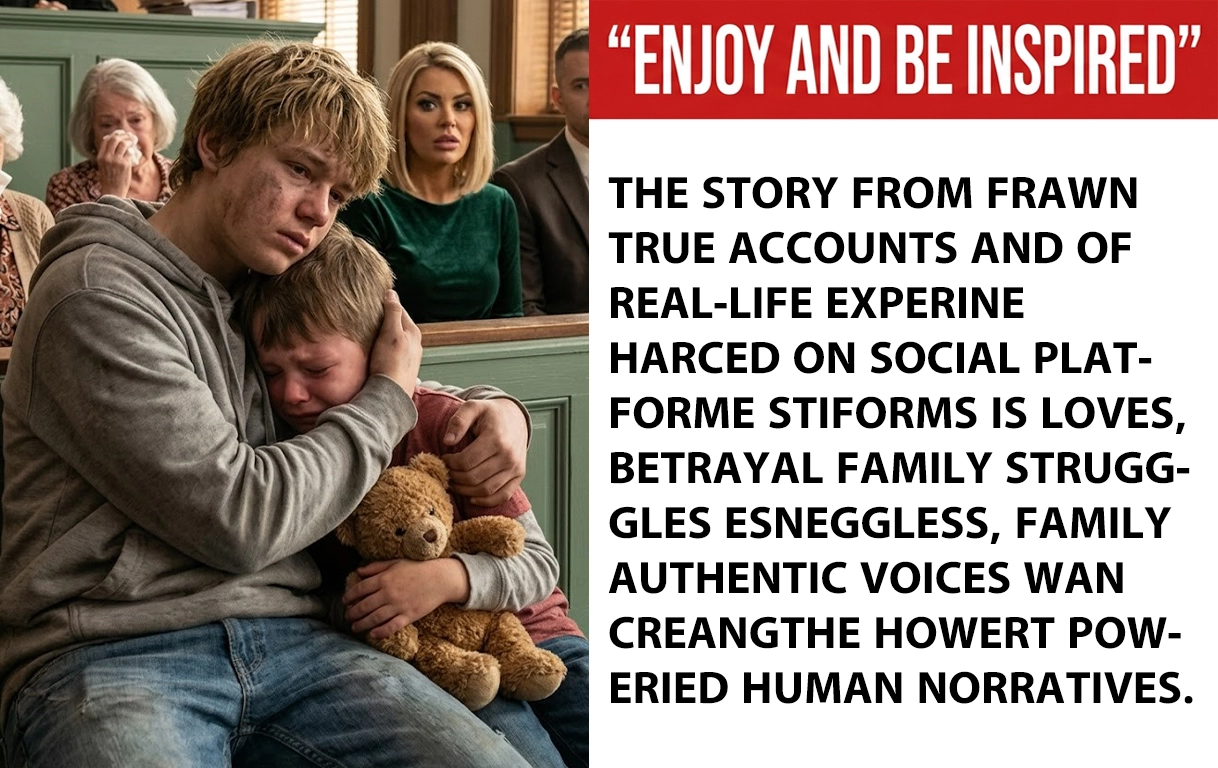
The little boy ran across the courtroom and launched himself into his brother’s arms sobbing uncontrollably.
“We’re going home?” Noah cried.
Ethan collapsed to his knees holding him tightly.
“Yeah, buddy,” he whispered through tears. “We’re finally going home.”
Even Ms. Bennett wiped her eyes.
Mrs. Rodriguez clapped loudly.
Denise cried openly.
Claire stormed out humiliated while her boyfriend followed behind her in silence.
But nobody cared anymore.
Because after four years of fighting the world—
the brothers had finally won.
That evening, the Chicago sunset painted the streets gold as Ethan and Noah walked home hand in hand.
For the first time, the city didn’t feel cruel.
It felt alive.
Hopeful.
Free.
Ethan looked down at his little brother and smiled.
“How about we celebrate?”
Noah grinned instantly.
“With tacos?”
Ethan laughed.
“Absolutely.”
“With extra hot sauce?”
“You’re gonna regret that later.”
Noah giggled so hard he nearly tripped on the sidewalk.
And in that moment, Ethan finally understood something powerful:
Real family isn’t the person who shares your blood.
It’s the person who stays.
The person who sacrifices.
The person who chooses you every single day, even when life becomes unbearable.
Because true love is not proven in courtrooms.
It’s proven in exhaustion.
In sacrifice.
In empty stomachs.
In promises kept.
And after years of darkness, two brothers walked home together carrying the one thing nobody could ever take from them again:
Each other.