PART 2
Eleanor didn’t answer the question right away.
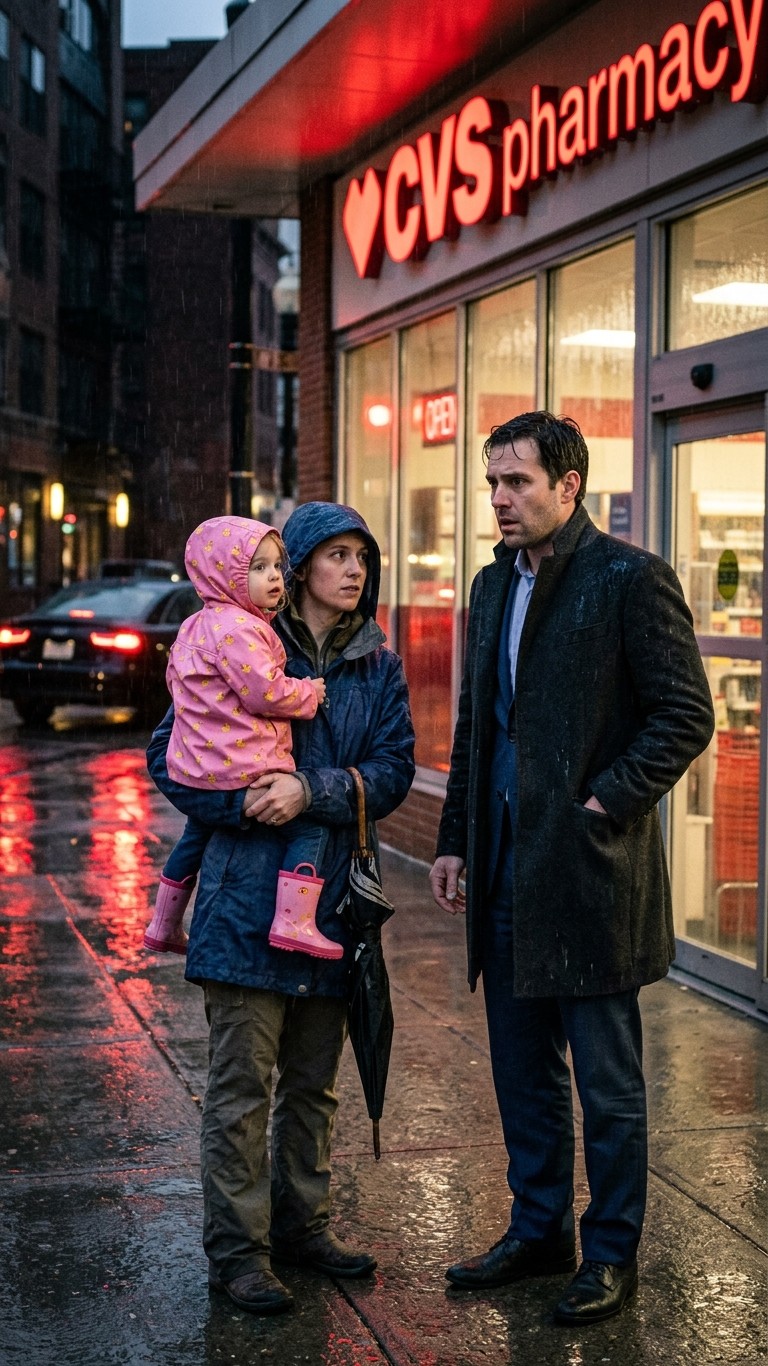
She stood in the rain with Sophie half-asleep against her shoulder, the broken umbrella hanging at her side like something she had given up on fixing a long time ago, and she looked at Maxwell with the expression of a woman deciding whether the man in front of her had earned the truth or was simply demanding it because he could afford to.
“Why didn’t I tell you,” she repeated. Not a question. An echo she was testing for weight.
“Eleanor—”
“Because your mother told me to disappear.”
Maxwell went still.
The rain kept falling. A car horn sounded somewhere down the block. Sophie stirred slightly against Eleanor’s neck and murmured something about ducks.
“That’s not possible,” Maxwell said.
“It is very possible,” Eleanor said. “Because she did it in your kitchen. At the marble island where I left my key. While you were in Hong Kong closing the Meridian deal and I was eight weeks pregn:ant and terrified.”
Maxwell’s jaw tightened. “What exactly did she say?”
Eleanor shifted Sophie higher on her hip. The child was burning with fever and getting heavier by the minute, and Eleanor’s arms were shaking with the effort of holding her steady while having a conversation she had spent three years avoiding.
“She said she had proof that I married you for money,” Eleanor said. “She said she had hired someone to build a file — bank records, emails, things taken out of context, things manufactured entirely — and that if I didn’t sign the divorce papers and leave quietly, she would make sure that file reached every newspaper, every investor, and every person who had ever trusted your judgment.”
“That’s insane. I would have—”
“You would have what, Max?” Eleanor’s voice cracked for the first time. “You were gone eleven months out of twelve. You answered your mother’s calls before mine. She sat at the head of your table and decided the guest list for your events and vetted the women your friends married. She ran your life and you let her because it was easier than having the conversation you should have had with her twenty years ago.”
Maxwell opened his mouth.
Closed it.
“She told me that if I stayed and had the baby, she would make sure I lost custody,” Eleanor continued. “She said she had attorneys who could prove I was unfit. She said the Callahan name would bury me in court, and by the time it was over, my child would be raised by nannies in a house where I was not welcome.”
“And you believed her?”
“I believed her because she had already done it to your brother’s first wife,” Eleanor said quietly. “Or did you forget about Julia?”
Maxwell went very still.
Julia. His older brother Thomas’s first marriage. The one that ended abruptly when Thomas was twenty-six. The one their mother had described as “a misunderstanding that resolved itself.” The one nobody in the family mentioned anymore.
“Julia didn’t just leave,” Eleanor said. “Your mother made her leave. The same playbook. The same threats. Julia told me everything the week before your mother came to the kitchen.”
“Julia talked to you?”
“Julia warned me,” Eleanor said. “She called me because she heard through a mutual friend that I was pregn:ant, and she wanted me to know what was coming before it arrived.”
Sophie coughed against Eleanor’s shoulder, a deep wet sound that made both of them flinch.
“I need to get her inside,” Eleanor said. “She’s been sick for four days and I can’t—”
“Come with me,” Maxwell said.
“No.”
“Eleanor, she needs a doctor, not a pharmacy antibiotic.”
“She needs her mother to stop having conversations in the rain with a man whose family tried to erase us.”
“My mother,” Maxwell said carefully. “Not me.”
Eleanor looked at him.
“You never once looked for us, Max.”
The sentence landed like something dropped from a great height.
“I tried,” he said. “I spent—”
“You spent money,” she said. “You hired investigators. You searched databases. You did everything a billionaire does when he wants to find something he’s lost.” She held his gaze. “But you never once asked your mother why I actually left. Because some part of you already knew the answer would cost you something you weren’t ready to pay.”
Sophie lifted her head.
“Mommy,” she said drowsily. “The rain man is still here.”
Eleanor almost smiled despite everything.
“Yes, baby. The rain man is still here.”
Sophie looked at Maxwell with those gray eyes — his gray eyes — and said, with the devastating simplicity only a child can produce, “Are you sad too?”
Maxwell crouched down in the rain until he was level with his daughter’s face.
“Yes,” he said honestly. “I’m very sad.”
Sophie reached out one small hand and patted his wet hair.
“It’s okay,” she said. “Mommy says being sad means you still care about something.”
Maxwell looked up at Eleanor.
“I never stopped caring,” he said.
“I know,” Eleanor said. “But caring and protecting are not the same thing. And you never protected me from the one person I needed protecting from.”
She turned toward the apartment door.
“The medicine is in the bag,” she said. “Thank you for paying. Don’t follow me upstairs.”
She went inside.
The door closed.
Maxwell stood in the rain for a long time.
Then he took out his phone and made a call he should have made three years ago.
“Thomas,” he said when his brother answered. “I need to ask you something about Julia. And I need you to tell me the truth this time.”
The silence on the other end told him everything before Thomas said a single word.
THE FINAL CHAPTER
Thomas talked for almost an hour.
Maxwell sat in the back of his car, rain drumming on the roof, driver circling the block, listening to his older brother describe, in exhausted detail, the exact same playbook Eleanor had described.
The manufactured file. The threats. The attorneys. The quiet, surgical removal of a woman from the Callahan family before anyone outside the inner circle even knew what had happened.
“Why didn’t you fight it?” Maxwell asked.
Thomas was quiet for a moment. “Because Mom told me Julia was having an affair. She showed me evidence. Texts, photographs, hotel receipts.” He paused. “It took me four years to find out she had fabricated every piece of it.”
“Four years?”
“Julia reached out to me eventually,” Thomas said. “By then she had remarried. She had a son. She told me what Mom had done, showed me her side, and I realized the woman I had trusted my entire life had lied to me so comprehensively that I couldn’t tell where the truth ended and her version began.”
“And you said nothing,” Maxwell said. “To me. To anyone.”
“She’s our mother, Max,” Thomas said, and his voice carried the particular weariness of a man who had already fought this battle inside himself and lost. “What was I supposed to do? She controls the foundation. She sits on the board. Half the family’s charitable relationships exist because of her social network. I confronted her privately. She denied everything. Then she reminded me that my position in the company depended on her continued goodwill.”
“She threatened you.”
“She managed me,” Thomas said. “The way she manages everything. Quietly. Precisely. Without ever leaving fingerprints.”
Maxwell ended the call and sat in the dark car for a long time.
Then he called his attorney.
“I need a full forensic review of my mother’s financial activity within the Callahan Foundation for the last ten years,” he said. “Discreet. No board notification.”
“Maxwell, your mother is the foundation’s co-chair—”
“I’m aware of her title,” Maxwell said. “I’m also aware that she has systematically driven two women out of my family using fabricated evidence and legal threats. I want to know what else she’s been doing that I’ve been too comfortable to look at.”
The forensic review took three weeks. What it revealed went far beyond Eleanor and Julia.
Maxwell’s mother, Victoria Callahan, had spent over a decade quietly redirecting foundation funds into personal trusts, funding legal retainers for the attorneys she used to threaten family members, and maintaining a private investigation firm on a rolling contract whose sole purpose was to compile files on anyone who married into the Callahan family without Victoria’s approval.
Eleanor had not been paranoid.
She had been the target of a system.
Maxwell went to see Eleanor on a Saturday morning, three weeks after the CVS.
He did not bring flowers. He did not bring gifts. He did not bring attorneys or offers or grand gestures.
He brought a folder.
Eleanor opened the apartment door with Sophie on her hip, looking considerably better now that the antibiotics had done their work. Her eyes went to the folder immediately.
“What is that?” she asked.
“Proof,” he said. “Of everything you told me in the rain. Everything my mother did to you. And to Julia. And to the foundation.”
Eleanor looked at the folder for a long time without taking it.
“Why are you showing me this?” she asked.
“Because you deserve to know that I finally did the thing you told me I should have done three years ago,” he said. “I asked the question. And I didn’t stop asking until I had every answer.”
“And your mother?”
“Removed from the foundation board as of yesterday,” Maxwell said. “Her access to family trusts has been frozen pending a full review. Thomas and I presented the findings to the board together.”
Eleanor’s expression didn’t change.
“She must have been furious,” she said.
“She told me I was making the biggest mistake of my life,” Maxwell said.
“And what did you say?”
“I told her the biggest mistake of my life already happened three years ago in a kitchen where I wasn’t present,” he said. “And I’ve been paying for it every day since.”
Sophie wriggled down from Eleanor’s arms and walked over to Maxwell on unsteady legs. She looked up at him.
“Rain man,” she said.
“Hi, Sophie,” he said.
“Mommy said you might come back.”
He looked at Eleanor. “She did?”
“I said you might,” Eleanor said carefully. “I didn’t say I was ready for it.”
“Are you?” he asked.
She looked at the folder. At Sophie. At the man standing in her doorway who had finally, three years too late, chosen to see what his mother had been doing instead of what his mother had been telling him.
“Not yet,” she said. “But I’m not saying no. I’m saying slow.”
“I can do slow,” he said.
“You’ve never done anything slowly in your life, Max.”
“I know,” he said. “But I’ve also never had a reason this important.”
Sophie tugged his hand.
“Do you like ducks?” she asked.
He looked down at her pink rain boots with the tiny yellow ducks and felt something crack open in his chest that had been sealed shut for three years.
“I love ducks,” he said.
“Good,” Sophie said firmly. “Mommy only lets duck people inside.”
Eleanor stepped aside.
Not all the way.
Just enough.
Maxwell walked through the door of a small apartment above a laundromat and sat on a secondhand couch and let a two-year-old show him every single one of her stuffed animals by name while her mother watched from the kitchen doorway with an expression that was not yet trust but was no longer the opposite of it.
It was a beginning.
Late. Imperfect. Earned by exactly nothing except finally showing up without an agenda.
But a beginning.
Share this for every parent who found their way back to the family they almost lost, and every child who waited patiently for the rain man to come inside. ❤️👇
— Update: Victoria Callahan retained an attorney and has not spoken to either of her sons since the board meeting. Maxwell visits Sophie every Saturday morning. Last week she made him wear a paper crown and serve invisible tea to a stuffed elephant named Gerald. He said it was the best meeting he’s had in thirty years. Eleanor is considering letting him take Sophie to the aquarium next month. She hasn’t decided yet. She’s taking it slow. He’s learning what that means.
