PART 2-> The End
The next morning, I woke up before the sun.
I made myself coffee in Joe’s old blue mug, the one with the chipped handle he never let me replace. I sat at the kitchen table and opened the notebook to the last page Joe had ever written in.
His handwriting was shaky by then. The cancer had already started taking pieces of him. But the words were clear.
“Barbara. If the day comes when our children forget what this place cost us, remind them. And if they still don’t listen, protect what we built. Even from them.”
Underneath that, in smaller letters: “The deed is under the bedroom floor. Third plank from the window. I love you. Always.”
I had found the deed eleven years ago, the week after Joe d!ed. I had never moved it. I had never needed to.
Until now.
I pulled up the floorboard carefully. Inside was the original deed to the farm, both our names on it, along with a second document I had almost forgotten existed — a notarized letter Joe had drafted with our attorney, giving me sole and absolute authority over the property, its use, and its future.
My children had never asked about any of this.
Not once in eleven years.
They assumed the farm was simply theirs by default, the way children assume the sun will rise without anyone having to light it.
I called John.
“I need you to do something for me today,” I said. “Before they come back.”
“Name it,” he said.
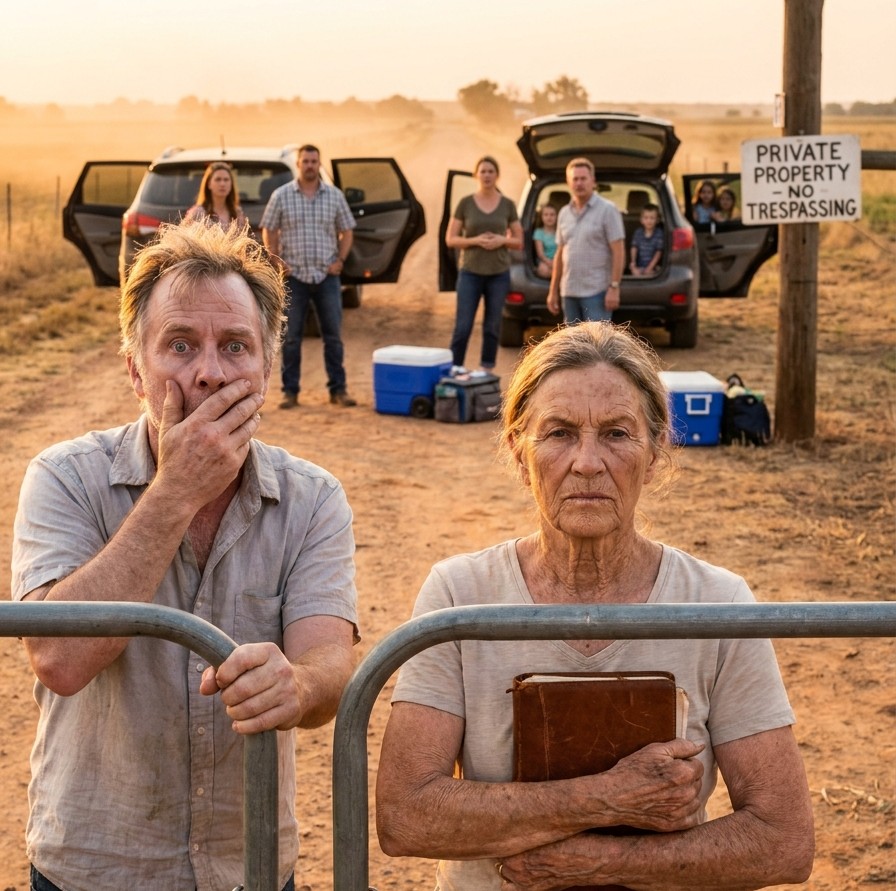
“Lock the front gate. Chain it. And put up a sign.”
He was quiet for a moment.
“What should the sign say?”
I looked at the notebook.
“It should say: ‘This property is privately owned by Barbara Whitmore. Entry by invitation only. No invitation has been issued this weekend.'”
John let out a slow breath.
“And Barbara?” he asked. “What about the notebook?”
“Put it on a table outside the gate,” I said. “Open to the page that shows every dollar Joe and I spent building this place. Every tree we planted. Every fence post we dug. Every market morning we woke up at four in the morning for thirty years.”
“They threw that notebook in the trash,” John said quietly.
“I know,” I said. “That’s exactly why I want them to see it before they see the lock.”
By four that afternoon, I was sitting in my bedroom with the curtains drawn, watching through the window as the first car turned onto the dirt road leading to the farm.
Charlie’s SUV.
Behind him, Lauren’s minivan.
Behind her, David’s truck with a trailer full of coolers and camping chairs and a portable speaker already thumping bass through the open windows.
Twelve people.
Three cars.
Enough food and alcohol for a weekend they had never once asked permission for.
Charlie reached the gate first.
He got out of his car and stared at the chain like it was a foreign object.
Then he saw the sign.
I watched his face change from confusion to irritation to something colder as he read it twice. Then he turned and looked at the table John had set up beside the gate post.
The notebook was open.
The page showed Joe’s handwriting, columns of numbers, thirty years of expenses, every dollar accounted for, every sacrifice documented in blue ink by a man whose hands were cracked from work his children had never bothered to understand.
Lauren got out of her minivan.
“What’s going on?” she called. “Why is the gate locked?”
Charlie held up his phone. “I’m calling Mom.”
My phone rang.
I answered.
“Mom, what is this?” Charlie’s voice was sharp. The voice he used when things weren’t going the way he had already decided they should.
“What is what?” I asked calmly.
“The gate is locked. There’s a sign. And Dad’s old notebook is sitting out here like some kind of—”
“Like some kind of what, Charlie?”
Silence.
“Like some kind of reminder?” I offered.
“Mom, we drove three hours. The kids are in the car. Lauren brought steaks. You can’t just—”
“I can,” I said. “It’s my farm. My name is on the deed. And I was not invited to whatever this weekend was supposed to be, so I assumed I wasn’t welcome to participate.”
“That’s ridiculous. You live here.”
“And you removed me from the family group chat because I don’t understand adult things,” I said. “So I’m handling this like an adult. The gate stays locked.”
I heard Lauren’s voice in the background: “Is she serious right now?”
David’s truck pulled up. Doors opened. More voices.
“Mom,” Charlie said, lowering his voice to the patient, condescending tone I had tolerated for years. “You’re being dramatic. Just unlock the gate and we’ll talk about this inside.”
“There’s nothing to talk about inside,” I said. “Everything that needs to be said is written in the notebook you threw in the trash yesterday.”
The line went quiet.
“Read it, Charlie,” I said. “All of it. Every page. Then call me back.”
I hung up.
They didn’t call back for forty-seven minutes.
I know because I watched the clock while I sat in my bedroom listening to the muffled sounds of twelve people standing outside a locked gate on a hot afternoon, reading a notebook they had never once asked about in eleven years.
When Charlie finally called again, his voice was different.
Not soft exactly.
But the sharpness was gone.
“Mom,” he said. “I didn’t know Dad took out a second mortgage to pay for Lauren’s college.”
“You never asked,” I said.
Silence.
“And David’s wedding,” he continued. “This says you and Dad sold the south field to cover it.”
“Twenty-two acres,” I said. “The ones with the pecan trees your father planted the year David was born.”
More silence.
Lauren’s voice came through the background, muffled but unmistakable. “She sold the pecan field for my brother’s wedding?”
“For all of you,” I said, because Charlie had apparently put me on speaker without telling me, which was fine, because I was done having private conversations with people who excluded me from group ones. “Every page in that notebook is something your father and I gave up so you could have more. And not once, not one single time in thirty years, did any of you ask what it cost us.”
Nobody spoke.
“Charlie,” I said. “You threw that notebook in the trash yesterday and told me to tidy up before the others arrived.”
I heard his breathing change.
“Lauren, you walked past me in the hallway without saying hello. David, you haven’t looked me in the eye in this house for two years. And your wife sent me a message telling me to leave the keys under the flowerpot like I’m a housekeeper at a vacation rental.”
“Mom—” David started.
“I’m not finished,” I said.
They waited.
“Your father wrote something on the last page of that notebook,” I said. “I don’t know if you’ve reached it yet. But before you read it, I want you to hear it from me first.”
I took a breath.
“He wrote: ‘If the day comes when our children forget what this place cost us, remind them. And if they still don’t listen, protect what we built. Even from them.'”
The silence that followed was the heaviest I had ever heard from my own children.
“The farm is mine,” I said. “It has always been mine. And starting today, it will be treated like mine. If you want to visit, you call me first. Not your sister-in-law. Not the group chat I’m apparently too simple to be part of. You call me, your mother, and you ask. And you say please.”
Charlie’s voice came back, rougher now, the particular roughness of a grown man trying very hard not to cry in front of his siblings. “Mom, I’m sorry about the chat. That was wrong.”
“It was,” I said.
“And the notebook,” he said. “I shouldn’t have—”
“No,” I said. “You shouldn’t have.”
“Can we come in?” Lauren asked quietly. “Not for the weekend. Just to talk.”
I looked out the window.
Twelve people standing beside three cars on a dirt road in the late afternoon sun. Coolers melting. Steaks warming. Children confused. Adults, for once, looking exactly as uncomfortable as they should.
“John will open the gate,” I said. “You can come in for one hour. No suitcases. No speakers. No coolers.”
“Mom—”
“One hour,” I repeated. “And someone is going to make me a cup of tea when they walk through that door. I haven’t had anyone make me tea in this house since your father d!ed.”
I hung up.
John opened the gate.
They walked in slowly, one by one, the way people walk into a house they are no longer certain belongs to them.
Charlie came in first. He stopped at the kitchen table, looked at the notebook lying open on the surface where I had placed it, and sat down without a word.
Lauren made the tea.
She didn’t ask how I liked it.
She already knew.
She had just never bothered to make it before.
We sat around that table for three hours, not one. Nobody mentioned the steaks. Nobody turned on a speaker. The children played quietly in the yard while John watched them, and inside, for the first time in more years than I could count, my family sat in the house their father built and actually listened to the woman who helped him build it.
Charlie added me back to the group chat that night. Not because I asked. Because David told him to. Loudly.
The first message I received was from Lauren.
“Mom, thank you for dinner last Sunday. The lemon cake was incredible. Can I have the recipe?”
I smiled.
Typed back: “Come visit next weekend and I’ll teach you. Bring nothing but yourself.”
She replied: “I’ll bring flowers.”
I looked at Joe’s blue mug on the counter.
The chipped handle.
The coffee ring that would never wash out completely.
“They’re learning,” I whispered.
Slowly.
Late.
But learning.
Share this for every parent who built everything and was treated like furniture inside their own home. Your children don’t get to inherit what they refused to respect. ❤️👇
— Update: Charlie drove three hours last Saturday just to fix the porch railing that had been loose for two years. He didn’t tell me he was coming. He just showed up with tools and got to work. When I brought him lemonade he looked at me and said, “I should’ve been doing this the whole time, Mom.” I didn’t argue. He was right.
