PART 2
Grandma didn’t knock.
She opened my parents’ front door with the key she had carried since my grandfather built that house fifty-three years ago, the same key my father had asked for twice and been refused both times because Grandma said, “I’ll give it back when I’m d!ed, and not a minute sooner.”
I watched from the minivan as she walked inside without removing her coat.
Mason was half-asleep against the window. Ellie had finally stopped shivering and was curled beneath the blanket with her thumb in her mouth, something she hadn’t done in over a year. The melted corner of Mason’s dinosaur pressed against the glass, leaving a dark smear I would never clean off because some marks deserve to stay.
Through the living room window, I saw the hallway light come on.
Then I heard Grandma’s voice.
Not shouting. Grandma never shouted. She did something worse. She spoke at a volume that made shouting feel unnecessary, the way a judge speaks when the courtroom already knows the verdict.
“David,” she said to my father. “Open your mouth and explain to me why my great-grandchildren are sleeping in a car in your driveway.”
My father’s voice came back, muffled but defensive. “Mom, it’s complicated. Vanessa is coming in the morning and—”
“Vanessa,” Grandma repeated. The name landed like something dropped from a height. “Your pregnant daughter in her five-bedroom house with her dentist husband is the reason my six-year-old great-grandson is coughing ash in a minivan.”
“Claire is being dramatic,” my mother’s voice cut in from somewhere upstairs. “The shelter opens at seven. She’ll be fine.”
Grandma went quiet.
That was the part that scared me.
Because Grandma’s silence was never empty. It was the silence of a woman loading a weapon she had been carrying for a very long time.
I heard footsteps. The front door opened. Grandma walked down the steps, crossed the driveway, and opened the passenger door of my minivan.
She looked at Mason. Then at Ellie. Then at me.
“Get the children out,” she said. “Bring them inside.”
“Mom and Dad said—”
“I heard what they said,” Grandma replied. “And now they’re going to hear what I say.”
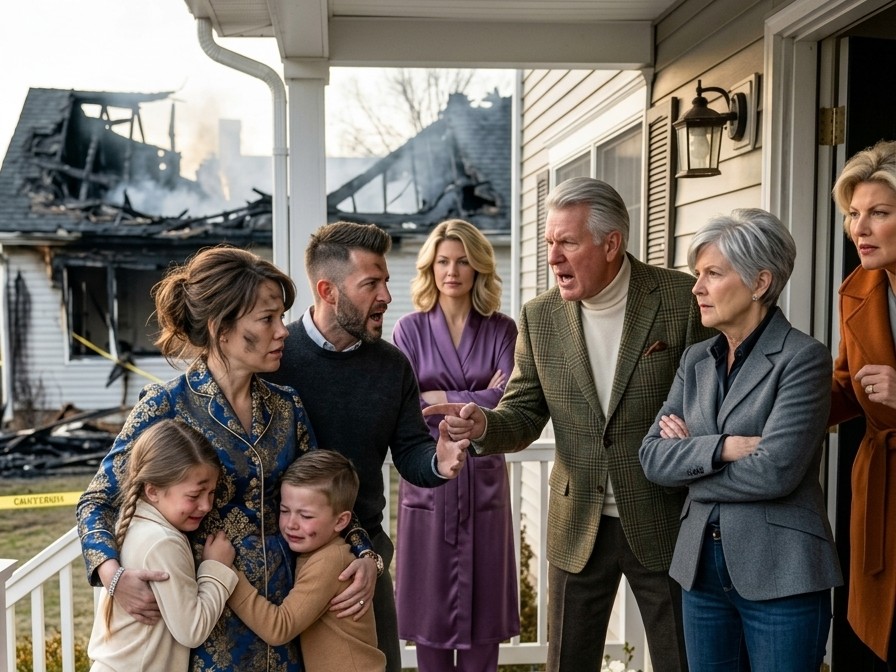
I carried Ellie. Mason walked beside Grandma, holding her hand. When we stepped through the front door, my parents were standing in the hallway — my father in his bathrobe, my mother halfway down the stairs, both of them wearing the particular expression of people who had been caught doing something they fully intended to get away with.
Grandma set her leather folder on the hallway table.
“Sit down,” she said. “Both of you.”
“Mom, it’s almost six in the morning—” my father started.
“Sit. Down.”
They sat.
Grandma took Ellie from my arms, carried her to the guest room, laid her on the bed, covered her with a clean quilt, and came back. She did the same with Mason, tucking his melted dinosaur beside him, smoothing his ash-covered hair with the same hands that had braided my hair thirty years ago.
Then she closed the guest room door, walked back to the living room, and stood in front of my parents.
“I am going to tell you something,” she said. “And when I am finished, neither of you is going to speak until I say you can.”
My mother opened her mouth.
“Patricia,” Grandma said. One word. My mother’s name. But the way she said it could have stripped paint off a wall.
My mother closed her mouth.
Grandma opened the leather folder.
“Do you know what this is?” she asked my father.
He looked at it. Frowned. “What?”
“This,” Grandma said, “is the original mortgage documentation for this house. The house your father built. The house you have been living in for thirty-one years.”
“I know whose house it is, Mom.”
“Do you?” Grandma said. “Because according to these documents, this house was placed in a family trust thirty-eight years ago. Your father and I are the trustees. You are not the owner, David. You are the occupant. You have always been the occupant.”
My father’s face changed.
“And do you know what else is in this folder?” Grandma continued, pulling out a second document. “The original loan records for Vanessa’s down payment.”
My mother went rigid.
“Three years ago,” Grandma said, looking directly at my mother, “Vanessa and Brad needed sixty-two thousand dollars for the down payment on that beautiful five-bedroom house you’re so eager to protect. Brad’s dental practice had been open for eight months and hadn’t turned a profit yet. So Vanessa called me.”
She set the document on the coffee table.
“I gave her the money,” Grandma said. “From my personal savings. Your father’s life insurance. The money I had been setting aside for both of my granddaughters equally.”
She looked at me.
“Claire never received her share,” Grandma said. “Because Vanessa told me Claire didn’t need it. Vanessa told me Claire’s husband had good insurance and they were doing fine.”
I felt the room tilt slightly.
“Claire’s house just burned down,” Grandma said quietly. “Her children are sleeping in ash-covered pajamas in a room you tried to keep them out of. And the daughter you protected tonight is living in a house paid for with money that belonged to both of them.”
My father pressed his hands against his knees.
My mother stared at the floor.
“I have one more question,” Grandma said. “And I want you both to think very carefully before you answer.”
She looked between them.
“When did you stop being parents to Claire and start being employees of Vanessa?”
THE FINAL CHAPTER
Nobody answered Grandma’s question that morning.
Not because they didn’t have answers. Because every answer they could have given would have confirmed exactly what Grandma had just exposed — that somewhere over the last decade, my parents had quietly, gradually, completely reorganized their family around Vanessa’s comfort and treated me as the daughter who could absorb whatever was left over.
Grandma didn’t wait for an answer. She didn’t need one.
She turned to me instead.
“Claire,” she said. “Get some sleep. When you wake up, we’ll figure out the next steps.”
“Grandma, I don’t have—”
“You have me,” she said. “And that has always been enough.”
I slept for four hours in the guest room with both children pressed against me, Ellie’s small hand curled around my finger, Mason’s melted dinosaur between us like a trophy from a war zone. When I woke up, Grandma was sitting at the kitchen table drinking coffee and writing in a notebook.
My parents were nowhere in sight.
“Where did they go?” I asked.
“I sent them to Vanessa’s house,” Grandma said calmly. “I told them they could spend the day there since that’s clearly where their priorities live.”
She slid a piece of paper across the table.
It was a cashier’s check. Made out to me. For sixty-two thousand dollars.
“Grandma,” I whispered. “I can’t take this.”
“You’re not taking it,” she said. “I’m giving you what was always yours. Vanessa received her half three years ago. This is your half. The fact that nobody told you it existed is exactly the problem I’ve been watching build for ten years.”
I stared at the check.
“There’s more,” Grandma said. She opened the leather folder again. “Your grandfather and I purchased this house in 1971. It has been held in a family trust since 1986. Your father occupies it. He does not own it.” She looked at me over her coffee cup. “I am the sole surviving trustee. Which means I decide what happens to this property.”
“Grandma—”
“I’m not finished,” she said.
She pulled out one more document.
“This is an amendment to the trust I had prepared six months ago,” she said. “After your father refused to lend you money for Mason’s school fees and then bought Vanessa a new car for her birthday the same week.”
I hadn’t known she knew about that.
“The amendment transfers the trust beneficiary designation,” Grandma said. “Upon my passing, this house goes to you and your children. Not to your father. Not to Vanessa. To you.”
I put my hand over my mouth.
“Your father has been informed,” Grandma said. “As of this morning.”
“Is that why he left?”
“He left because he spent thirty-one years believing he was the owner of a house his mother let him borrow,” Grandma said. “And this morning he found out the difference.”
Mason appeared in the kitchen doorway, still in his ash-covered pajamas, holding his dinosaur.
“Grandma Great,” he said — that was what he called her, had called her since he first learned to talk — “is our house gone?”
Grandma set down her coffee cup, opened her arms, and let a six-year-old boy with soot on his sleeves climb into her lap the way I used to climb into her lap thirty years ago.
“Your house had a very bad night,” she said carefully. “But we’re going to build you a new one.”
“With a big yard?”
“The biggest yard I can find.”
“Can my dinosaur come?”
Grandma looked at the melted stuffed animal with the burned corner and the missing eye.
“Your dinosaur,” she said, “has already proven he can survive anything. He’s definitely coming.”
Mason pressed his face against her shoulder.
Ellie wandered in a moment later and climbed up too, and Grandma sat there at my parents’ kitchen table holding both of my children, wearing her church coat over her pajamas, looking exactly like what she had always been — the one person in this family who never once confused comfort with love or convenience with loyalty.
My parents came back that evening.
My father stood in the kitchen doorway for a long time before speaking.
“Mom,” he said. “I was wrong.”
“Yes,” Grandma said. “You were.”
“Claire, I’m—”
“Don’t apologize to me right now,” I said. “Apologize to Mason. He asked me in the car at two in the morning why Grandpa didn’t want him inside. He’s six years old, Dad. Six. And he asked me that question while coughing ash.”
My father’s face crumbled in a way I had never seen before.
He walked to the guest room where Mason was playing quietly with his dinosaur.
I don’t know what he said in there. The door was closed. But when he came out fifteen minutes later, his eyes were red and Mason was holding his hand.
“Grandpa said he’s sorry,” Mason told me. “He said sometimes grown-ups forget the important stuff.”
“He’s right about that,” I said.
Vanessa called the next day. Not to check on us. To ask Grandma if the trust amendment was “legally binding or just a scare tactic.”
Grandma answered with four words: “Call my attorney, dear.”
Vanessa didn’t call me for three weeks after that. When she finally did, it was short, awkward, and contained exactly one sentence that mattered: “I should have told you about the money.”
“Yes,” I said. “You should have.”
It wasn’t forgiveness. It was acknowledgment. And for now, that was enough.
We used the sixty-two thousand dollars as a foundation. Ryan’s hospital insurance covered most of the rebuild. Grandma contributed more than she should have and refused every attempt I made to set up a repayment plan. “You can pay me back by raising those children to open their door when someone needs help,” she said. “That’s the only currency I accept.”
The new house was finished seven months later. Smaller than the old one. But it had a big yard, the way Mason had requested, and a porch where Grandma sat every Sunday afternoon drinking coffee and watching Ellie chase butterflies across the grass.
My parents visit now. Carefully. Slowly. The way people visit when they understand that the door they once closed is now open only because someone else’s grace decided to prop it back up.
My father fixed the porch railing last month without being asked. My mother brought Mason a new stuffed dinosaur. He accepted it politely, then set it on the shelf and went back to playing with the melted one.
Some things can’t be replaced.
Some things shouldn’t be.
Share this for every grandparent who showed up when nobody else would, and every child who survived the fire with nothing but a melted dinosaur and a family that almost forgot what family means. ❤️👇
— Update: Grandma turned eighty-nine last month. We had the party at our new house. Mason made her a card that said “Thank you for the big yard, Grandma Great.” She put it on her refrigerator next to the photo of my grandfather. She told me later it was the best birthday present she’s ever received. I believe her.
