PART 2
I sat in the church parking lot for twenty minutes after the service ended.
My neighbor Ruth had already gone home. She’d said what she said — that’s your girl, isn’t it — with the matter-of-fact gentleness of a woman who has known me for thirty years and understood exactly what those four words would cost me to hear.
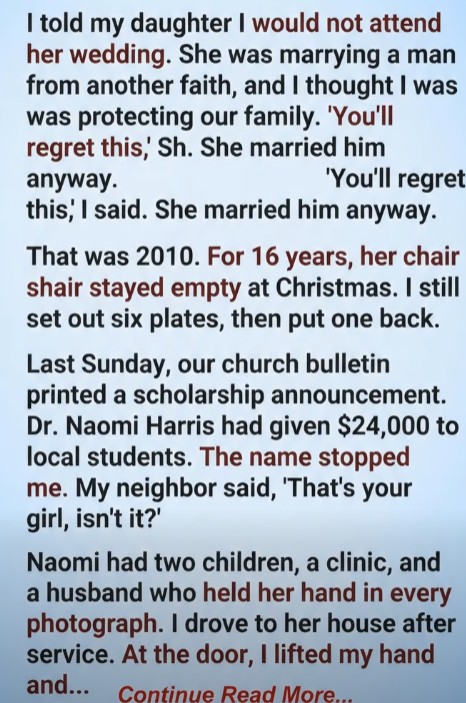
Dr. Naomi Harris. $24,000 to local students.
I held the bulletin in my hands and read her name eleven times.
Naomi had been twenty-six when she married David. I had told her she was making a mistake. I had told her his faith and ours were incompatible. I had told her she would regret it. I had told her she was breaking our family apart and she alone would be responsible for what came next.
She had looked at me with the steady brown eyes she inherited from her grandmother and said, “I love him, Daddy. I hope you’ll be there.”
I wasn’t there.
She sent me a photograph three weeks after the wedding. The two of them on a beach somewhere, laughing at something outside the frame. I put it in the kitchen drawer and did not look at it for a year. When I finally did, I put it back in the drawer and closed it again.
For sixteen years I had been putting things in drawers and closing them.
I drove to her address after the service.
I found it through the clinic website listed under the scholarship announcement. Dr. Naomi Harris, MD, founding physician of the Harris Community Health Clinic on East Nineteenth Street. The clinic served uninsured and underinsured patients in the eastern district, offered sliding-scale fees, and had, according to the About page I read in the church parking lot, been operating for nine years.
Nine years.
My daughter had opened a clinic nine years ago and I had learned about it from a church bulletin.
The house was a craftsman on a quiet street three miles from the clinic. A vegetable garden along the front walk. A bicycle leaning against the porch railing. A basketball hoop in the driveway with a worn spot on the pavement beneath it from years of use.
Two children.
The scholarship announcement had said two children. I did not know their names. I did not know their ages. I did not know if they were boys or girls or one of each. I was a grandfather to two people I had never met because sixteen years ago I told their mother she would regret her choices and she had responded by building a life so full that my absence was the only empty space in it.
I sat in front of her house for a long time.
Then I lifted my hand to knock.
The door opened before my knuckles reached the wood.
A girl. Maybe ten years old. Dark braids. Her father’s nose. Her mother’s eyes exactly.
She looked at me with the open assessment of a child who has not yet learned to disguise her evaluation of strangers.
“Hi,” she said.
“Hello,” I said. “Is your mother home?”
“Mom!” the girl shouted over her shoulder, without taking her eyes off me. “There’s an old man at the door.”
From somewhere inside the house came the sound of movement, a cabinet closing, footsteps on hardwood.
Then Naomi appeared behind her daughter.
Forty-two years old. Her hair natural now, shorter than I remembered. A few lines around her eyes that hadn’t been there in 2010. The kind of face that has moved through difficulty and come out the other side without bitterness, which is a specific kind of beauty that has nothing to do with age.
She looked at me.
I looked at her.
Sixteen years collapsed into the space between the door and the porch step.
“Grace,” Naomi said to her daughter, without looking away from me. “Go find your brother.”
Grace looked between us with the acute interest of a ten-year-old who understood she was being removed from something important.
“Why?” she asked.
“Because I asked you to,” Naomi said.
Grace went, casting one more evaluating look at me over her shoulder before disappearing into the house.
Naomi stepped onto the porch and pulled the door mostly closed behind her.
She crossed her arms. Not aggressively. The posture of a woman holding herself steady.
“Daddy,” she said.
The word hit me somewhere I had not been prepared for.
She had not called me that in sixteen years. She could have said Father, or used my name, or said nothing at all. She said Daddy with the particular neutrality of someone using the accurate word without attaching a feeling to it yet.
“I saw your name in the bulletin,” I said. “The scholarship.”
“I know,” she said. “Ruth called me.”
Of course Ruth had called her.
“She said you looked like you’d seen a ghost,” Naomi said.
“I looked like a man who realized he’d missed sixteen years of his daughter’s life,” I said. “That might look similar.”
Naomi was quiet.
“I drove here,” I said. “I sat outside for a while. I wasn’t sure if I had the right.”
“You don’t,” she said. “Not automatically. Not after sixteen years.”
“I know.”
“I have a husband,” she said. “Two children. A clinic. A life. David held my hand at both deliveries and at my father-in-law’s funeral and through every hard thing that has happened in the last sixteen years. He is a good man, Daddy. He was always a good man. You decided he wasn’t before you ever sat across a table from him.”
“I know,” I said again.
“You missed Grace’s birth,” she said. “And Marcus’s. You missed my clinic opening. You missed David’s citizenship ceremony — he became an American citizen eight years ago, he studied for six months, he was so proud.” Her voice remained steady, not angry, the measured recounting of a woman stating facts rather than building a case. “You missed all of it because you were protecting our family from a man who has spent sixteen years being our family.”
I had no answer to any of that.
Because there was no answer. There was only the fact of each missed moment, accumulated like unpaid debt, and the man standing on the porch trying to find words adequate to the weight of it.
“I was wrong,” I said. “About David. About what love was supposed to look like. About what I was protecting and from whom.” I looked at my daughter’s face — this woman I had last seen sixteen years ago who had become someone I would not have recognized on the street. “I told you you’d regret your choices. You didn’t regret them. I regretted mine.”
Naomi looked at me for a long time.
“What do you want?” she asked.
“To sit somewhere,” I said. “With you. Not to explain myself. Not to ask forgiveness you’re not ready to give. Just to sit somewhere and look at you and know what your life looks like now.”
The door opened slightly behind her.
Grace appeared in the gap.
“Mom,” she said. “Is the old man staying for dinner?”
Naomi looked at her daughter. Then at me.
Something shifted in her expression. Not warmth exactly. The consideration of a woman weighing something carefully before she committed to it.
“Grace,” she said. “His name is Grandpa.”
Grace looked at me with wide interested eyes.
“Oh,” she said. “Okay. Are you staying for dinner?”
PART 3 — THE FINAL CHAPTER
David came home at six fifteen.
He walked through the back door still in his work clothes — he taught secondary school mathematics, I learned, and coached the debate team on Thursdays, which was why he was slightly later than usual — and stopped when he saw me sitting at his kitchen table.
To his credit, he did not react the way I might have reacted if the father who had refused to attend my wedding showed up in my kitchen sixteen years later.
He set his bag down.
He looked at Naomi.
She gave him the smallest nod.
He looked at me.
“James,” he said. My name. Carefully. “I wasn’t expecting you.”
“I wasn’t expecting myself,” I said. “I hope this is alright.”
David pulled out the chair across from me and sat down. Not beside me. Across. The same position his wife had taken on the porch — present but measured. The distance of people who had learned not to close gaps that hadn’t yet been honestly bridged.
“Naomi called me when you were outside,” he said.
“I assumed she might.”
“She asked me if she should let you in.”
I looked at him.
“What did you tell her?”
“I told her it was her decision,” he said. “It has always been her decision. I stopped trying to make those decisions for her about fifteen years ago.”
There was no aggression in it. Just the matter-of-fact statement of a man who had navigated his wife’s family estrangement for sixteen years and had apparently arrived at a place of clarity about what he could and couldn’t control.
“She told me you were a good man,” I said. “At the door.”
“She’s been telling you that for sixteen years,” David said. “In the letters you didn’t respond to.”
I had not known about letters.
“She wrote to you,” David said. “Every year. First few years she sent them. After that she wrote them and kept them. She said the writing helped even if you weren’t reading.” He paused. “She stopped four years ago.”
I thought about my daughter at a desk, writing letters to a father who had told her she would regret her choices, maintaining a connection in the only form available to her because I had closed every other one.
Four years ago she had stopped.
I had found her name in a bulletin three weeks later and driven to her house, which meant I had arrived late by four years even for a version of showing up that asked nothing of her.
“I’m sorry,” I said. To David. Directly. “For not being at the wedding. For deciding what kind of man you were before I knew you. For sixteen years of my daughter setting out six plates at Christmas and putting one back.”
David was quiet.
“She told you about the plates,” he said.
“Just now. On the porch.”
“She does that every year,” he said. “I stopped trying to convince her not to. It’s what she needs to do.” He looked at his hands. “I want you to understand something, James. Naomi is one of the most extraordinary people I have ever known. She built a clinic. She raised two children. She has given more to this community than most people give in a lifetime. And she did all of it with one chair empty at Christmas.” He looked at me. “Not because she needed the chair filled. Because she is the kind of woman who keeps space for people even when they’ve given her no reason to.”
Grace appeared in the doorway. “Dinner’s ready. Marcus set the table.”
Marcus. Seven years old. He peered around his sister’s shoulder at me with eyes that were entirely his father’s and a cautious assessment that was entirely his mother’s.
“Are you really Grandpa?” he asked.
“Yes,” I said.
“Mom said you were far away for a long time,” he said.
“I was,” I said. “I’m here now.”
Marcus considered this with the practical economy of a seven-year-old evaluating new information.
“Okay,” he said. “I put out an extra plate.”
I pressed my hand flat against the table for a moment.
Then I stood up and followed my grandchildren to the dinner table.
Dinner was roast chicken and vegetables and rice, and Grace talked for most of it about a book she was reading and a girl at school she found irritating and a documentary about deep-sea creatures that had given her complicated feelings about the ocean. Marcus ate with focused efficiency and occasionally corrected his sister’s facts with the solemn authority of a younger sibling who has learned that accuracy is power.
Naomi and David moved around each other in the kitchen with the easy coordination of two people who have been doing this for sixteen years. Passing things without being asked. Finishing each other’s sentences about the children’s schedules. The particular fluency of a marriage that has been built carefully and lived in deeply.
I watched all of it.
I had told this woman she would regret her choice.
She had chosen correctly and I had chosen wrongly and she had built an entire extraordinary life in the space my absence created rather than waiting for me to fill it.
After dinner, Grace asked if I wanted to see her room.
I said yes.
She walked me upstairs and showed me her bookshelf, which was organized by color, and her collection of pressed flowers, and a photograph on her desk of Naomi at what appeared to be the clinic’s opening day, ribbons and everything, David standing beside her with his arm around her shoulders.
“Mom cried at the opening,” Grace said. “Happy crying. Dad says she cried for twenty minutes.”
“She worked hard for it,” I said.
“She works hard for everything,” Grace said, with the straightforward admiration of a daughter talking about her mother. “She says the hard things are worth it if they matter.”
I looked at the photograph of my daughter on the day she opened her clinic.
I had not been there.
I had not been anywhere.
“Grandpa,” Grace said. “Are you going to come back?”
“If your mother will let me,” I said.
“You should ask her,” Grace said. “She always says yes if you ask the right way.”
“What’s the right way?”
Grace thought about it.
“Tell her the truth,” she said. “She doesn’t like when people say what they think she wants to hear. She likes the real thing.”
I went downstairs and found Naomi alone in the kitchen.
“I want to come back,” I said. “Not to make up for sixteen years — I understand that’s not possible. But to be present for whatever comes next. At whatever pace you decide. On whatever terms you set.”
Naomi dried her hands on the dish towel and turned to face me.
“I’m not ready to call this fixed,” she said.
“I’m not asking for fixed,” I said. “I’m asking for next Sunday.”
She looked at me for a long time.
“David’s mother comes for dinner some Sundays,” she said. “You’d have to sit across from her.”
“That’s fair,” I said.
“Grace will ask you fifty questions.”
“I noticed.”
“Marcus will ignore you until he decides you’re trustworthy and then he’ll want to show you everything he knows about trains.”
“I have time for trains,” I said.
Naomi folded the dish towel.
“Next Sunday,” she said. “Four o’clock. Don’t be late.”
I drove home that evening and sat in my kitchen for a long time.
The Christmas plates were on the shelf where they always were. Six of them, the blue-rimmed ones Naomi’s mother had given us years before she passed. I had set five and put one back every December for sixteen years.
I looked at them for a while.
Then I took all six down and counted them.
There were actually eight.
I had forgotten that David’s parents had given us two when they visited — the only visit before everything fell apart.
Eight plates.
I set them all on the shelf in a row.
It was not Christmas. It was a Sunday in late summer and there was nobody in my house and no dinner to prepare.
But I counted eight plates and left all of them out.
Because next Sunday there would be David and Naomi and Grace and Marcus and David’s mother and possibly Ruth from next door if I asked her and the man who had missed sixteen Christmases had finally done the only thing that was ever going to matter.
He had shown up for the next one.
