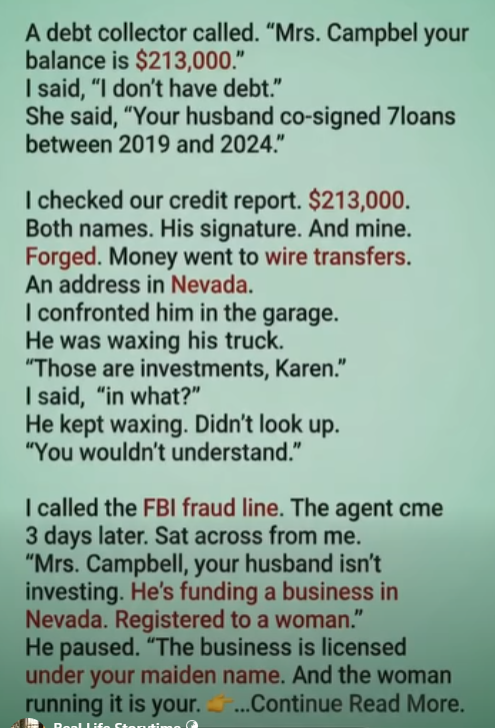
PART 2
The agent paused for exactly long enough to make sure I was ready.
“The woman running it is your husband’s sister,” he said.
I set my coffee cup down very carefully on the kitchen table.
Deborah.
My sister-in-law. The woman who had been at every holiday for fourteen years. Who had held my hand at my mother’s funeral. Who had called me her “favorite person my brother ever brought home” at our tenth anniversary dinner. Who sent me birthday texts every year and called me her best friend in the speech she gave at her own wedding.
Deborah.
“She’s been operating the business for three years,” the agent said. He opened a folder on my kitchen table — a real folder, the kind that contains documents with official seals and case numbers and the particular weight of a federal investigation that has already been running longer than the people inside it know. “The business is a real estate consulting firm. The clients are real. The contracts are real. But the operating capital came entirely from loans your husband took out in both your names.”
“Using my forged signature,” I said.
“Yes.”
“And the money went directly to the Nevada account.”
“To Deborah’s business account,” he said. “Which she used to pay salaries, office expenses, and—” He paused again.
“And what?” I asked.
“Her personal mortgage,” he said. “And her car. And two vacations to Portugal that she documented on the business as client entertainment.”
I looked at the folder.
Seven loans. Five years. $213,000.
My maiden name on a business I had never heard of. My forged signature on loans I had never applied for. My credit, my legal identity, my clean financial history — all of it used as infrastructure for a scheme built by my husband and his sister while I made dinner and attended their holiday parties and called Deborah my best friend.
“How long have you been investigating this?” I asked.
“Fourteen months,” the agent said. “The loan applications flagged a pattern match in a fraud detection system. Your maiden name appeared in public business filings that didn’t match your known address or employment history. It took time to build the full picture.”
“Fourteen months,” I said. “And my husband didn’t know you were looking?”
“He did not.”
“He was still waxing his truck three days ago,” I said. “Telling me the loans were investments. Telling me I wouldn’t understand.”
The agent looked at me with the measured sympathy of a man who has delivered this kind of information to people sitting at their kitchen tables before and has learned to let them process at their own speed.
“Mrs. Campbell,” he said. “I need to ask you something, and I need an honest answer.”
“Yes.”
“Did you have any knowledge of the business in Nevada? Any awareness of the account, the loans, or the arrangement with your sister-in-law?”
“No,” I said.
“Any reason someone might suggest otherwise?”
I thought about that.
“My husband told me we had investments,” I said. “He managed our finances. I trusted him because I had no reason not to.” I paused. “I had a reason. I just didn’t know about it yet.”
The agent nodded.
“Your cooperation from this point forward is important,” he said. “We’ll need a formal statement. We’ll need you to document everything you know about your household finances, the accounts you were aware of, and any communications you can provide.”
“Can I ask you something first?” I said.
“Yes.”
“The business is licensed under my maiden name,” I said. “Did Deborah choose that? Or did my husband?”
The agent looked at his folder.
“Based on the communications we’ve reviewed,” he said, “that was your husband’s suggestion. He told his sister it would be harder to trace if the business name didn’t connect directly to him.”
“So he used my name as a shield,” I said. “And if this had gone differently — if someone had investigated and found a business in my maiden name with his loans funding it — I would have looked like the one running it.”
“That is one possible interpretation,” the agent said carefully.
“It’s the correct interpretation,” I said.
He didn’t disagree.
After he left, I sat at the kitchen table for a long time.
My husband was at work. He came home at six, as he always did, kissed me on the cheek, and asked what was for dinner.
I had not made dinner.
“I had a visitor today,” I said.
He opened the refrigerator.
“Oh yeah? Who?”
“An FBI agent,” I said. “Regarding $213,000 in loans you took out using my forged signature. And a business in Nevada registered to my maiden name that Deborah has been running for three years.”
He turned around from the refrigerator.
His face did something I recognized. Not the specific arrangement of guilt, exactly. The specific arrangement of a man recalculating whether to perform shock or skip straight to damage control.
He chose damage control.
“Karen, listen to me—”
“Don’t,” I said. “I need you to understand something before you say another word. I have already given a statement. I have already provided documentation. And the agent told me, specifically, that my cooperation as a v!ctim of fraud will significantly affect the trajectory of this investigation.” I looked at him. “If you try to make me part of your explanation right now, I will call the agent and tell him you’re here and attempting to discuss the case.”
He closed the refrigerator.
“You called the FBI,” he said.
“Three days ago,” I said. “When you were waxing your truck and telling me I wouldn’t understand.”
PART 3 — THE FINAL CHAPTER
He called Deborah that night.
He did it from the back porch, which he apparently believed was out of earshot. It was not. I had opened the kitchen window while making tea — I had started making tea again, something I hadn’t done in years, because the situation required something warm and deliberate and entirely mine — and I heard most of it.
“She knows everything,” he said. “She talked to the FBI. Three days ago.”
Deborah’s voice was high enough on the other end that I could hear her tone if not her words.
“I don’t know how much they have,” he said. “A lot. Karen gave them documents.”
More Deborah.
“I can’t talk here,” he said. “I’ll call you from the car.”
He came inside. Looked at me making tea at the kitchen counter.
“I’m going to take a drive,” he said.
“Okay,” I said.
He left.
I called my sister while he was gone. Then I called an attorney a colleague had recommended three months earlier for an unrelated matter, one of those recommendations you file away and never expect to use.
Her name was Stephanie Reeves. She answered her cell at eight thirty in the evening because, she told me later, she always answered calls from unknown numbers in the evenings because they were almost always people who had just found out something and needed to know immediately what their options were.
I explained the situation in ten minutes.
Stephanie was quiet for a moment.
“Forged signatures on seven loan applications,” she said. “A business registered to your maiden name without your knowledge. FBI already involved. Correct?”
“Correct.”
“And you have a clean financial history prior to these loans.”
“Spotless,” I said. “I checked my credit annually. Nothing appeared until this year because the loans were structured to defer reporting.”
“That’s intentional,” Stephanie said. “That’s someone who knew how credit reporting works and designed the fraud around the reporting timeline.” She paused. “Mrs. Campbell, what do you want the outcome to be?”
I thought about fourteen years of marriage. About holiday dinners and Deborah’s wedding toast and a man who had looked at me three days ago from behind a can of car wax and said “you wouldn’t understand.”
“I want my name cleared,” I said. “I want the debt removed from my credit. I want documentation that I was a v!ctim of this fraud and not a participant.”
“And the marriage?”
“I’ll address that separately,” I said. “But not in a way that protects him from the legal consequences of what he did.”
“Good,” Stephanie said. “That’s the right order.”
She filed within the week.
The federal case moved on its own timeline. My husband was interviewed by agents twice. Deborah was interviewed once and retained her own attorney immediately afterward, which the agent later told me was “consistent with someone who understands their exposure.”
The civil case — my claim against my husband for fraud, identity theft, and financial exploitation — ran parallel. Stephanie was thorough. The documentation was extensive. My husband’s attorney proposed a settlement twice. Stephanie declined both times with the same response:
Full financial remedy, public record of victim status, and no language limiting Mrs. Campbell’s cooperation with federal proceedings.
The second time his attorney called, they agreed.
The marriage ended four months after the debt collector called.
Not with a fight. Not with a scene in the garage while someone waxed a truck. Just papers, prepared by Stephanie, signed in a conference room on a Thursday afternoon with two attorneys present and no conversation beyond what was necessary to execute the documents.
My husband looked older than I had ever seen him look.
I did not feel sympathy. I had expected to and didn’t, which told me something about the weight of what had been done and how long it had been sitting on me without my knowledge.
Deborah was charged federally with conspiracy to commit wire fraud and misuse of financial identity. She pled guilty six months later. She received probation and a restitution order. She sent me a letter from her attorney’s office that contained twelve paragraphs about context and pressure and influence and not one sentence that used the word “wrong” without qualifying it.
I did not respond.
The business in Nevada was dissolved. The loans were discharged from my credit record through a combination of the federal case outcome and the civil settlement. My maiden name was removed from every filing.
I had my name back.
All of it.
I moved to a smaller house three miles from where I had lived for fourteen years. I planted a garden because I had always wanted to and had never gotten around to it. I got a dog because the house was quiet in a way that needed something with a heartbeat in it.
My sister came to stay for two weeks in the spring. We drank tea in the garden and talked for hours every evening and she said at one point, “You seem lighter.”
“I feel lighter,” I said. “Which is strange given everything.”
“It’s not strange,” she said. “You’ve been carrying something for years without knowing what it weighed. Now you know. And you put it down.”
I thought about that.
I had been the infrastructure of a fraud without knowing I was the infrastructure. My name, my credit, my identity had been the foundation of something built entirely without my consent. And while that was happening, I had been making dinner and going to holiday parties and trusting a man who looked at me from behind a can of car wax and told me I wouldn’t understand.
He was wrong about that.
I understood everything.
I understood it precisely and completely and with the particular clarity that arrives when a debt collector calls and the number is $213,000 and the agent who comes three days later opens a folder and says the woman running the business is your—
And finishes the sentence.
And you sit at your kitchen table and make tea and call an attorney and start the long, unglamorous work of taking your name back.
