The Missing Dress
My Versace dress had been missing for three weeks. It was midnight blue, almost black in certain light, with hand-sewn crystals along the neckline that caught every reflection around it. My father had given it to me for my fortieth birthday. Inside the gift box was a handwritten note: “For the nights when you need to remember that elegance is armor.” That sounded exactly like him — part lawyer, part poet, completely convinced that confidence could save a person.
I searched everywhere. Closets. Storage rooms. Garment bags. The trunk of my car. I blamed the dry cleaner. Accused myself of forgetting. Eventually, grief pushed the missing dress out of my mind, because my father was dead and nothing else seemed important. Until I walked into St. Augustine Cathedral and saw another woman wearing it in the family section, holding my husband’s hand.
The Family Section
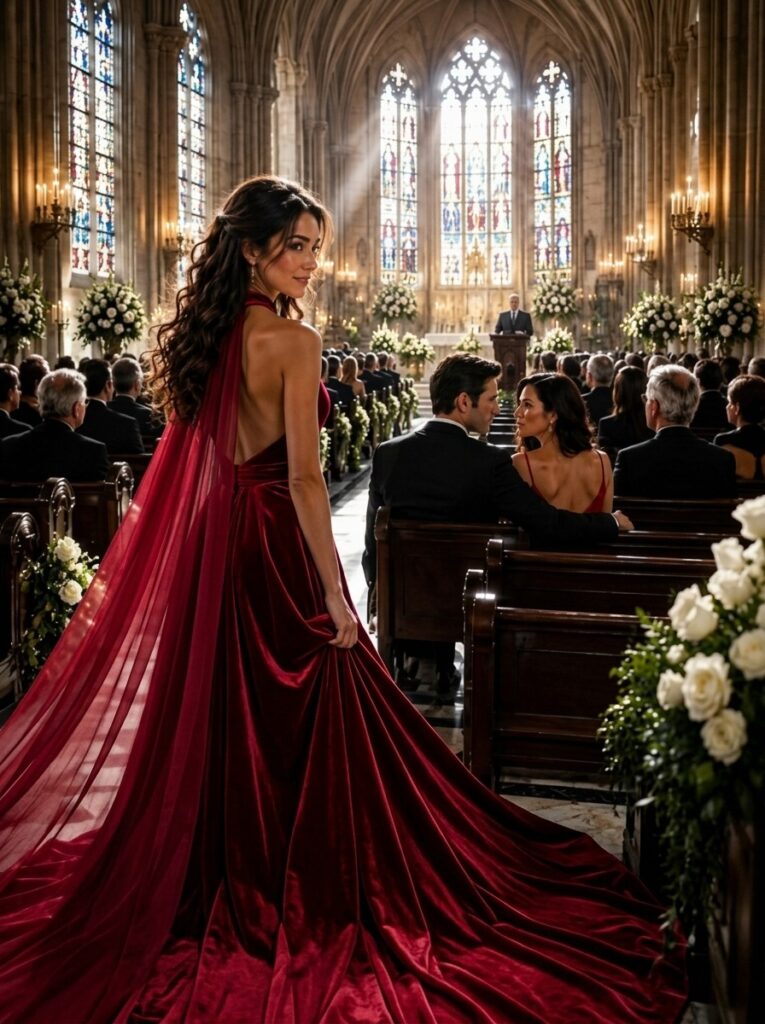
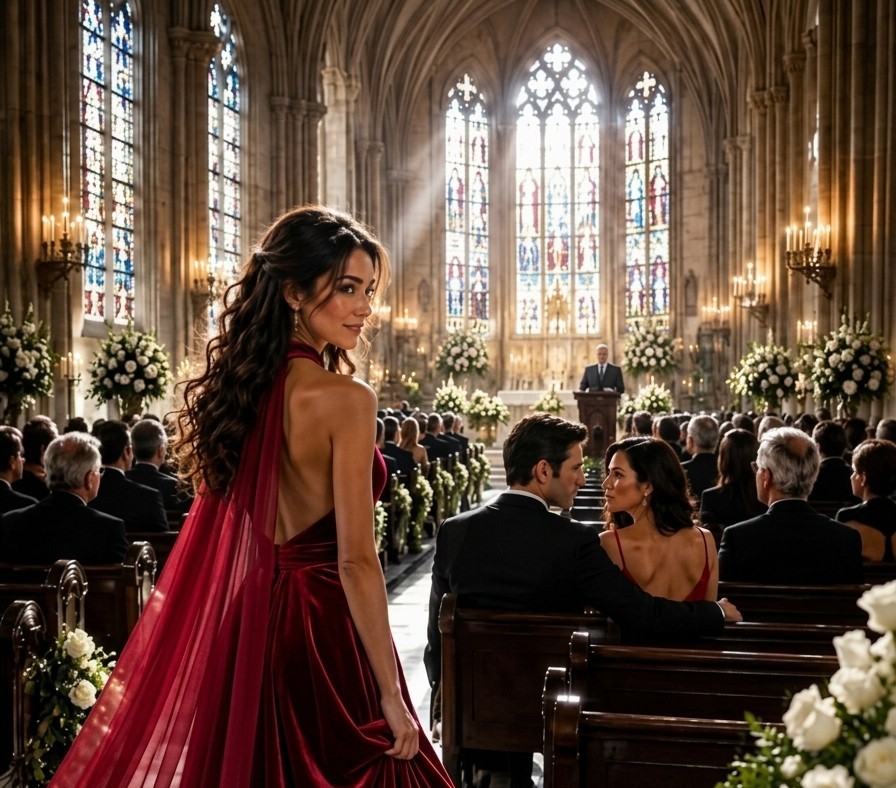
The cathedral smelled of candle wax and polished wood. Hundreds of people had gathered — judges, business owners, politicians, old friends. White roses surrounded my father’s casket. And in the front row, exactly where family belonged, sat my husband Grant beside Rebecca Thornton, a young marketing executive at his company, wearing a midnight-blue Versace dress covered in crystals that sparkled beneath the stained glass exactly the way I remembered.
“What are you doing here?” I asked. Rebecca turned around slowly and smiled — the kind of smile designed to appear innocent while provoking maximum damage. “I’m so sorry for your loss, Natalie,” she said sweetly, one hand wrapped around my husband’s. I looked at the dress. “Why is she wearing my dress?” Silence. Rebecca touched the neckline casually. “Oh, this? Grant gave it to me. He said you never wore it.”
I looked at my husband. “Tell me she’s lying.” Grant looked away. Fifteen years of marriage, and he still handled conflict like a teenager caught on a test. “Not here, Natalie,” he whispered. Not here. Those two words hurt more than the affair — because they meant he wasn’t denying it. He was simply embarrassed that I noticed.
The Last Phone Call
Then I noticed something near the altar. My father’s attorney, Benjamin Blackwood, his oldest friend, holding a large cream-colored envelope covered in my father’s handwriting. And I remembered our final phone call — the day before he died. I had told him everything. The affair. The lies. The missing dress. The marriage falling apart.
My father listened quietly. Then he asked one question: “Are you absolutely certain?” I said yes. His voice became strangely calm. “Thank you for telling me.” At the time, I didn’t understand why those words mattered. Now, watching Benjamin prepare to open the will, I was beginning to.
The First Sentence
After the burial, everyone gathered in the private reception room. Grant sat beside Rebecca again, neither looking concerned. Benjamin adjusted his glasses and opened the document. The room fell silent. Then he read the first sentence: “To my daughter Natalie, who called me yesterday about her husband’s affair…”
The room erupted into shocked whispers. Grant’s face lost all color. Rebecca stopped breathing. Benjamin continued in the measured tone of a man who understood that precision is more devastating than volume. “I want you to know that I spent the last six hours of my life making sure you would never need that man again.”
The Forensic Audit
“First, I am leaving the entirety of my estate — including all properties, investments, and controlling interest in Hargrove and Associates — exclusively to Natalie. No portion shall be considered marital property, as it is structured within an irrevocable trust established prior to her marriage.” Grant shifted in his seat. Rebecca’s hand slid off his arm.
“Second, I have instructed my attorney to include a forensic audit I commissioned three months ago of Grant Hargrove’s personal and business finances. The audit reveals that over the past fourteen months, Grant has redirected approximately six hundred and forty thousand dollars from accounts jointly managed with my daughter into private accounts, shell companies, and expenditures directly benefiting Ms. Rebecca Thornton.” Every head turned toward Grant and Rebecca. Grant stood. “This is — you can’t just —” “Sit down, Mr. Hargrove,” Benjamin said. “I’m not finished.”
“Third. Enclosed with this will is a sealed packet for my daughter’s divorce attorney containing the forensic audit, bank records, wire transfers, hotel receipts, jewelry purchases — including a Versace dress removed from my daughter’s closet and gifted to Ms. Thornton — and communications documenting the full scope and duration of the affair.”
The Letter
“Fourth,” Benjamin said, his voice softening for the first time, “a personal note from your father.” He paused. Adjusted his glasses. Then read: “Natalie. You called me yesterday and told me you were afraid. That you didn’t know how to leave. That you felt trapped by a man who made you believe you had nothing without him. I want you to hear this clearly, in front of every person who matters: you have never had nothing. You have always had me. And now, even after I’m gone, you still do.”
“Everything I built, I built so that my daughter would never have to stay in a room where she is not loved. Leave that room, sweetheart. The door is open. And the dress he stole from you was never just fabric. It was armor. Wear your own armor from now on.”
The reception room was crying. Not just family — cousins, friends, people who barely knew my father. My Aunt Helen had both hands over her mouth. Benjamin’s voice had cracked on the last line. And I sat completely still — not frozen, but calm. For the first time in years, the panic was gone. The woman who walked into that cathedral believing she had nothing was sitting in a room where her father, from beyond death itself, had just handed her everything she needed to walk away free.
The Dress Returned
Grant intercepted me in the hallway afterward, his face slick with sweat. “Your father was clearly not in his right mind — we can contest —” “The audit was conducted by a licensed firm and commissioned through legal channels,” Benjamin said, appearing behind me. “It is admissible. And it has already been forwarded to your wife’s divorce attorney.” I turned to Rebecca. “Take the dress off. It’s mine. My father gave it to me. It’s documented in his records and itemized in the audit. Take it off, or my attorney adds theft to the filing.” She left the building eleven minutes later wearing a borrowed coat. The dress was returned the following morning.
Elegance Is Armor
The divorce was finalized in four months. Grant contested nothing — his attorneys advised him that fighting the audit would expose more. He lost the house, purchased with my father’s money. He lost the investment accounts, structured under the irrevocable trust. And he lost Rebecca, who disappeared the week the financial records went public — because she hadn’t loved Grant. She had loved what Grant could spend.
A year later, I sat in my father’s study — now mine — wearing a simple black sweater and no jewelry. His photograph hung beside his law degree. The empty cream envelope was framed next to it. And on the shelf behind his desk, in a glass case, I placed the Versace dress. Not to wear. To remember.
Because my father spent the last six hours of his life making sure his daughter would never need a man who didn’t deserve her. The will he left behind wasn’t just a legal document. It was the longest, most deliberate love letter I will ever receive. And the dress he gave me was never just fabric. It was a father’s promise that his daughter would always have armor — even when he was no longer there to hold the shield.