Ezra lived in the house next to mine for years. We were never especially close in the beginning. We waved from our driveways, exchanged the occasional hello, and then kept moving with our lives.
That changed one Sunday when I saw him struggling with grocery bags near his front steps. One of the bags nearly slipped from his hands, and before I even thought about it, I walked over and helped him carry everything inside.
To thank me, he invited me in for coffee.
I almost said no. I had errands to finish, laundry waiting at home, and a dozen ordinary reasons to keep moving. But something about the way he stood there — tired, embarrassed, trying not to ask for more help than he already had — made me stay.
We ended up talking for nearly an hour.
At first it was just small things. The neighborhood. The weather. How long we had both lived on that street. But then the conversation drifted into old memories, people we used to know, places that had changed, and the strange speed of time. By the time I stood up to leave, it felt less like I had spent an hour with a neighbor and more like I had stepped unexpectedly into someone else’s history.
At the door, I smiled and told him that next time he needed help with groceries, he should just let me know.
Neither of us knew that simple sentence would quietly turn into a twelve-year tradition.
As the years passed, Ezra’s health declined. Driving became harder for him. Walking from the car to the kitchen became slower, then difficult, then nearly impossible on some days. So every Sunday, I started picking up groceries for him.
At first, he insisted on paying me.
I always refused.
Eventually, he stopped offering.
Instead, every Sunday I would carry the bags into his kitchen, put things away if he needed me to, and sit down with him for a while. Sometimes we had coffee. Sometimes tea. Sometimes just silence broken by a few easy sentences.
We talked about everything.
Sometimes about his childhood.
Sometimes about the wife he had lost years earlier.
Sometimes about my own life, my frustrations, my kids, the strange little things that happen when you trust someone enough to stop performing and just speak.
And sometimes we talked about nothing important at all.
Those Sundays became one of the most dependable parts of my life.
It is strange how a routine can become part of your emotional structure without you noticing. I never wrote “visit Ezra” on a calendar after the first few years. I didn’t need to. Sunday simply meant groceries, his porch, the smell of old coffee, and whatever story he felt like telling that day.
Then one morning I looked outside and noticed Ezra’s porch light was still on.
It was late enough that it should have been off.
Something about it unsettled me immediately.
By noon, I learned he had passed away peacefully in his sleep.
He was eighty-four.
The news hit me harder than I expected. I stood in my kitchen for a long time just staring at the counter, trying to process the fact that one of the most regular parts of my life had ended overnight. No more Sunday bags. No more stories. No more quiet half-smiles when I showed up with his favorite bread.
The funeral was small.
Much smaller than I expected.
A few relatives I had never met. Two old neighbors. A pastor. That was it. I kept waiting for more people to arrive, for some flood of friends or extended family who would prove that the man I had spent twelve years visiting had been surrounded by love in a dozen other directions too.
But that didn’t happen.
I remember standing near the back afterward, looking at the flowers, thinking about how lonely a person’s final goodbye can look from the outside.
A few days later, someone knocked on my front door.
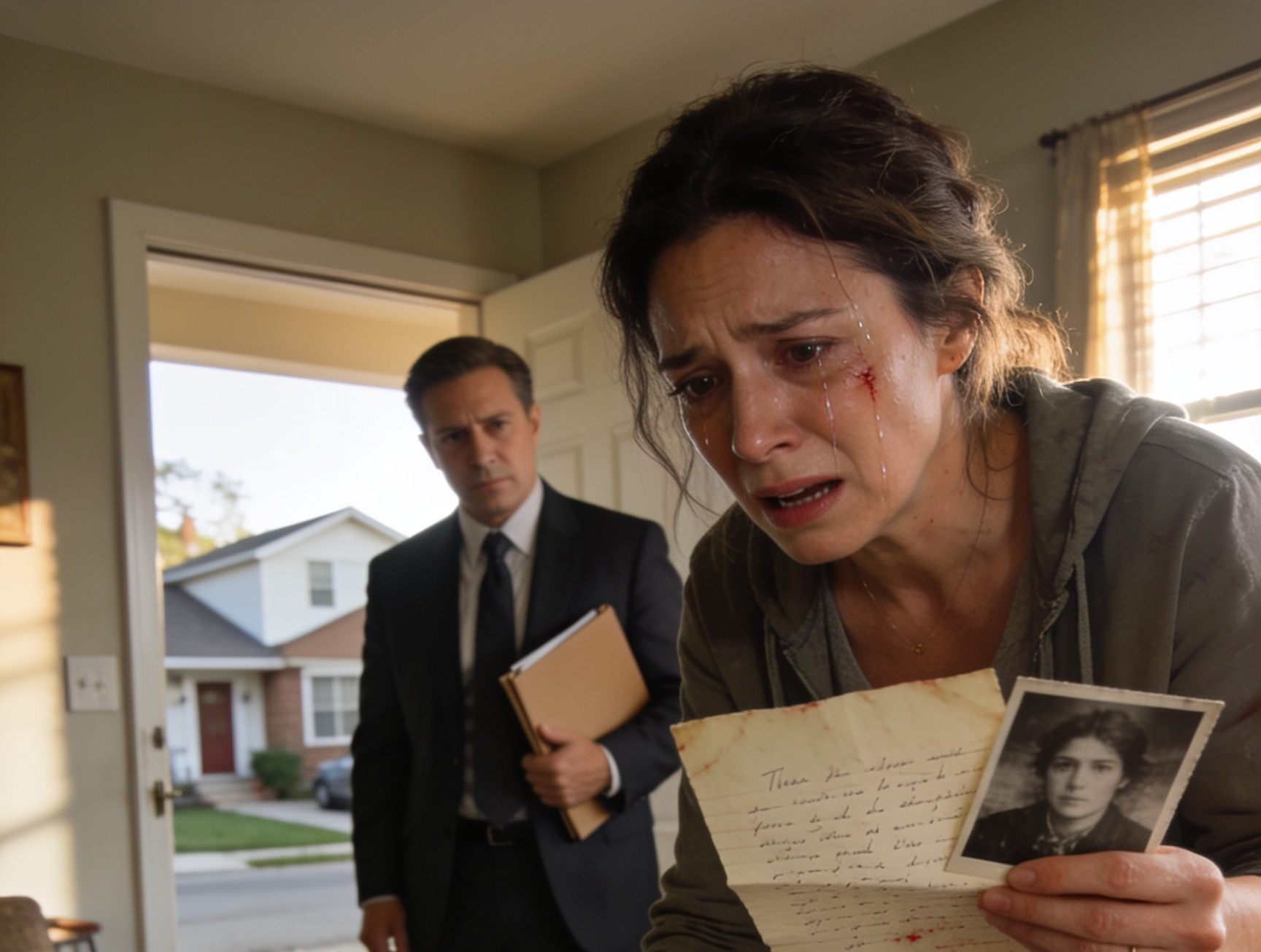
When I opened it, a man in a dark suit introduced himself as Ezra’s lawyer.
At first, I thought there must be some mistake.
I had no reason to be involved in anything legal. I wasn’t family. I wasn’t mentioned in any conversations about wills or estates. I was just the neighbor who brought groceries.
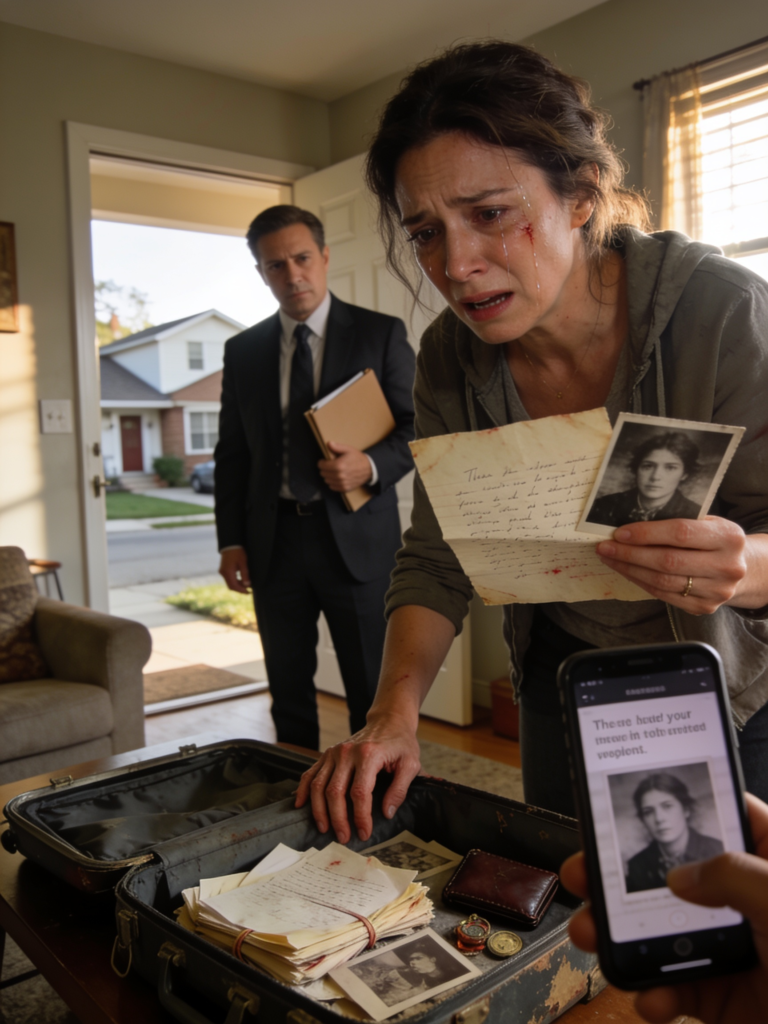
Then he lifted a battered old suitcase and said, “Mr. Ezra Levin left instructions for this to be given to you personally.”
For a second, I honestly didn’t move.
The suitcase looked old enough to belong in an attic. The corners were scraped raw, the leather handle was cracked, and one of the brass clasps was slightly bent. It didn’t look valuable. It looked used. Important in the way only deeply personal things ever are.
I took it from him with both hands.
He told me Ezra had been very clear. The suitcase was mine. He wanted me to open it alone.
By the time I brought it into my living room and set it on the coffee table, my hands were already shaking.
Not because I expected money.
Not because I thought there would be some huge secret inside.
But because I suddenly understood that whatever was in there mattered enough for Ezra to plan this before he died.
I sat down slowly and opened the clasps.
Inside was a stack of letters tied with a faded ribbon.
Underneath those were old photographs, some black-and-white, some curled at the corners with age. There was a worn leather wallet, a small box with a broken latch, and an envelope resting on top of everything else.
On the front, in Ezra’s careful handwriting, were four words:
For my Sunday friend.
That was when my throat tightened.
I opened the envelope first.
Inside was a letter.
It began simply.
“If you are reading this, then I have finally missed a Sunday.”
I had to stop for a second after that line.
I pressed my hand against my mouth and kept reading.
Ezra wrote that he had known for a long time his body was slowing down faster than he ever admitted out loud. He wrote that pride had kept him from asking for help in the beginning. He said that the first day I carried in his groceries, I had done more than save him from dropping a bag on the porch.
“You saved me from feeling invisible,” he wrote.
I read that sentence three times.
Then I kept going.
He wrote about the Sundays. About how he always pretended our conversations were casual, but secretly looked forward to them all week. He wrote that there are different kinds of hunger in life, and by the end, groceries were not the only thing I had been bringing into his home.
“You brought noise into quiet rooms,” he wrote. “You brought witness to days that would otherwise have passed unnoticed.”
By the time I reached the second page, I was crying.
He thanked me for refusing his money all those years. He said it had allowed him to believe, maybe for the first time in a very long while, that kindness could still exist without calculation.
Then he explained the suitcase.
The letters were from his late wife.
The photographs were from their life together — courtship, holidays, first apartments, bad haircuts, cheap anniversaries, and the ordinary little moments people never realize will one day become sacred.
The wallet had belonged to her too.
And tucked into the small box was a ring.
Not a flashy one. Not something expensive enough to belong behind glass. Just a simple band worn smooth by time.
At the bottom of the suitcase was another envelope.
Inside that one was a check.
I actually stared at it in disbelief.
It was more money than I had expected Ezra to have, let alone leave to me.
There was also a note attached.
“This is not payment,” it said. “Payment would insult what those Sundays were. Think of this as a final thank-you, and a request.”
The request was that I keep a few things, donate some of the money to the local senior outreach center, and use the rest on something that would make life easier or kinder for my own family.
He even added one final line in his small, neat handwriting:
“Please do not argue with a dead man. I have had plenty of time to decide.”
I laughed through my tears when I read that.
Then I cried harder.
But the money wasn’t what made my hands shake.
It was the weight of being seen that clearly by someone I once thought of as just the elderly man next door.
For twelve years, I believed I was doing a small kindness.
I thought I was helping with groceries.
I thought I was keeping an old man company.
I thought I was being useful in a limited, ordinary way.
I never understood that, to Ezra, those Sundays had become part of what made his life feel human all the way to the end.
I spent the rest of that afternoon going through the photographs one by one.
Ezra as a young man in a wool coat.
Ezra with his wife at a county fair.
Ezra standing beside a car with a grin I had never seen on the old version of him.
Ezra holding a baby I assumed must have been his son.
Ezra at a table full of people long gone now.
There was a whole world inside that suitcase. A whole life carefully folded away, waiting for someone he trusted.
And somehow, that someone was me.
A week later, I did exactly what he asked.
I donated part of the money to the senior outreach center in town.
I kept the letters and a handful of photographs he had marked with tiny pencil dots on the back, as if he had already chosen which memories he wanted me to carry.
And with the rest, I started a small fund to help elderly residents on our street with groceries, rides, and basic errands.
Nothing formal. Nothing dramatic.
Just something useful.
Something Ezra would have liked.
Now, every Sunday, I still think about him.
Sometimes when I’m carrying grocery bags up someone’s porch steps.
Sometimes when an older neighbor starts telling me a story and I realize I’m not in a hurry after all.
Sometimes when I pass his old house and imagine the porch light glowing softly against the evening.
If there is one thing Ezra left me besides that suitcase, it was this:
Never underestimate how much a simple act of consistency can mean to someone who has very little left to count on.
Twelve years of groceries did not feel heroic while I was living them.
But to Ezra, they were love in its most reliable form.
And now I know that sometimes the most ordinary kindness becomes the part of your life someone else treasures enough to carry with them to the very end.