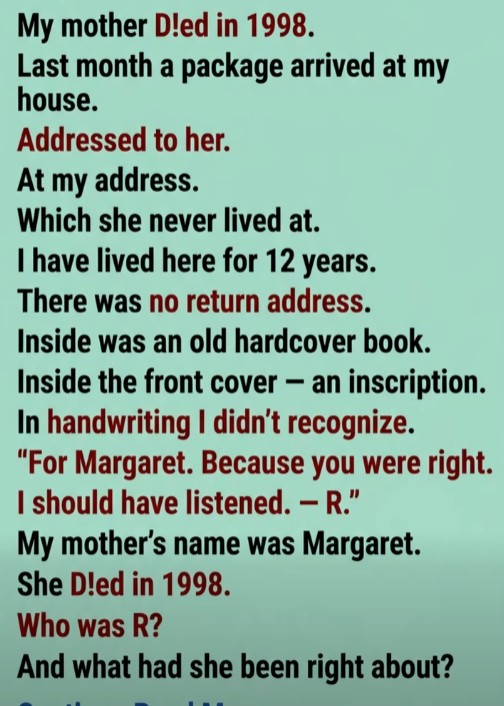
My mother died in 1996.
Last month a package arrived at my house. Addressed to her. At my address, which she never lived at in her entire life. I have lived in this house for fourteen years, long after she was already gone.
There was no return address.
Inside was an old hardcover book, its spine cracked from age and handling. I opened the front cover and found an inscription written in handwriting I didn’t recognize.
“For Diane. Because you were right. I should have listened. — R.”
My mother’s name was Diane.
She died in 1996.
Who was R? And what had she been right about?
I sat at my kitchen table for nearly an hour holding that book, turning it over in my hands like the answer might be hidden somewhere on the cover instead of inside the pages.
The book itself was a worn copy of East of Eden, the kind with a cracked spine and yellowed pages that suggested it had been read more than once, maybe many times, by someone who genuinely cared about it. There was no name on the inside flap besides the inscription. No bookstore stamp. No clue at all about where it had come from, other than a postmark on the package that simply said Tucson, Arizona.
My mother had never lived in Arizona. As far as I knew, she had never even visited.
I called my aunt Joyce, my mother’s younger sister, the only person still living who might remember anything from that part of her life before I was born.
“Joyce,” I said, after explaining what had arrived. “Does the initial R mean anything to you? Someone from Mom’s past, maybe before she met Dad?”
There was a long pause on the line, long enough that I knew immediately the answer was not going to be simple.
“There was someone,” Joyce finally said. “Before your father. A man named Robert. They were together for almost three years, back in the late sixties, before everything happened.”
“Before what happened?” I asked.
“Your mother wanted to move to California,” Joyce said slowly, like she was choosing each word carefully after holding them back for decades. “Robert had a job opportunity out there, something in aerospace, and he wanted her to come with him. She told him she had a feeling it wasn’t the right move, that something about it felt wrong, though she could never explain exactly what. He didn’t listen. He went anyway. The company folded eighteen months later in some kind of financial scandal, and he lost almost everything he’d invested in it.”
“And then what?” I asked.
“He came back,” Joyce said. “Tried to win her back too. But by then your mother had already met your father. She told Robert it was too late, that she’d moved on, and that she hoped he’d find whatever he was looking for eventually.” She paused. “I always wondered if he ever did.”
I looked down at the book again. Because you were right. I should have listened.
“Joyce,” I said quietly. “I think he just answered that question. Twenty-eight years too late.”
It took me almost three weeks to find him.
A retired aerospace engineer named Robert Hale, eighty-one years old, living in an assisted living facility just outside Tucson. I found him through an old alumni newsletter from a university his name appeared in decades ago, then a property record, then finally a phone call to the facility itself, where a kind receptionist confirmed he was indeed a resident there.
I wrote him a letter before I called, because something about the inscription made me feel like he deserved the chance to choose whether this conversation happened at all.
He called me himself four days later, his voice thinner than I expected, careful in the way elderly voices sometimes are when they’re choosing each word with intention.
“You’re Diane’s daughter,” he said, not quite a question.
“I am,” I said. “I got the book.”
He was quiet for a moment. “I wasn’t sure it would even reach you. I found her obituary online a few months back, completely by accident, searching for something else entirely. I didn’t know she’d passed. I’d always assumed, foolishly I suppose, that there would still be time someday to tell her she’d been right.”
“Right about what, exactly?” I asked. “My aunt told me a little. About California. About the job.”
Robert exhaled slowly on the other end of the line. “She had this way of seeing things before they happened. Not psychic, nothing like that. Just… perceptive, in a way most people aren’t. She told me the man running that company had a look about him she didn’t trust. Something in how he talked about the investors, how careful he was about which numbers he showed people and which he didn’t.” He paused. “I thought she was being overly cautious. I went anyway. Eighteen months later I watched everything I’d put into that company disappear in about six weeks, and I spent most of my thirties trying to climb back out of that hole.”
“Why send the book now?” I asked. “After all this time?”
“Because I’m eighty-one,” he said simply. “And I’ve spent sixty years occasionally thinking about a woman who told me the truth when I didn’t want to hear it, and I never once told her she’d been right. I thought, before I run out of chances entirely, I should finally say it. Even if she wasn’t here to hear it herself.”
“She would have appreciated that,” I said. “She was like that with me too, sometimes. Saw things before I did. I didn’t always listen either.”
Robert laughed softly, a tired but genuine sound. “Then I suppose you understand exactly what that book was worth to me.”
We talked for almost an hour that day. He told me stories about my mother I had never heard before, a version of her from a life that existed entirely before mine began, young and sharp and stubbornly honest in a way that apparently never changed.
I visited him once, three months later, on a trip to Arizona I hadn’t originally planned to take. He was smaller than I expected, sitting by a window in a quiet common room, and when I walked in he looked at me for a long moment before saying, “You have her eyes.”
I brought the book back with me when I left. He insisted. He said it had already done what he needed it to do.
It sits on my shelf now, next to a photo of my mother from around the same era Robert remembered her in, young and laughing at something just out of frame.
Because you were right. I should have listened.
Sometimes the truth takes sixty years to find its way home. But it still finds its way.
Share this for every overdue apology that finally found its address, and every person brave enough to say it before it’s too late. ❤️👇
— Update: Robert passed away five months after we spoke. His daughter called to let me know, and mentioned he’d kept my number written on a card by his bed the whole time. She said he talked about that phone call often. I’m glad the book found me when it did.