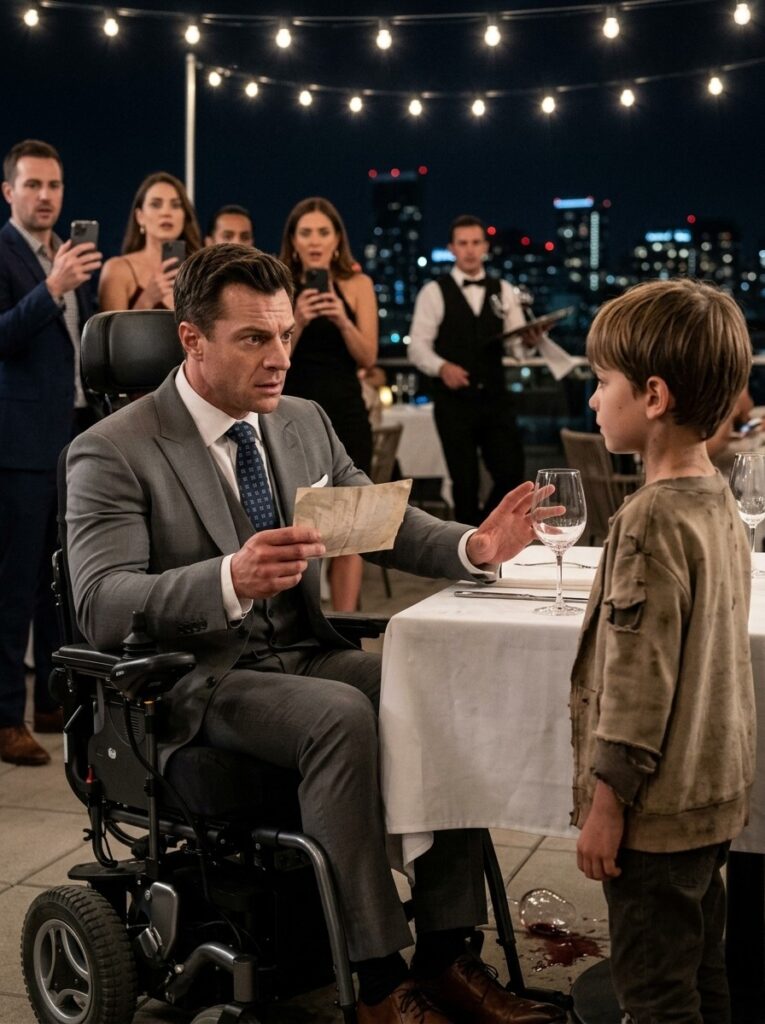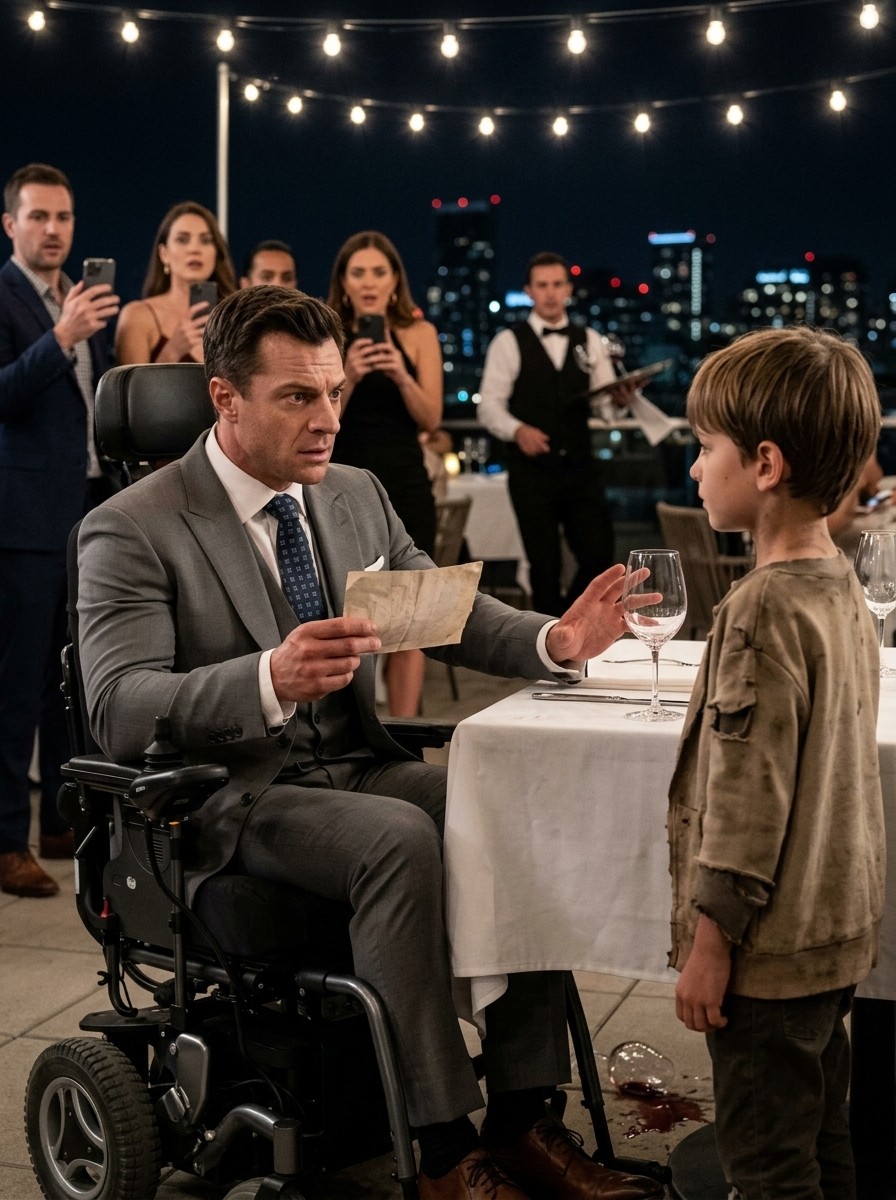
A child in torn clothes interrupts a private dinner at a luxury restaurant and refuses to leave a powerful man’s table. What he says next forces a confrontation the man has spent years avoiding, and by the time the boy finishes, half the room is watching something nobody expected to see that night.
A boy in a worn jacket and scuffed shoes walked straight through the middle of a private dinner at the rooftop restaurant, past two security guards who hadn’t reacted fast enough, and stopped directly beside the table of Richard Voss.
Conversation died around him. Phones started rising before anyone fully understood why.
Richard looked up, mildly amused, the way men like him got amused by things that didn’t yet seem like a threat. “Can I help you, son?”
“My mother said you’d know me,” the boy said.
Richard’s smile flickered, just slightly. “I don’t know your mother.”
“You do,” the boy said. “Her name was Elena.”
The name landed like something dropped from a height. Richard’s hand tightened around his wine glass.
“Elena Castillo,” the boy said. “She worked at Meridian General. She said you used to meet her in the parking garage after her shifts.”
A woman at the next table leaned toward her husband and whispered something. Phones kept rising.
“That’s enough,” Richard said, his voice losing its earlier ease. “I don’t know what this is, or who put you up to it, but—”
“She died eleven years ago,” the boy said. “You sent flowers to a different funeral. The wrong one. You never even noticed.”
Richard’s face went white.
“I’m not lying,” the boy said quietly. “I have proof. It’s in my pocket.”
Richard’s hand was shaking when he reached for his water glass, missed it slightly, and set it back down without drinking.
“What’s your name,” he said, his voice quieter now, the performance of confidence completely gone.
“Danny,” the boy said.
“How old are you, Danny?”
“Eleven.”
The math arrived in Richard’s face before he said anything else. Eleven years. The same eleven years since whatever funeral he’d apparently attended that wasn’t actually Elena’s.
A woman who had been seated two tables away, silent until now, suddenly stood up. She was older, maybe seventy, dressed simply compared to the rest of the room. “Richard,” she said. “Who is this child?”
“Margaret, I have no idea—”
“He has your eyes,” Margaret said. She wasn’t asking a question.
Danny reached into the inner pocket of his torn jacket and pulled out a folded photograph, soft at the creases from being carried for a long time. He held it out toward Richard without stepping any closer.
Richard took it with both hands, like he was afraid it might disappear if he moved too quickly.
A young version of himself stood in a hospital hallway, arm around a smiling woman in nurse’s scrubs, his hand resting against her visibly pregnant stomach. Both of them were laughing at something outside the frame.
“That’s not possible,” Richard whispered. “Elena told me she lost the baby. Before she—” He stopped himself.
“She didn’t lose anything,” Danny said. “She told me you stopped calling after she said she was keeping me. She said you got scared and disappeared, and then a few years later she heard you’d sent flowers to a funeral and assumed it must have been hers, because nobody ever corrected you.”
The restaurant had gone almost completely silent now, the kind of silence where even the kitchen sounds seemed to fade into the background.
“Where is she,” Richard said. “Where is your mother right now.”
Danny’s expression didn’t change. “She’s not the one I came to find tonight.”
It took three days for Richard to track down the truth of what had actually happened eleven years earlier, working with a private investigator he’d hired the same night, his hands still unsteady as he gave instructions over the phone in the restaurant’s coat check area while half the dinner guests pretended not to watch him leave.
Elena Castillo had not died. The funeral Richard attended eleven years ago, sent there by a mutual acquaintance who said only that “Elena’s family lost her,” had actually belonged to Elena’s mother, who shared her first name. Elena herself had moved across the state shortly after, raised Danny largely on her own, and according to the investigator’s careful digging, had spent years assuming Richard knew exactly what had happened and had simply chosen to stay away.
Two people, each believing a different version of loss, neither one bothering to confirm it directly, for eleven years.
Richard found her address by the end of that week. He drove there himself rather than sending anyone else, which Danny later told him was the first thing that made him think his father might actually be different from what his mother had described.
Elena answered the door already knowing, somehow, before he said a word, exactly why he was standing there. Danny had told her everything the night he came home from the restaurant, the dinner he wasn’t supposed to attend with his uncle, the boy too curious and too determined to simply sit quietly through someone else’s evening when he recognized the name on the reservation list his uncle had mentioned in passing.
“You thought I was dead,” Richard said, standing on her porch step like a man uncertain whether he had any right to be there at all.
“I thought you knew the truth and chose to disappear anyway,” Elena said. “Which version of the story would you have preferred to believe about yourself?”
He didn’t have an answer for that. Not a good one, anyway.
What followed wasn’t simple, and I won’t pretend it resolved itself the way these stories sometimes do, cleanly and completely within a single dramatic conversation. Richard missed eleven years. No amount of money or sudden effort erases that math.
But he showed up. Consistently, awkwardly at first, learning slowly how to be present in a child’s life he’d missed the beginning of entirely. Danny was cautious with him for a long time, testing whether this version of his father would last past the first few visits, the way children do when they’ve already learned that adults sometimes disappear.
A year later, Richard still drives two hours every other weekend. Danny picked the visitation schedule himself, deciding the pace at which trust could be rebuilt, and Richard, for once in his life, didn’t argue with the terms someone else set for him.
Elena and Richard never got back together. That part of the story stayed exactly as complicated and unresolved as real life usually keeps things. But Danny has both parents now, in whatever imperfect, late-arriving form that takes, and most days, according to Elena, that’s enough.
Share this for every child who had to do the work of bringing two grown adults back to the truth they were both too afraid to confirm. ❤️👇
— Update: Danny’s school had a father-son event last month. Richard went. He says it was the first time in eleven years he didn’t feel like he was performing being someone important. He just felt like somebody’s dad.