When my father died, I thought the hardest part would be watching him slip away.
I was wrong.
The hardest part came three days later, when his lawyer gathered us in the living room to read the will.
My sister Lara sat across from me in a cream blouse and a face full of restrained impatience, like this was one more appointment standing between her and something more interesting. I sat there exhausted, hollowed out, still carrying the fog that comes after years of caregiving and one final week of almost no sleep.
I had fed my father.
Bathed him.
Changed his bedding.
Managed his medications.
Held his hand through the nights when he was frightened and too proud to say it.
For the last three years of his life, I had shaped my days around his needs so completely that I no longer knew where my own life ended and his began.
Lara visited when it was convenient.
She liked to arrive with expensive fruit, kiss his forehead, and tell everyone she was “so worried about Dad.” Then she would leave forty minutes later and disappear for another two weeks.
I told myself not to compare.
I told myself love looked different in different people.
I told myself those things because the truth made me bitter, and bitterness felt dangerous when I still had to get up every morning and care for the man in the next room.
So when the lawyer unfolded the will, I expected very little.
Not a reward.
Not praise.
Not even fairness.
But I did expect to hear something that reflected reality.
Instead, I heard this:
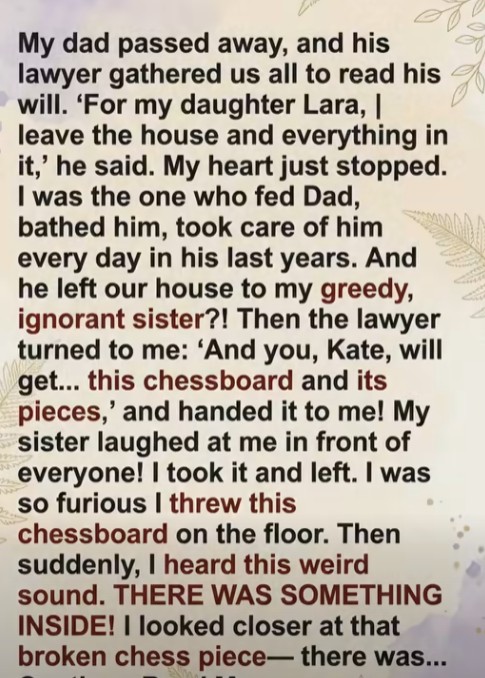
“For my daughter Lara, I leave the house and everything in it.”
Everything in it.
I remember the room turning strangely distant after that, as if someone had quietly shut a glass door between me and the rest of the world.
My hands went cold.
The house was the only real asset my father had left. It was the house I had practically lived in while taking care of him. The house where I had spent years cooking his meals, scrubbing his bathroom, carrying him to bed when his legs got bad, and sleeping lightly so I could hear him call for me in the night.
And he had left it all to Lara.
My sister inhaled sharply, then lowered her eyes in what I knew was fake surprise.
“Oh, Dad,” she murmured softly, like she was trying to sound overwhelmed instead of victorious.
I stared at her and felt something ugly move through me.
Then the lawyer turned another page.
“And for my daughter Kate,” he said, “I leave the chessboard and its pieces from my study.”
That was it.
The chessboard.
For a second, I thought I had misheard him.
The chessboard had sat untouched in my father’s study for as long as I could remember. It was old, wooden, slightly worn along the edges, and emotionally useless in the kind of raw practical way grief sometimes becomes. While Lara got the house, I got an object.
A prop.
A souvenir.
Something that sounded almost insulting in its smallness.
My sister looked at me, and I saw the laugh before I heard it.
It came out as a soft, ugly little burst she tried to hide behind her hand. But everyone heard it.
“Oh my God,” she said. “A chessboard?”
The lawyer gave her a warning look, but she didn’t care.
I could feel the heat climbing up my neck. Not just grief. Not just shock. Humiliation.
I had spent years proving my loyalty in the least glamorous ways possible, and in the end it looked as though I had been thanked with carved wood while Lara walked away with walls, land, furniture, and money.
The lawyer handed the chessboard to me carefully, almost respectfully, like he knew how absurd it seemed but wasn’t allowed to say so.
I took it without a word.
Then I stood up and left before I gave my sister the satisfaction of seeing me cry.
By the time I got home, I was shaking.
Not the delicate trembling of sadness.
The violent, furious kind that comes when pain and humiliation mix together until they no longer know which one is speaking.
I carried the chessboard into my living room and stood there staring at it.
It felt heavy in my hands. Too heavy, maybe, but I wasn’t calm enough to notice that properly yet.
I kept hearing Lara’s laugh.
A chessboard?
That one line repeated in my head until something in me snapped.
I threw it onto the floor.
The wood cracked sharply. Pieces scattered across the room. One of the bishops split against the leg of the coffee table. The king rolled beneath a chair. The board itself broke along one side with a sound like a door slamming shut.
Then I heard something else.
A strange little rattle.
I froze.
At first I thought one of the pieces had hit a coin or a button on the floor.
But when I bent down and picked up one of the broken pieces — the white knight, split near the base — I heard it again.
Something was inside.
My pulse started hammering so hard I could hear it in my ears.
I turned the piece over in my palm and pried it apart carefully with my fingernail.
Inside was a tiny rolled piece of paper.
For a moment I just stared at it.
Then I unrolled it with shaking fingers.
It was my father’s handwriting.
Small. Unsteady. But unmistakable.
It said:
“Kate — if you are reading this, then you finally made the move I knew you would.”
I sat down right there on the floor.
My breathing turned shallow.
I looked around at the broken board, then back at the note, and suddenly the whole thing no longer felt random.
It felt planned.
Deliberate.
I grabbed the rest of the chess pieces and started checking them one by one.
Most were solid.
A few were not.
Inside the black rook was a tiny key.
Inside the white queen was another folded note.
Inside the black bishop was a bank deposit slip.
My hands were shaking so badly I nearly dropped everything.
The second note was longer.
“Lara wanted the house,” it began. “So I let her believe that was the prize.”
I actually covered my mouth when I read that.
My father went on to explain that the house was deeply in debt. He had taken out a reverse mortgage years earlier when medical expenses started climbing faster than he could manage. There was almost no equity left. By the time taxes, repairs, and the balance were dealt with, the house would be more burden than blessing.
But that was not all.
The key, he explained, opened a lockbox at his bank.
The deposit slip showed an account in my name.
An account I had never heard of.
Over the last four years, my father had quietly sold several pieces of inherited land he had owned jointly with a cousin, plus some collectibles and investments Lara never knew existed. He had placed the money into that account little by little, under the guidance of his lawyer, specifically to keep it separate from the estate.
Separate from the house.
Separate from Lara.
Separate from the performance.
The final note was hidden inside the king.
That one broke me.
“Real care,” he wrote, “is rarely rewarded in public. The people who do the hardest loving are often the least celebrated in the room. I had to let Lara see what she wanted to see. If I left anything openly to you, she would have fought it, delayed it, poisoned it, or found a way to make your grief uglier than it already is. So I gave her the stage. I gave you the ending.”
I cried so hard I had to stop reading twice.
Every cruel thing I had been telling myself since the will reading began to unravel.
He had known.
He had seen everything.
Not just the medications and the meals and the clean sheets.
He had seen the resentment I swallowed, the exhaustion I hid, the way I kept showing up without applause because someone had to.
And he had understood Lara too.
He knew exactly what dazzled her.
He knew she would grab the house before asking what came with it.
He knew she would laugh at the chessboard.
And he knew I would eventually break it open.
That final part almost made me laugh through my tears. It was so absurdly, painfully him. My father loved chess. He used to tell me that the most important moves are often the ones your opponent dismisses as unimportant.
I sat on my living room floor until the light changed and the room dimmed around me.
Then I called the lawyer.
He was quiet for a moment after I explained what I had found.
Finally he said, “Your father hoped you would discover it sooner rather than later.”
“So you knew?” I asked.
“I knew enough to make sure his instructions were carried out,” he said carefully. “The rest was meant to come from him.”
The next morning, I went to the bank.
The key opened a lockbox exactly as the note had promised.
Inside were documents, the full account information, a letter addressed to me, and one addressed to Lara in case she ever tried to contest anything. My father had thought of everything. Every transfer had been documented. Every legal step had been witnessed. Every piece of the plan had been placed where it needed to be.
By the time I sat down with the banker and understood the amount in that account, I had to steady myself against the table.
It was enough to buy a modest house outright.
Enough to rebuild my life.
Enough to repay, in the quietest and most precise way possible, every invisible year I had given him.
Lara, meanwhile, inherited a crumbling house full of repairs, debt, and tax problems she had been too blinded by greed to investigate before celebrating.
When she finally learned the truth, she called me screaming.
She said I had manipulated him.
She said I had hidden things.
She said the will reading had humiliated her.
I almost laughed at that.
Humiliation was hearing your sacrifices reduced to a chessboard while the room watched.
Humiliation was being laughed at for loving someone in practical, unglamorous ways.
But for the first time in my life, I didn’t argue with Lara.
I just listened.
Then I said, “Dad made his move. Not me.”
And I hung up.
A month later, I went back to the broken chessboard pieces and gathered them into a wooden box.
I kept the king, the queen, and the knight on my shelf.
Not because they were valuable.
Because they told the truth.
My father could be difficult, proud, secretive, and frustrating in ways only family can fully understand. But in the end, he saw more than I gave him credit for. He knew who had shown up. He knew who wanted appearances and who had done the real work.
He simply waited until the board was clear enough to prove it.
People like Lara think the prize is whatever shines brightest in the room.
But my father knew better.
The house was never the victory.
The final move was.