Full story:
The last thing I heard before everything went dark was Victor Payne laughing. It wasn’t nervous laughter or shock. It was the slow, satisfied sound of a man who believed he had won again. My head slammed against the kitchen tile, my vision folded into black, and his laughter followed me down like it owned the air.
In our house, everyone used a title for him when he was in the room. My mother said “sir” the way you might say “yes” in front of a teacher — automatic, quiet, careful. I said it too when I was younger and still believed obedience could protect me from the worst of it. The older I got, the more obvious it became that obedience only teaches cruel people how to hurt you without resistance.
Victor could find an excuse for anything. A dish set down too loudly. A shirt folded the wrong way. A glance he decided was disrespect. Sometimes he didn’t even bother inventing a reason. He would sink into his recliner with a beer in his hand, tilt his head toward me, and say, “Violet, come here. I’m bored.” My mother would drop her eyes as if doing what he asked might somehow stop him from becoming worse.
He loved an audience. He liked forcing me to stand in the middle of the living room while he humiliated me. “Look at her,” he would say to my mother, with that smug half-smile on his face. “Twenty-two years old and still completely useless.” For years I let those words sink into me until I almost believed they were true.
For a long time, I cried when he humiliated me, and that crying fed him. Then something inside me hardened. Not courage exactly — more like exhaustion finally turning into something colder. I stopped begging. I stopped apologizing for things I didn’t do. I stopped giving him the reaction he wanted. The less I gave him, the angrier he became.
The night everything changed, he had been drinking. I could smell it on him before he even stood up. We were in the kitchen, and I was clearing plates when he called my name in that lazy voice that usually meant trouble. When I didn’t move fast enough, he came toward me. He leaned close enough for his breath to hit my face and asked, “You think you’re brave?”
I don’t know what made me answer him the way I did. Maybe it was exhaustion. Maybe it was years of swallowing fear until there was no room left for it. “No,” I said. “I think you’re predictable.”
The smile disappeared from his face instantly. The first hit drove me into the counter. The second knocked the breath out of me. My mother stood frozen at the sink, twisting her wedding ring as if that tiny circle of gold could save her from choosing a side. “Tell her,” Victor barked. My mother swallowed hard and whispered, “Apologize, Violet.”
I looked at her and asked the only thing left to ask. “For what?”
His fist came down so fast I barely saw it. My head hit the tile floor, and everything went black.
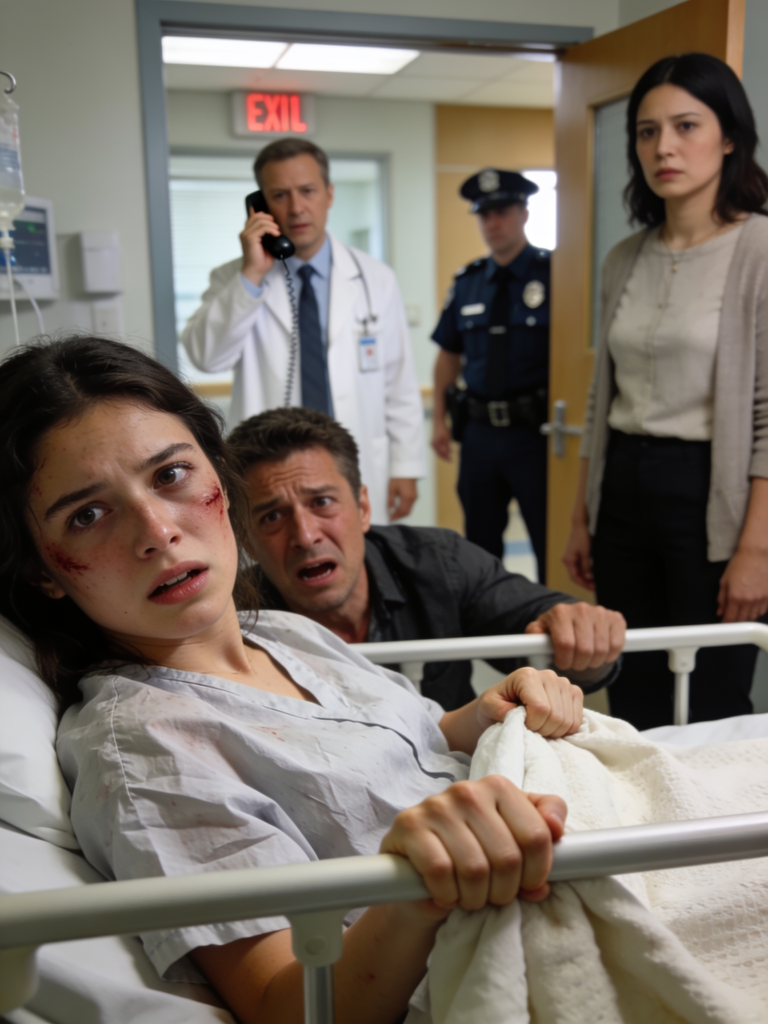
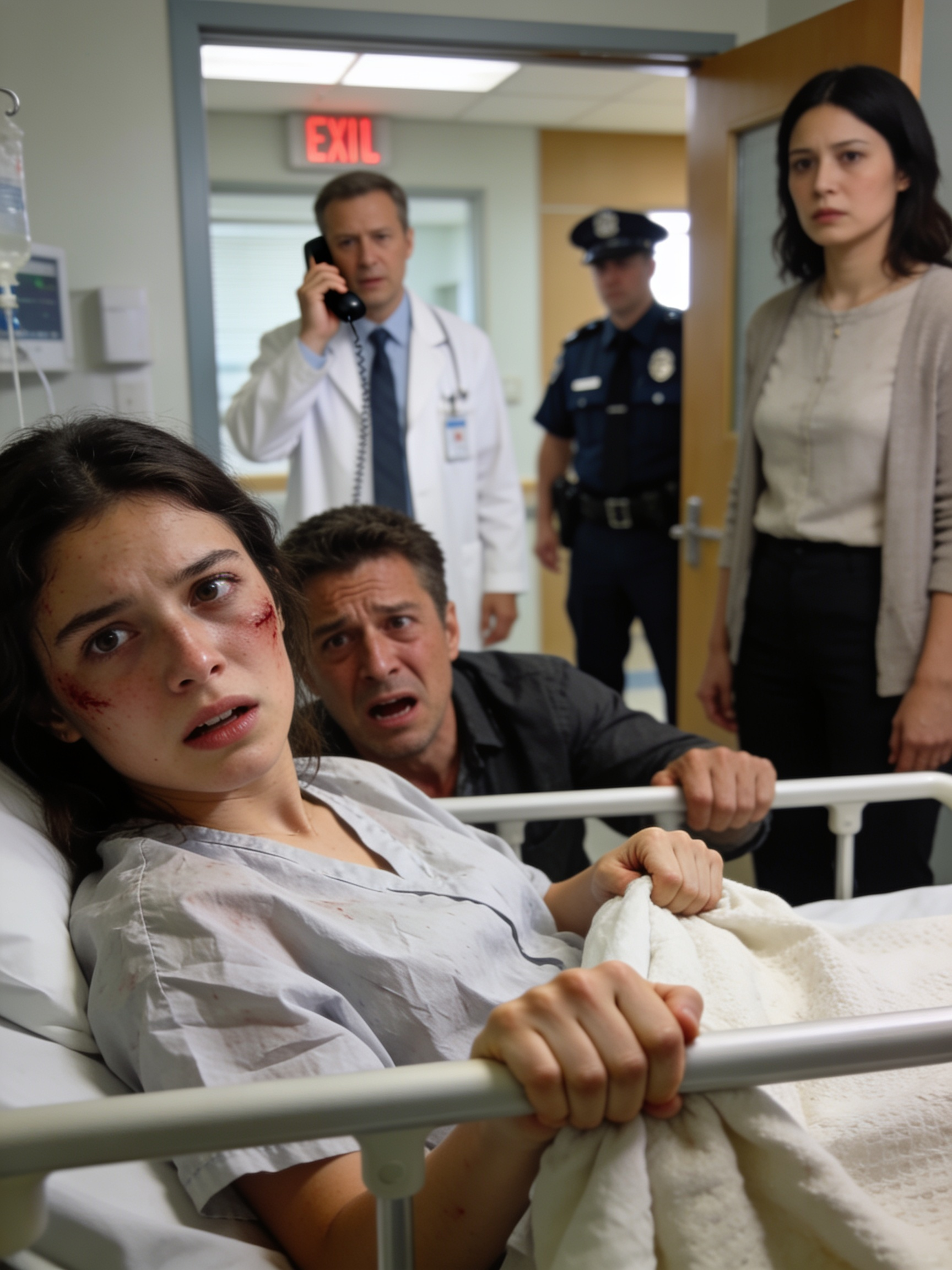
When I woke up, the hospital lights were so bright they hurt. My mouth tasted like metal. My whole body felt heavy and far away, like it belonged to someone else. Victor stood beside my bed wearing an expression that was supposed to look concerned. My mother was holding my hand, but it wasn’t comfort. It was pressure. A warning. Stay quiet. Don’t make this real.
Then the doctor walked in.
He asked what happened, but my mother answered before I could speak. “She slipped while taking a bath,” she said, fast and smooth, like she had rehearsed the sentence all the way there. For years, that kind of lie had protected him. One quick explanation, one neat little story, and everyone looked away.
But this doctor didn’t look away.
He studied my face first. Then my arms. Then the older bruises Victor thought had faded enough to stay hidden. I saw the exact moment his expression changed. His eyes sharpened. His shoulders stiffened. He wasn’t listening to an explanation anymore. He was looking at evidence.
Then he picked up the phone.
“I need police in Emergency Room Three,” he said. “Now.”
For the first time that night, Victor stopped smiling.
It was such a small moment, but I felt it all the way through me. That tiny crack in his confidence. That flicker of panic he couldn’t hide. For years, he had ruled our house like the truth only existed if he approved of it. But in that hospital room, the truth belonged to someone else now.
My mother started murmuring that there had to be some misunderstanding. A nurse stepped between my bed and Victor. Another nurse came closer and asked me quietly, “Do you feel safe going home?”
Safe.
I had heard that word before, but never like that. Never as something that might actually apply to me. I started crying so hard I could barely breathe, because no one had ever asked me that question like the answer mattered.
That was when I realized I had been waiting for this moment longer than I understood. I hadn’t been building some dramatic escape plan with a packed bag hidden under my bed. Real life isn’t that neat. But I had been collecting things. Photos of bruises. Voice recordings when Victor got loud enough not to care who heard him. Notes with dates, threats, and injuries because some part of me knew memory alone would never be enough.
Trauma makes time slippery. Evidence doesn’t.
The police arrived quickly. Victor tried to speak over everyone. He said I was emotional. Confused. Dramatic. He said I had fallen and didn’t know what I was saying. It was strange hearing him try to explain me to strangers, as if they should automatically accept his version the way everyone else always had.
But this time, no one did.
One officer asked my mother to step into the hallway. Another told Victor to keep his hands where they could see them. Then someone pulled a chair close to my bed and asked me to tell them exactly what had happened.
So I did.
My voice shook. I cried. I had to stop and start again more than once. But I told them everything. The daily humiliations. The excuses he invented. The beer in his hand. My mother’s silence. The fear that ruled the house. The way I had spent years trying to predict how much pain I would go to bed with based on the sound of his footsteps alone.
I told them this wasn’t the first time. I told them where to find the photos and recordings. I told them I was tired of being afraid in my own body.
No one interrupted to ask what I had done to provoke him. No one told me I was overreacting. They listened. They wrote things down. And with every passing minute, the room felt less like his.
Later, after Victor was removed, a social worker sat beside me and explained what would happen next. Reports. Statements. Protective options. Safe places to go. Legal help. It all came at me in pieces, but what I remember most was the feeling that the world had suddenly grown doors where before there had only been walls.
For years, Victor had made me believe pain was private and survival was something you performed alone. But in that hospital room, surrounded by forms, badges, questions, and choices, I saw something I had never truly believed in before.
Help.
The hardest part wasn’t hearing what Victor had done. I already knew that truth. The hardest part was looking at my mother and finally understanding that every silence had been a decision. Fear may have trapped her, but it had also become her excuse. She had spent years telling herself that keeping him calm was the same as keeping me alive.
It wasn’t.
When she finally whispered my name, I turned my face away. That hurt more than I expected. Not because I still believed she would save me, but because some part of me had wanted to believe it for far too long.
By dawn, I understood something I had never fully believed before. Victor’s laughter was not the last sound of my story. It was just the sound that came right before everything changed.
A doctor looked closely. A nurse asked the right question. I answered. That was all.
There was no miracle waiting on the other side of that night. No instant healing. No sudden erasure of years I could never get back. But the trap had finally sprung shut. Not because I got revenge, and not because life suddenly became fair, but because the truth had finally reached people who were willing to act on it.
Victor had spent years teaching me that truth only mattered if he allowed it to.
In Emergency Room Three, the truth mattered anyway.
And for the first time in my life, that was enough to make me believe I might actually survive him.