Part 1
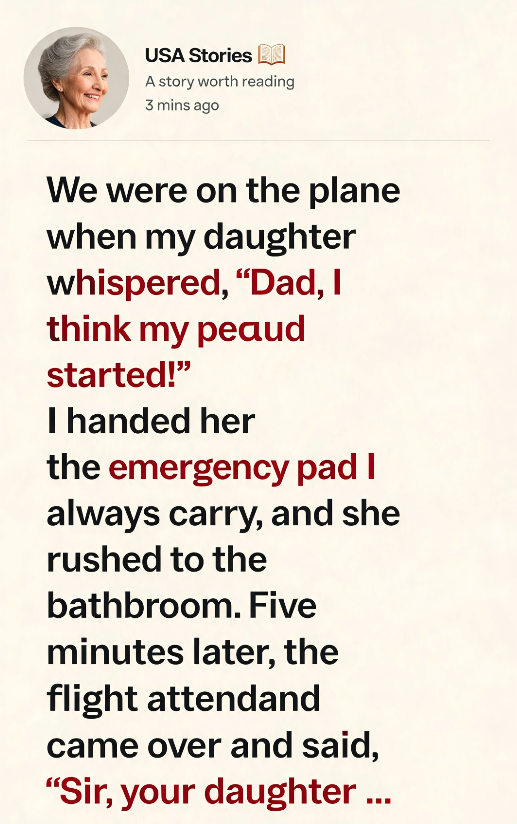
We were on the plane when my daughter whispered, “Dad, I think my period started!”
I handed her the emergency pad I always carry, and she rushed to the bathroom.
Five minutes later, the flight attendant came over and said, “Sir, your daughter…”
Part 2: Why I Always Carry One
My name is David Ellison and I have been a single father since my daughter Maya was four years old.
She is thirteen now.
I want to explain the pad before I explain the rest, because the pad is the part of this story that people always want to understand first, and the explanation is simple enough: when you are a single father raising a daughter, you learn quickly that there are things you need to know and things you need to carry, and the knowing and the carrying are not optional, they are just part of the job.
I started carrying one when Maya was eleven.
Not because I had been told to or because I had read it somewhere, but because I had a conversation with my sister Carol one afternoon where I described my preparedness system for various emergencies — spare granola bar, bandaids, the small sewing kit I kept in my jacket pocket since the button incident at her school concert in 2022 — and Carol had looked at me and said, “Do you carry pads?”
I had not been carrying pads.
I went to the pharmacy the next day.
I bought three different kinds because I did not know which kind was right and I asked the woman stocking the shelf to explain the differences and she explained them with the helpful efficiency of someone who appreciated the question, and I chose the ones she recommended and put one in my jacket’s inside pocket and one in my backpack and one in the small emergency kit I kept in the glovebox of my car, which already contained bandaids and ibuprofen and a emergency poncho and the granola bar.
Maya had never needed them until today.
We were on a flight from Columbus to Portland to visit my brother for Thanksgiving. Window seat for Maya, middle seat for me, aisle seat for a businessman who had put on noise-canceling headphones before we finished boarding and had not removed them since.
Two hours into the flight Maya leaned toward me.
She was thirteen and had developed, over the last year, the self-conscious awareness of her own body that comes with that age — the particular combination of knowing more than she used to and being uncertain about what all of it means. She had been embarrassed about her body in ways she had not been before, which was normal and which I was trying to navigate with the specific, careful attention of a father who understood he was operating in territory where getting it wrong mattered.
She leaned very close and said, very quietly, into my ear: “Dad. I think my period started.”
Her face was the particular combination of alarm and embarrassment that I had been preparing myself to see for two years.
I did not make a face. I did not say anything that would require her to repeat herself or that could be heard by the businessman with the noise-canceling headphones or the woman across the aisle who was reading a paperback.
I reached into my jacket’s inside pocket.
I took out the pad, which I had been carrying for two years against exactly this kind of moment, and I placed it in Maya’s hand under the tray table.
“Bathroom’s at the back,” I said. “Take your time.”
She looked at me.
Just for a second — that flash of surprise that happens when you expect a problem and discover there isn’t one.
Then she unclipped her seatbelt and made her way down the aisle.
I watched her go with the particular feeling of a parent who has just had the chance to be what their child needed them to be in a moment that mattered, which is one of the best feelings available to a human being and one that I did not expect to feel at thirty-eight thousand feet on a Tuesday in November but was grateful for anyway.
She had been in the bathroom for about five minutes when the flight attendant appeared beside my seat.
Her name tag said Claire.
She was perhaps forty, with the practiced calm of someone who has dealt with every possible situation at altitude and approached them all with the same steady professionalism.
She crouched slightly to be at my level.
“Sir,” she said quietly. “Your daughter asked me to give you a message.”
I sat up.
“She wanted me to tell you—” Claire paused, and her expression shifted into something that was no longer professional calm but something warmer and less managed. “She said to tell you, and I’m quoting directly: ‘Tell Dad he’s the best dad in the entire world and I love him and also we need to talk about switching to the kind with wings because apparently that’s a thing.’”
I pressed my lips together.
Claire was smiling now. Fully, unguardedly, the smile of a woman who has been a flight attendant for fifteen years and has collected a library of human moments at altitude and has just added a good one.
“She also said,” Claire continued, “that you’ve been carrying that in your jacket for two years and she didn’t know until today and she wants to know how many other things you’ve been quietly prepared for that she doesn’t know about.”
I thought about the sewing kit. The emergency poncho. The granola bar. The ibuprofen. The list in my phone of every teacher’s email address and every friend’s parent’s phone number and every allergy of every child who had ever come to our house for a sleepover.
“Quite a few things,” I said.
Claire laughed.
It was the kind of laugh that surprised her slightly — the involuntary kind, the kind that happens when something is genuinely funny rather than professionally appropriate.
“She’s going to be a few more minutes,” Claire said. “She’s also asking if we have any chocolate, which — we actually do. It’s not on the menu but we keep it for emergencies.”
“Chocolate counts as an emergency,” I said.
“That’s what I told her,” Claire said.
Part 3: What Maya Said When She Came Back
She came back down the aisle twelve minutes after she had gone.
I had been watching the seat-back screen without watching it, the way you watch something when your attention is elsewhere, thinking about how she had looked when she handed back the pad — that flash of surprise — and about how much of parenthood was exactly that: the quiet preparation for moments you couldn’t predict, the carrying of things the other person didn’t know you were carrying, the hope that when the moment arrived you would have what was needed.
She slid into the window seat.
She was carrying a small packet of airline chocolate that Claire had apparently produced from whatever flight attendants keep in the back for actual emergencies.
She opened the chocolate.
She offered me a piece.
We sat for a moment in the particular comfortable quiet of two people who have just been through something small and real together and are letting it settle.
“Dad,” she said.
“Yeah.”
“How long have you been carrying that?”
“Two years,” I said.
She was quiet.
“Did Aunt Carol tell you to?”
“She asked if I was,” I said. “The answer at the time was no. I corrected it.”
Maya broke off another piece of chocolate and looked at the seat-back screen, which was showing a map of our route — the little airplane icon somewhere over the midwest, the dotted line stretching ahead of us toward Portland.
“What else do you carry?” she asked.
“Bandaids,” I said. “Ibuprofen. A sewing kit. An emergency poncho. A granola bar, though that one gets eaten sometimes and I don’t always replace it immediately.”
“A sewing kit,” she repeated.
“The button incident,” I said.
She turned her head toward me. “That was three years ago.”
“The lesson lasted longer than the incident,” I said.
She almost smiled.
“What else?” she said.
“Your teacher’s email. Your friends’ parents’ numbers. The phone number for the urgent care on Fifth Street and the one on Henderson. Your blood type, which is O positive, which I have in my wallet on a card in case of an emergency where you can’t speak for yourself.”
Maya was quiet.
“My blood type,” she said.
“O positive,” I said. “Universal donor. You’re the good kind.”
She was quiet for a long time.
The businessman in the aisle seat had still not removed his noise-canceling headphones. Outside the window the clouds were thick and white and the afternoon light came through them diffuse and even.
“Dad,” she said.
“Yeah.”
“Mom left when I was four,” she said. “I know you know that. But I’ve been thinking about it more lately. About what it means that it’s been just us.”
I did not say anything. When Maya started sentences like this one, the right response was to let her find where they were going.
“I used to think it was hard,” she said. “Not having a mom. I used to feel like I was missing something everyone else had.”
She broke off another piece of chocolate.
“I don’t feel that way anymore,” she said. “Or I feel it sometimes, but not — not like it means something is wrong with us. More like we just have a different thing. A good different thing.”
She held out the last piece of chocolate.
I took it.
“You’ve been carrying pads in your jacket for two years,” she said. “In case I needed one. And you didn’t tell me because you didn’t want to make it a thing. You just wanted to have it if I needed it.”
“Something like that,” I said.
“That’s the thing I mean,” she said. “That’s what we have.”
I looked at the clouds outside the window and thought about four years old and the look on her face this morning and the sewing kit and the blood type card and the granola bar that got eaten sometimes and the feeling of a thirteen-year-old’s hand taking something from mine under a tray table at thirty-eight thousand feet without needing an explanation.
“I love you, Maya,” I said.
“I love you too, Dad,” she said. “Also I meant it about the wings. Can we please switch to the kind with wings? I feel like that’s important information.”
“We can switch to the kind with wings,” I said.
“Thank you,” she said.
Claire came by twenty minutes later to collect the chocolate wrapper.
She looked at Maya and then at me with the warm, particular expression she had worn when she delivered the message, the expression of someone who has seen enough of humanity at altitude to know a good moment when they’re standing beside one.
“Everything okay?” she asked.
“Everything’s good,” Maya said. “My dad carries my blood type in his wallet.”
Claire looked at me.
“O positive,” I said.
Claire shook her head slowly, with the expression of a woman filing something away in her library of altitude moments.
“You win the flight,” she said.
We landed in Portland at four fifteen.
My brother met us at arrivals with the particular relieved energy of a man who had been cooking for two days and needed an audience for it. He hugged Maya first, which was correct, and then me, and then asked how the flight was.
“Good,” Maya said. “Educational.”
My brother looked at me.
“She’ll explain,” I said.
She did, over dinner, in the slightly dramatic retelling style she had developed over the last year that made everything funnier than it had been in real time. The whisper. The jacket pocket. The flight attendant. The chocolate. The request about wings-style.
My brother listened to the whole thing.
Then he looked at me.
“You’ve been carrying that for two years,” he said.
“Two years,” I confirmed.
He nodded slowly, the way men nod when they are acknowledging something they have no adequate words for and are not going to try to put into words anyway.
“Carol?” he said.
“Carol,” I confirmed.
Maya finished her story and ate her dinner and fell asleep on the couch at eight thirty, the way she slept when she was young and had spent all her energy and simply stopped, completely and immediately, without transition.
I covered her with the blanket from the chair.
My brother and I sat at the kitchen table with coffee.
“She’s going to be alright,” he said. Not a question.
“Yeah,” I said. “She is.”
“You both are,” he said.
Outside the Portland window the rain was doing what Portland rain does, which is fall steadily and without drama, the way things fall when they have been falling for a long time and see no reason to make a performance of it.
I thought about the pad in the inside pocket, which was no longer there, and the one in the backpack, which I would relocate to the jacket when I unpacked tonight, and the one in the glovebox at home, and all the other things I carried and would carry, quietly, against the moments I couldn’t predict, for as long as she needed me to.
Some of the job is visible.
Most of it is in the pockets.
Share this for every single parent who learned to carry what their child would need before their child knew they needed it.