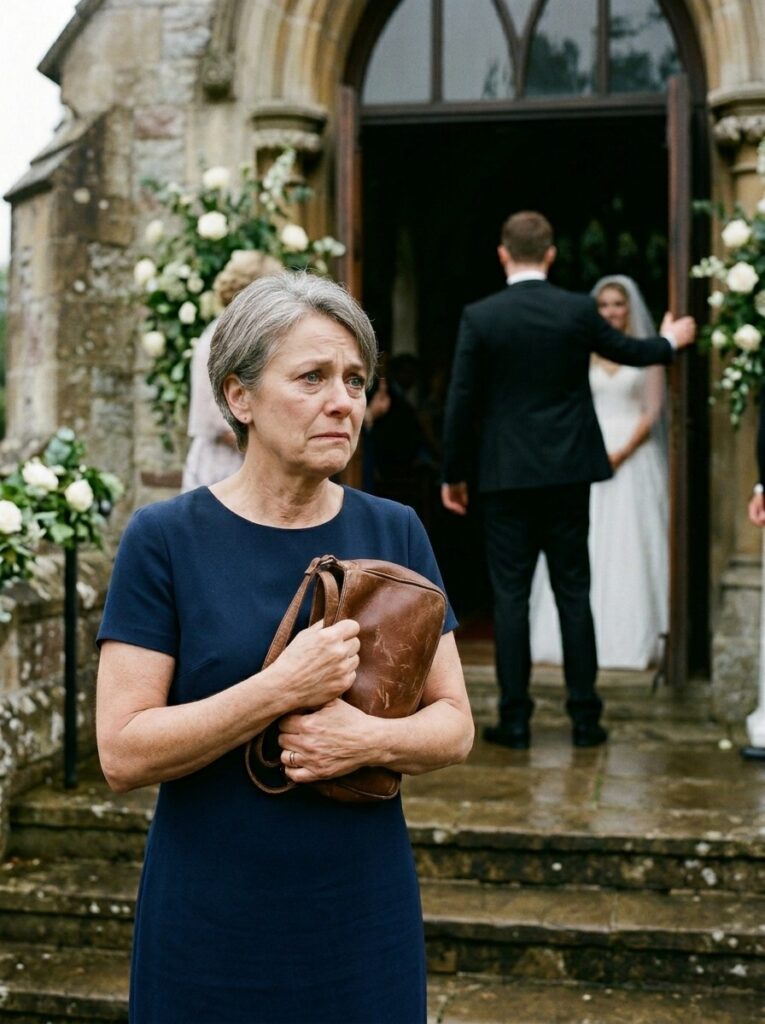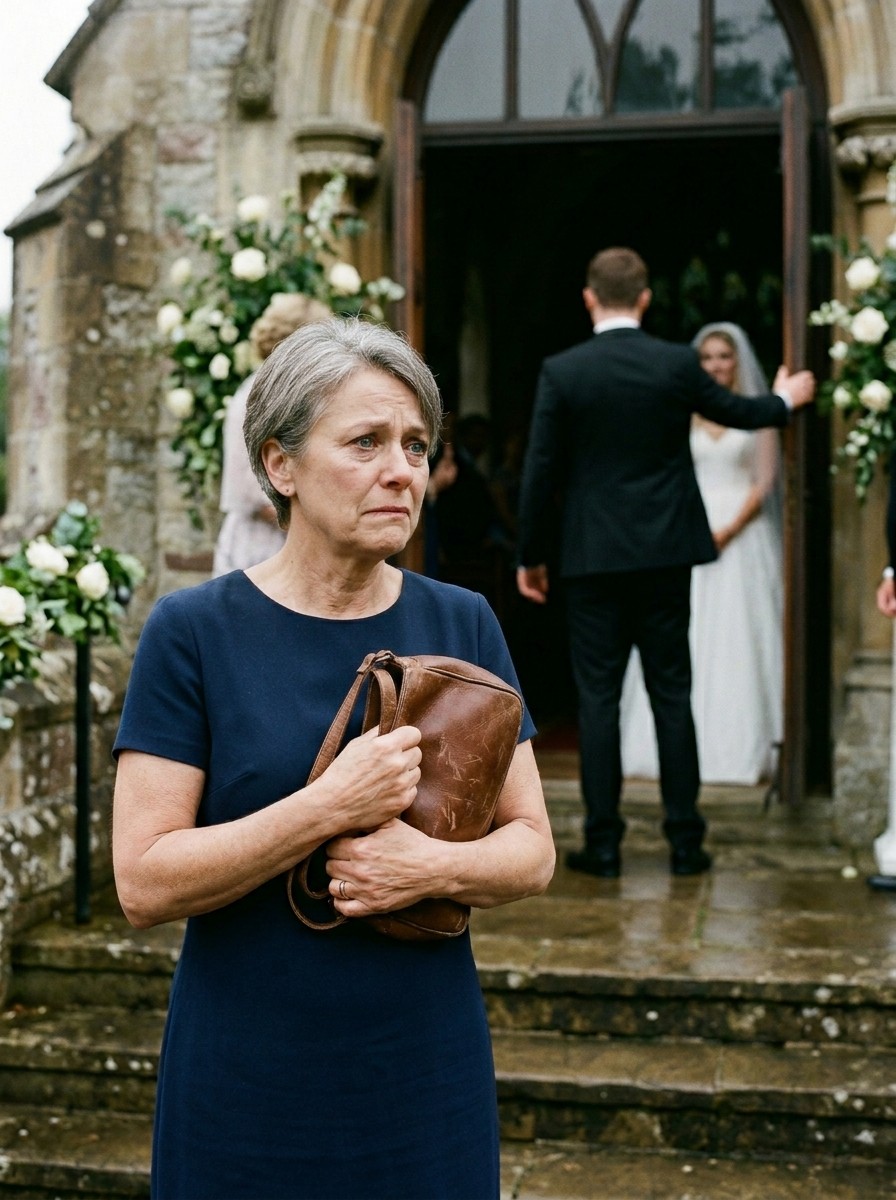
When I arrived at my son’s wedding, he stepped in front of the church entrance and told me, “You weren’t invited, Mom. The family agreed you’re not part of us anymore.” I looked at him quietly, tightened my grip on my purse, and answered softly, “That’s alright, son… but you should probably check your phone.” What nobody inside that church realized was that the truth had already started moving toward them hours earlier.
“You weren’t invited, Mom. The family decided you don’t belong with us anymore.”
My own son said those words to me at the doors of his wedding ceremony, surrounded by white roses, polished guests, and a crowd that suddenly stopped smiling just long enough to stare.
And standing there in my navy dress, holding the worn leather purse my mother once carried, after spending hours preparing for this day, I realized something painful: humiliation leaves scars, but silence can carry something far more dangerous than anger.
The worst part wasn’t Mason refusing to let me inside.
It was how natural the words sounded coming from him.
Like he had practiced them.
Like they no longer hurt him to say.
As if someone else had placed those thoughts inside his mind long before he repeated them out loud.
Inside the church stood Brielle, elegant and flawless in a fitted white gown, wearing the satisfied smile of a woman convinced she had already won.
She looked at me only briefly, but it was enough.
There was no warmth in her eyes.
Only control.
And by then, I understood exactly what that looked like.
Two years earlier, my life had been completely different.
My husband, Lawrence, was still alive, though barely, lying in a hospital room filled with the smell of medicine and final goodbyes. The cancer took him quickly. Too quickly.
Before he passed, he left me with one request and a sealed envelope.
He didn’t ask me to protect the house.
He didn’t ask me to protect the money.
He asked me to protect our son. Even from himself.
A few days later, while sitting across from the family attorney, I finally understood what he meant.
Lawrence hadn’t died bankrupt like most people assumed. He had quietly built an empire over decades: factories, investments, properties, accounts nobody knew existed. Everything had been placed under my supervision until Mason proved mature enough to handle it.
So I stayed quiet.
I kept driving the same car.
Living in the same house.
Following the same ordinary routine.
Then Brielle entered our lives.
Perfect smile. Expensive heels. Sweet voice. Calculating eyes.
The very first time she came into my home, she barely looked at our family photos. She never asked about Lawrence. Instead, she studied the office. The drawers. The paperwork.
Like she wasn’t meeting a family.
Like she was evaluating an opportunity.
After that, everything accelerated.
The engagement happened overnight.
The wedding plans became outrageously expensive.
Phone calls from Mason became shorter.
Sunday dinners disappeared.
And slowly, every request arrived disguised as affection.
First they needed “a little help” paying for wedding expenses.
Then more help.
Then one day I discovered through Instagram that they had already gotten legally married without telling me.
The caption read:
“Celebrating with the people who matter most.”
I stared at that picture on my phone and felt something colder than anger.
I felt erased.
At that point, my son wasn’t accidentally leaving me out anymore.
He was helping someone remove me from his life piece by piece.
And when they finally came back to my house, they didn’t arrive with apologies or flowers.
They brought legal documents.
A lawyer.
A carefully rehearsed conversation “for the baby.”
Brielle rested her hand over a stomach still strangely silent while they pushed papers across my table asking me to transfer ownership of my house to Mason.
That was the moment I understood this story had never really been about love or a wedding.
It was about something much uglier.
I didn’t yell.
I didn’t cry.
I didn’t give them the emotional breakdown they probably expected.
Instead, I started paying attention.
One phone call.
One unfamiliar name.
A gray folder.
A USB drive.
Bit by bit, instinct became evidence. Dates. Financial records. Voice recordings. Contradictions. Pieces that completely shattered the perfect image Brielle had sold to everyone around her.
So by the time Mason blocked me from family events, ignored my birthday, and finally stopped me outside his own wedding, I was no longer standing there as a broken mother begging for acceptance.
I was standing there as a woman who finally understood the truth.
I looked directly into his eyes.
He expected tears.
Excuses.
Humiliation.
Instead, I simply held my purse tighter and said calmly:
“That’s alright, son… but don’t forget to check your phone.”
I didn’t argue after that.
I turned around, walked down the church steps with my head high, and climbed into the waiting car.
Only after the door closed behind me did a single tear finally fall.
Not because I lost.
Because I knew exactly what was about to happen next.
Within minutes, someone inside that church was going to lose control of the entire story.
And for once, it wouldn’t be me.
At exactly 3:10 PM, just as the priest prepared to begin the ceremony, Mason’s phone vibrated inside his jacket pocket.
Once.
Then again.
Then a third time.
He frowned and pulled it out.
On the screen appeared only my name… followed by a single sentence.
“Open the email. Then decide if you still want to say those vows.”
Mason almost put the phone back.
He almost ignored it.
Brielle touched his arm.
“Baby, leave it. She’s just trying to ruin our day.”
But something about the way I had spoken at the door stuck with him.
Not the words.
The calm.
He had never heard me that calm.
Not when Lawrence died.
Not when they brought the lawyer to my kitchen table.
Not once.
That calm scared him more than any tears ever could have.
He opened the email.
Inside were three attachments.
The first was a background report.
Brielle’s real name was not Brielle Ashford.
It was Bridget Ann Calloway.
She had been married twice before.
The first husband was a retired dentist in Scottsdale. She left the marriage with his vacation home and two investment accounts. The divorce was settled quietly.
The second husband was a widowed contractor in Charlotte. She left that marriage with his late wife’s life insurance payout and a commercial property she had convinced him to put in her name three months before filing.
Both marriages lasted under two years.
Both men had recently lost someone close to them.
Both men described the same pattern in their depositions: isolation from family, financial pressure disguised as partnership, emotional manipulation dressed up as devotion.
Mason was husband number three.
A grieving son.
A fresh inheritance he didn’t know about.
A mother who looked easy to remove.
Brielle had not found Mason by accident.
She had found him by design.
The second attachment was a recording.
Forty-seven seconds long.
Brielle’s voice.
Clear as glass.
She was on the phone with someone. A woman. The name on the call log was “Diane C.” — the same Diane who had introduced Brielle to Mason at a charity fundraiser eighteen months earlier.
“He still thinks his mother is broke,” Brielle said on the recording. “Once I get the house transferred, I’ll push for the rest. The old woman won’t fight it. She’s too tired. And Mason does whatever I tell him now.”
A pause.
Then laughter.
“Girl, this one’s easier than the last two.”
Mason stood at the altar holding his phone.
Two hundred guests watched him.
The organist had stopped playing.
The priest waited with his hands folded.
And Brielle stood three feet away, watching the color drain from her groom’s face the way water drains from a cracked glass.
Slowly.
Then all at once.
“What is it?” she asked.
Mason didn’t answer.
He played the recording out loud.
He didn’t mean to.
His hands were shaking so badly he hit the speaker icon by mistake.
Brielle’s own voice echoed through the church.
“He still thinks his mother is broke.”
Two hundred guests heard every word.
“The old woman won’t fight it.”
Brielle lunged for the phone.
Mason pulled it away.
“Mason, that’s taken out of context—”
“Out of context?”
His voice broke.
“You told someone I do whatever you say.”
“I was joking—”
“You’ve been married twice before. You never told me.”
The church went completely silent.
Not the kind of silence that comes before applause.
The kind that comes before something collapses.
“Two husbands,” Mason continued. “Both widowers. Both lost everything.”
He looked at her.
“That’s not a coincidence, Brielle. That’s a pattern.”
She reached for his hand.
He stepped back.
The same way I had watched him step away from me for two years.
The same motion.
But this time, he wasn’t stepping away from his mother.
He was stepping away from the person who had taught him to.
“Is the baby even real?” he asked.
The room inhaled.
Brielle’s hand moved to her stomach.
“Of course it’s real. How could you ask me that?”
Mason opened the third attachment.
A medical record.
Obtained legally through a court-ordered disclosure request filed by the family attorney four weeks earlier, after I had provided enough preliminary evidence to justify it.
The record showed that Brielle had visited a fertility clinic eight months earlier.
Not for prenatal care.
For a consultation about her inability to conceive.
The doctor’s notes were clear.
There was no pregnancy.
There had never been a pregnancy.
The baby she had used to push legal documents across my kitchen table did not exist.
Mason read the document.
Then he read it again.
Then he set his phone on the altar the way a man sets down something he no longer recognizes.
“There’s no baby,” he said.
He wasn’t asking.
Brielle’s mask cracked.
Not slowly this time.
All at once.
“Mason, listen to me—”
“You told me my mother was toxic. You told me she was trying to control me. You told me she didn’t deserve to be at our wedding.”
His voice dropped to a whisper.
“And the whole time, she was the only person telling me the truth.”
Brielle grabbed his arm.
“Everything I did was for us—”
“No,” Mason said. “Everything you did was for you. And I helped you do it.”
He pulled his arm free.
He turned to the guests.
He looked at his uncle, his cousins, the friends who had nodded along when Brielle suggested his mother was unwell.
“I need to leave,” he said.
No one stopped him.
He walked down the aisle.
Past the white roses.
Past the polished guests.
Past the priest who closed his Bible without a word.
And out the same church doors where he had told his mother she didn’t belong.
He found me sitting in the car.
I was still parked across the street.
I hadn’t left.
I couldn’t.
Because no matter what my son had said to me at those doors, he was still my son.
And a mother doesn’t drive away while her child is standing inside a fire, even if he’s the one who lit the match.
He knocked on the window.
I rolled it down.
His face was wet.
His bow tie was loose.
His hands were trembling.
“Mom.”
That was all he said.
One word.
The same word he had been saying since before he could walk.
But it sounded different now.
Heavier.
Like it carried every phone call he never made, every Sunday dinner he skipped, every birthday he ignored, and every lie he believed about the woman who would have walked through fire for him.
“Mom, I’m sorry.”
I looked at him for a long time.
I wanted to say it was fine.
I wanted to say I forgave him.
I wanted to open the door and hold him the way I held him when he was small enough to fit in my arms.
But I couldn’t.
Not yet.
Because forgiveness and trust are not the same thing.
And I had learned the difference the hard way.
“Get in the car, Mason.”
He walked around and sat in the passenger seat.
We sat in silence for a long time.
Then I reached into the worn leather purse my mother once carried.
I pulled out a sealed envelope.
The same envelope Lawrence had given me before he died.
I had never opened it.
Lawrence told me I would know when it was time.
I handed it to Mason.
“Your father left this for you. He asked me to give it to you when you were ready.”
Mason looked at the envelope.
His father’s handwriting on the front.
His own name.
He opened it slowly.
Inside was a single handwritten letter.
“Mason. If you’re reading this, it means your mother decided you were ready. She is the only person I trust to make that decision. Whatever happened between you, whatever distance grew, I need you to understand something I spent my whole life learning. The people who love you the most are the ones who will let you walk away and still be standing there when you come back. Your mother is that person. She will always be that person. I built everything I have so she could protect you. Not from the world. From the version of yourself that forgets where you came from. Don’t be that version, son. Come home.”
Mason folded the letter.
He pressed it against his chest.
And he cried the way grown men cry when they finally understand how much they’ve wasted.
Silently.
Completely.
Without trying to stop it.
I placed my hand on top of his.
I didn’t say anything.
Some things don’t need words.
They just need someone who never left.
The aftermath unfolded over several months.
Brielle’s real identity became public record during the annulment proceedings.
The legal marriage they had signed months before the church ceremony was dissolved.
Bridget Ann Calloway left town within weeks.
No forwarding address.
No social media.
No apology.
She moved the way people move when they’ve been doing it their whole lives.
Quietly. Quickly. Already looking for the next door to walk through.
Her first ex-husband reached out to me.
Then her second.
Both said the same thing.
“I wish someone had warned me.”
I told them both the truth.
“Someone probably tried. You just weren’t ready to hear it.”
Mason moved back home.
Not into the house.
Into the guest cottage behind it.
He said he needed to earn his way back before he slept under the same roof.
I didn’t argue.
Because he was right.
The first week, he barely spoke.
He sat on the porch in the evenings and stared at the yard the way people do when they’re trying to remember who they used to be.
The second week, he asked if he could help me with the garden.
Lawrence had planted that garden twenty years ago.
Tomatoes. Herbs. A row of sunflowers along the back fence that grew taller every summer.
I had kept it alive by myself for two years.
Now Mason knelt in the dirt beside me, pulling weeds, not saying much.
Just being there.
It was enough.
On a Sunday morning three months later, Mason walked into the kitchen while I was making coffee.
He placed something on the counter.
A small picture frame.
Inside was a photograph of Lawrence, Mason, and me.
Taken at Mason’s high school graduation.
Lawrence’s arm around both of us.
All three of us smiling.
“I found it in a box Brielle told me to throw away,” Mason said. “I didn’t throw it away. I hid it in my car. Under the spare tire.”
He looked at me.
“Even when I was saying all those things, Mom, I couldn’t throw that picture away.”
I picked up the frame.
I ran my thumb across the glass.
Lawrence’s face looked the same way it always did.
Steady. Patient. Like a man who knew the truth would take its time but trusted it to arrive.
“He always said you’d come back,” I whispered.
“How did he know?”
“Because he knew you. Even the parts of you that got lost for a while.”
Mason placed the frame on the kitchen windowsill where the morning light would catch it.
It has stayed there ever since.
I eventually told Mason about the inheritance.
Not all at once.
Slowly.
Over dinners and long drives and conversations that lasted past midnight.
He didn’t react the way I feared.
He didn’t ask for control.
He didn’t ask for access.
He asked one question.
“Did Dad really trust you with all of it?”
“Every dollar.”
“Then so do I.”
That was the moment I knew my son had come home.
Not to the house.
To himself.
Last Sunday, Mason brought flowers.
Not for any occasion.
Just because.
He set them on the kitchen table and sat down across from me.
“Mom, I need to say something.”
“Okay.”
“At the church that day. When I told you that you weren’t part of the family anymore.”
He stopped.
His jaw tightened.
“I practiced that sentence in the mirror the night before. Brielle wrote it for me. She made me rehearse it three times.”
He looked at me.
“And I said it to you like it was nothing. Like you were nothing.”
“Mason—”
“Let me finish. I said those words to the woman who sat next to Dad’s hospital bed for nine weeks without sleeping. The woman who kept his garden alive. The woman who never once told me what she was protecting me from because she wanted me to figure it out on my own.”
He pressed his hands flat on the table.
“I will spend the rest of my life earning that back.”
I reached across the table and placed my hand over his.
“You already started.”
He exhaled.
“When?”
“The moment you knocked on the car window.”
People think a mother’s strength is in what she does when her child is in danger.
It isn’t.
A mother’s strength is in what she doesn’t do.
She doesn’t open the envelope too early.
She doesn’t force the truth before it’s ready.
She doesn’t chase her son into a burning building when she knows the fire has to burn itself out first.
She stands outside.
She waits.
And when he walks out covered in ash, she opens the car door.
If someone is slowly pulling your child away from you — through charm, through manipulation, through carefully placed lies — do not panic.
Do not scream.
Do not give them the breakdown they are counting on.
Pay attention.
Collect the truth.
And wait.
Because the truth does not need volume.
It needs timing.
And a mother who refuses to disappear.
I turned off the kitchen light, placed my hand on the picture frame sitting in the windowsill, and felt the last bit of sunlight warming the glass.
Lawrence was smiling in that photograph.
Like he always knew this story would end here.
With his son back in the garden.
His wife at the kitchen table.
And the sealed envelope finally empty.
Some promises take years to keep.
This one took exactly as long as it needed to.