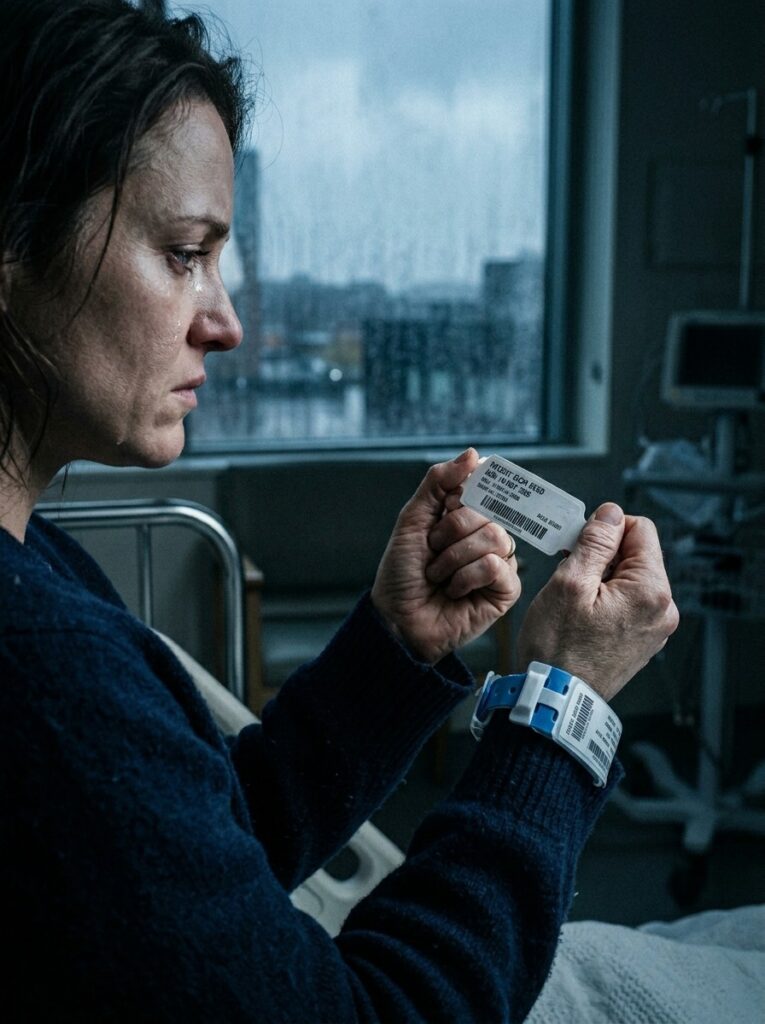
My mother called me from a stranger’s phone, crying. She said she was fine. She said she had just fallen. But the woman beside her at the hospital leaned close and whispered, “Ask her who she was with before she fell.” I drove four hours and arrived to find something I can never unsee.
My mother’s name lit up my phone at 11:22 on a Tuesday night.
Except it wasn’t her number.
Unknown caller. Her voice.
“Sweetheart, don’t worry,” she said immediately, which is what people say when they want you to worry but not too fast. “I had a little fall. I’m at Mercy General. Everything is fine.”
I was already standing up.
“Mom. What happened?”
“I just slipped. You know how I am. Clumsy.”
My mother is not clumsy. My mother is the woman who walked through ice storms to get to her nursing shifts for thirty-one years without ever falling once.
“I’m coming,” I said.
“Don’t be silly. It’s late and you’re four hours away—”
A pause on her end. Then a different voice. Female. Soft and careful.
“Hi. I’m sorry to interrupt. I’m a social worker here at Mercy General. Your mother is resting comfortably. But before you make any decisions about coming, I wanted to mention something.”
“What is it?”
A beat of silence.
“Can you ask your mother who she was with tonight? Before she came in.”
Something cold moved through me.
“Mom,” I said carefully. “Who were you with tonight?”
My mother’s answer came a half-second too fast.
“Nobody. I was home alone.”
I looked at the clock. 11:24 p.m.
My mother had told me last Sunday that she was going to dinner on Tuesday with her neighbor, Frank.
Frank, who had been her “friend” for two years.
Frank, who I had never met because every time I asked, she changed the subject.
Frank, whose last name I did not know.
I drove four hours in the rain.
When I walked into her room at 3:40 a.m., she was awake, her right arm in a temporary brace, a cut above her eyebrow closed with three small strips.
She looked relieved to see me.
She also looked afraid.
Not of me.
Of what I might find out.
The social worker was waiting outside the room. She handed me a small card with a name and a number written on it.
“This is who brought her in,” she said quietly. “He left before we could ask him to stay.”
I looked at the name.
Then I looked through the window at my mother, who was watching me with the expression of a woman holding a secret she had carried for a very long time.
“Ask her who she was with before she fell.”
The social worker’s card had one name on it.
Frank Dunn. No relationship listed. No number. Just the name in careful handwriting, like something that needed to be handled gently.
I sat beside my mother’s hospital bed and looked at the card and then looked at her. The brace on her arm. The three small strips above her eyebrow. The way she was watching the window instead of me.
“Frank Dunn,” I said.
She said nothing.
“Mom.”
“He’s a friend,” she said. Still looking at the window.
“He brought you to the hospital and left before anyone could speak to him.” I kept my voice even. “The social worker told me to ask who you were with. She said it specifically. That is not something social workers say when someone has simply fallen.”
My mother’s jaw tightened.
“I’m sixty-three years old,” she said. “I am allowed a private life.”
“You are,” I said. “You absolutely are. And I am not here to take that from you or to make you feel foolish or to have the kind of conversation where I treat you like a child.” I leaned forward. “I’m here because you’re in a hospital room at four in the morning and the man who brought you here left before anyone could ask him what happened. And the social worker outside that door looked at me the way people look when they are trying to protect someone.”
My mother turned from the window.
Her face, in the thin hospital light, looked very tired. Not the tiredness of a late night. The tiredness of carrying something heavy for longer than she should have.
“This was the third time,” she said. Quietly. Like a confession she had been holding in her chest for months.
I held completely still.
Because I knew that if I moved, if I made a sound, if I did anything that felt like reaction, she might take it back. Might fold it up and put it away again where I couldn’t reach it.
She told me about Frank. Slowly. The way you tell things you have rehearsed not telling.
He had come into her life through a neighbor, a mutual introduction at a dinner party two years ago. He was funny and attentive and made her feel, for the first time since my father died, like someone was paying attention to her specifically. Not to her role as mother or grandmother or the reliable one at the church potluck. To her.
And then the attention changed shape.
It happened slowly enough that she told herself each time it was the last time. That he was under stress. That she had said the wrong thing. That the right adjustment from her would fix it.
“I didn’t want you to look at me differently,” she said.
“Mom,” I said.
“I know what you’re going to say.”
“I don’t think you do,” I said. “Because what I’m going to say is that you raised me to walk toward hard things. You drove me to school on the morning after Dad’s accident when you had been awake for thirty hours and you were barely holding together, and you walked me to my classroom door, and you came back and picked me up in the afternoon, and you did all of that because you believed that ordinary life going on was the only answer to the worst things.”
She looked at me.
“You walked toward every hard thing in my life,” I said. “I’m just returning the favor.”
She reached out and took my hand. Her fingers were cold from the hospital air. I held them and didn’t say anything else for a while because sometimes the most important thing you can offer is just staying in the room.
The social worker came back in with a folder and a gentle face and we spent two hours making a plan that had real teeth in it.
Frank Dunn received a formal protection order.
My mother came home with me for three weeks, which she complained about every single day — the guest room was too quiet, my cooking was too cautious, the neighborhood was too suburban — and I believe she needed every one of those days.
She was angry at first. At the situation, at herself most of all, at me a little for being the witness to something she would have preferred to handle alone. Then she was sad in the deep, specific way of losing something you knew wasn’t good for you but had still believed in.
Then she was something quieter and more solid.
She moved to a new apartment the following spring. Four miles from my house. A place with a small balcony where she grows basil and mint in terracotta pots and drinks her coffee in the morning watching the street below.
She joined a book club. She started a ceramics class. She calls me on Sunday evenings and talks about both of these things with the particular enthusiasm of someone who has recently discovered that their own life, organized on their own terms, is actually quite interesting.
She told me last year that she is happier now than she has been in a very long time.
I believe her completely.
She was always better at walking toward hard things than she knew.