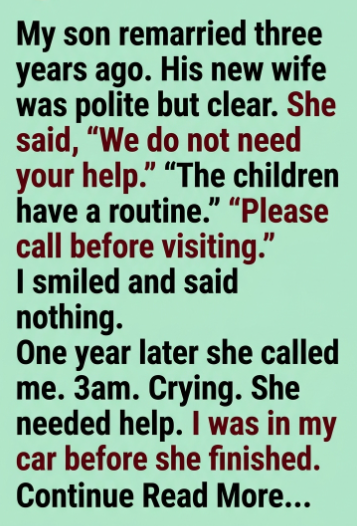
My son Daniel remarried two years after his first wife passed. Her name was Kristin — a competent, organized woman who had raised her two children from a previous relationship with precision and clearly defined systems. She came into this new family with understandable caution about how much outside involvement she wanted.
She was never unkind to me. She was polite, consistent, and she set her boundaries early and clearly — something I can respect even when it hurts.
About three months into her marriage to my son, she sat me down for a gentle but firm conversation. She said she appreciated my desire to be involved, but that the children had routines that worked, and she preferred I call ahead rather than stop by. She said they didn’t need help — they had things handled.
I smiled. I said I completely understood.
Then I went home and cried for an hour.
My daughter told me to give it time. So I gave it time. I called before visiting. I stayed a reasonable amount of time. I brought things without being asked and left without being invited to stay longer. I was patient in the way that requires daily effort and produces no visible result for months.
One year and three months after that conversation, my phone rang at 3am.
It was Kristin.
She was crying — not the quiet kind, the real kind — and her words were coming out in fragments. Daniel was at the hospital. Something with his heart. Not critical, but serious enough that he’d been taken by ambulance. She had two children asleep in the house, no one nearby, and she couldn’t leave them and couldn’t think clearly.
I was in my car before she finished the sentence.
I want to be precise about that. I was in my car, keys in hand, before she had finished saying what she needed.
I live twenty-two minutes from their house. I arrived in nineteen.
She Was Standing at the Door
I could see from her face that she had been holding it together through sheer effort for the past hour, and that she was very close to the edge of that effort.
I took the children. I settled them. Both were half-awake and frightened, and I sat between their beds and talked quietly and calmly about their stepfather and hospitals and the completely ordinary nature of medical situations until both of them went back to sleep.
Then I went downstairs, made tea, and sat with Kristin while she called the hospital again for an update. And again twenty minutes after that.
Daniel had a cardiac event — manageable, not catastrophic. He would need monitoring, medication adjustment, some lifestyle changes, and rest. He came home four days later.
During those four days, I was at their house every morning. I took the children to school. I made dinners that were waiting when Kristin came home from the hospital. I did laundry and groceries and the hundred small tasks that stop for no one, regardless of what else is happening.
I didn’t ask. I just did them.
Kristin didn’t tell me to call ahead once.
“I Owe You an Apology”
About two weeks after Daniel came home, once things had settled into a new and calmer routine, Kristin knocked on the door of the guest room where I was folding clothes.
She stood in the doorway.
“I owe you an apology,” she said.
“You don’t,” I told her.
“I told you we didn’t need help. I was wrong. I was scared of what needing help would mean. About control. About what it said about me if I couldn’t manage everything myself.”
She said, “You came anyway. You didn’t say I told you so. You just — came.”
“That’s what mothers do,” I said.
She looked at me for a long moment.
“I didn’t have that,” she said. “My mother wasn’t able to do that for me.”
And that’s when I understood why the walls had been so high. They had never been about me at all.
“You have it now,” I said. “If you want it.”
She nodded.
One Year Later
I don’t have a perfect relationship with my daughter-in-law.
I have an honest one.
Which is better.
She still texts before visiting sometimes — old habits — but she also calls just to talk now. Last week she asked me how to make my mother’s rolls for Thanksgiving, because she said she wants the kids to grow up with some traditions that feel like they’ve always belonged to them.
I taught her. Flour on both our hands, standing at the same counter she once asked me to stay away from.
Some walls aren’t built to keep you out forever.
Sometimes they’re just built by someone who’s never had a reason to believe they could come down.
Want me to add:
- A short intro/hook paragraph before the title (for SEO and scroll-stop on the website)?
- A pull-quote box version for WordPress (some themes support styled quote blocks)?
- Meta description + suggested title tags for search?
Also — since this one’s already at 78K on the reel, want me to check which of your other stories have similar “quiet reconciliation” hooks so you can queue up the next viral candidate while this one’s still hot?
could you make it longer version keep them read 15 min in website?
Got it — a true 15-minute read keeps them on-page longer (great for ad revenue and SEO dwell time). Here’s the full expanded version, built out with more scenes, dialogue, and reflection throughout.
My Daughter-in-Law Told Me She Didn’t Need My Help. Then She Called Me at 3AM, and Everything I Thought I Knew About Her Changed.
There is a particular kind of loneliness that nobody warns you about when you become a mother-in-law for the second time.
I had done this before — once, decades ago, with Daniel’s first wife, a warm, easy woman named Patricia who had welcomed me into her kitchen from the very first Thanksgiving. Patricia used to call me just to talk about nothing. She’d ask my opinion on paint colors. She’d send me photos of the grandchildren doing ordinary things — brushing their teeth, refusing to eat broccoli — because she knew those small moments were the ones I wanted most.
Patricia passed away when the children were young. Cancer, slow and then suddenly fast, the way it sometimes is. I grieved her as if she’d been my own daughter, because in every way that mattered, she had become one.
Two years later, my son remarried.
A Different Kind of Woman
Kristin was nothing like Patricia, and I want to say clearly, before anything else in this story, that this is not a criticism. She was competent. She was organized. She had raised two children largely on her own after a difficult divorce, and she had done it with the kind of precision that comes from necessity — meal plans on the refrigerator, homework schedules taped inside kitchen cabinets, bedtimes that did not move for holidays or houseguests or anything at all.
I understood, on some level, that a woman who has had to hold everything together alone develops systems. Those systems are not coldness. They are survival.
But understanding something intellectually and feeling it comfortably in your chest are two very different things, and for the first year of Kristin’s marriage to my son, I felt the difference every single day.
She was never rude to me. I want to be fair here, because fairness matters more to me now than it ever has. She was polite. She said please and thank you. She remembered my birthday. She simply did not want me involved in the daily texture of her household, and she told me so directly, in a conversation I have replayed in my mind more times than I can count.
The Conversation
It happened about three months into the marriage, on a Tuesday afternoon. I remember it was a Tuesday because I had brought over a casserole — nothing fancy, just something I thought the children might enjoy after school, the same chicken and rice dish I used to make for Daniel when he was young and playing baseball three nights a week.
Kristin met me at the door instead of letting me in.
She was gracious about it. She thanked me for thinking of them. And then she said, in the careful, rehearsed tone of someone who had clearly practiced this conversation in the mirror, “I want to talk to you about something, if that’s okay.”
I said of course.
She said, “I really do appreciate how much you want to be involved with the kids. I can see how much you love them, and I know that matters. But we’ve worked hard to build a routine that works for our family, and when things change unexpectedly — even good things, like a surprise visit — it throws the kids off. They do better with consistency.”
I nodded. I was still holding the casserole.
“So I’d really appreciate it,” she continued, “if you could call before coming by. And maybe we can set up a regular time each week instead — something predictable for everyone.”
I said that sounded reasonable.
She said, “We do not need your help, exactly. But we’d love your company, on our terms, if that makes sense.”
We do not need your help.
Four words. She probably doesn’t remember saying them exactly that way. People rarely remember the precise wording of the sentences that wound someone else — only the ones aimed at them. But I remember every syllable, because I stood on that porch holding a casserole dish that was slowly getting heavier in my hands, and I felt something in my chest quietly close.
I smiled. I said I completely understood.
I drove home with the casserole still in the passenger seat, untouched, and I cried in my driveway for the better part of an hour before I could make myself go inside.
Learning to Wait
My daughter, Daniel’s sister, called me that evening. I told her what happened, expecting sympathy, and instead she gave me something more useful.
“Mom,” she said, “give it time. She’s not doing this because she’s cruel. She’s doing this because she’s scared.”
“Scared of what?” I asked. “I’m not dangerous. I just want to bring casseroles.”
“Scared of losing control of the one thing she’s finally gotten steady,” my daughter said. “Think about what her life looked like before Daniel. She held everything together by herself for years. That kind of control isn’t about you. It’s about her surviving something you don’t fully know the shape of.”
I didn’t fully believe her at the time. I was too hurt to believe much of anything except that I had been quietly, politely, permanently pushed to the margins of my own son’s family.
But I decided to try.
For the following year, I called before visiting. Every single time. I never let myself show up unannounced, not even on a birthday, not even when I desperately wanted to. I brought things without being asked — books for the children, a small gift here and there — and I left without lingering, without asking to stay for dinner, without doing any of the things a grandmother instinctively wants to do.
I want to be honest: it was one of the harder disciplines of my adult life. Every visit felt like walking on a floor I wasn’t sure would hold my weight. Every phone call before arriving felt like asking permission to love my own grandchildren.
But I did it. Week after week. Month after month. Because my daughter was right about one thing, even if I couldn’t see the whole picture yet — Kristin’s walls had nothing to do with whether I deserved to be let in. They had to do with something in her own history that I hadn’t been shown yet.
The Ordinary Rhythm of a Year
I want to slow down here, because the year between that conversation on the porch and the phone call at 3am was not simply a waiting room. It was, in its own quiet way, a kind of relationship — thin, careful, but real.
I learned Kristin’s patterns. I learned that Tuesdays were hardest for her, because that was the day both children had after-school activities that overlapped and she had to be in two places nearly at once. I started, without asking, showing up on Tuesdays specifically — always calling first, always asking if it would help rather than assuming it would — to take one child to soccer while she took the other to piano.
At first she accepted this stiffly, almost reluctantly, the way you accept help you’re not sure you trust yet.
By month eight, she had started texting me on Monday nights to ask if Tuesday still worked.
By month eleven, she had started, very occasionally, asking my opinion on small things — what I thought about a particular parenting book, whether I remembered how Daniel had handled a growth spurt at that age, whether I had a recipe for something the kids had eaten at my house and wouldn’t stop talking about.
I want to be careful not to make this sound like a fairy tale unfolding exactly on schedule. It wasn’t smooth. There were weeks she went quiet again, weeks the old formality crept back in, weeks I called to check in and got polite, brief answers that told me nothing had really changed.
But underneath the unevenness, something was slowly, almost imperceptibly, shifting.
The Night Everything Changed
The phone rang at three in the morning on a Thursday in March.
I want to describe what it feels like to wake to a phone ringing at that hour when you’re a parent, because I don’t think it ever fully leaves you, no matter how old your children get. Your body understands before your mind does. I was sitting upright before I had even registered the sound consciously, my heart already pounding, my hand already reaching.
It was Kristin.
Her voice did not sound like the composed, organized woman who managed spreadsheets of school pickup schedules. It sounded like someone standing at the edge of something she couldn’t control, and it took me a moment to even understand the words coming through the fragments of her crying.
“Daniel — ambulance — his heart — I don’t know what — the kids are asleep and I can’t leave them and I don’t know who else—”
I did not let her finish the sentence.
I said, “I’m coming. I’m in the car right now.”
I want to be honest about what “right now” meant. I was in my car, in pajamas, with my coat thrown over them and my car keys already in my hand, within perhaps ninety seconds of hanging up the phone. I live twenty-two minutes from their house under normal conditions. That night, I made it in nineteen.
What I Found When I Arrived
Kristin was standing at the door when I pulled into the driveway, and I will never forget her face in that porch light. This was a woman who prided herself on holding everything together, who had built an entire architecture of routines and systems specifically so that she would never again be the person standing helplessly at a door waiting for someone else to arrive and save the situation.
And there she was, doing exactly that.
I could see, immediately, that she had been holding herself upright through sheer force of will, and that the sight of my headlights in the driveway had nearly let something in her give way.
I did not ask questions first. I went straight past her into the house and up the stairs, because I could hear, faintly, one of the children stirring, and I knew — the way you know these things after raising your own children through fevers and nightmares and every other 3am emergency — that the most urgent task in that moment was not information. It was calm.
I sat between the two beds. Both children were half-awake, frightened by the sound of an ambulance and their mother’s voice cracking through the house. I did not tell them everything was fine, because I don’t believe in lying to children about things they can sense are serious. I told them their stepfather’s heart needed some help tonight, that doctors were very good at helping hearts, and that the very best thing they could do to help him was to get some sleep so they’d have energy to visit him tomorrow.
It took perhaps forty minutes. I sang, quietly, the way I used to sing to Daniel when he was small — nothing fancy, just an old, half-remembered lullaby my own mother used to hum. Eventually both children slept.
I went downstairs and found Kristin sitting at the kitchen table, phone in hand, staring at nothing.
I made tea. I didn’t ask if she wanted it. I simply made two cups, the way you do for someone who is past the point of being able to answer small questions, and I set one in front of her.
The Four Days That Followed
Daniel had experienced what the doctors called a cardiac event — serious, frightening, but ultimately survivable and, with the right care, manageable. He would need monitoring. Medication. Some significant lifestyle adjustments. Rest, real rest, the kind a busy working father of two rarely gives himself permission to take.
He came home four days later.
I was at their house every single one of those mornings. I did not ask permission this time, and Kristin did not ask me to call ahead. Something between us had shifted in the space of a single terrifying night — not fully, not completely, but enough.
I took the children to school. I made dinners that were waiting on the counter when Kristin came home exhausted from the hospital. I did laundry that had piled up because no one had the bandwidth to think about laundry. I went to the grocery store and bought the specific brand of crackers the younger child insisted on, because I had learned, over the past year of careful, permitted visits, exactly which small things mattered to this family.
I didn’t ask. I just did them.
And Kristin — this woman who, thirteen months earlier, had stood on her porch and told me, gently but unmistakably, that she did not need my help — did not once ask me to call before coming over during those four days. She simply let me in, again and again, at whatever hour I arrived, without comment.
The Conversation in the Guest Room
About two weeks after Daniel came home, once the household had settled into a new, quieter rhythm — medication schedules taped to the refrigerator now alongside the old carpool schedules, a slower pace to everyone’s mornings — I was in the guest room folding a basket of the children’s laundry when I heard a soft knock on the doorframe.
Kristin stood there, arms crossed loosely, the way people stand when they’re bracing themselves to say something they’ve been rehearsing.
“I owe you an apology,” she said.
I set down the shirt I was folding. “You don’t,” I told her, and I meant it.
“I told you we didn’t need help,” she said. “I was wrong. I think I knew I was wrong, even then, but I couldn’t let myself admit it.”
I waited. I had learned, over the past year, that Kristin needed space to arrive at her own sentences without being rushed toward them.
“I was scared of what needing help would mean,” she continued. “About what it would say about me if I couldn’t manage everything on my own. My whole identity, for years, was built around being the person who didn’t need anyone. Because the one time I really needed someone—”
She stopped there. I did not push.
She tried again. “My mother wasn’t able to do that for me. Be there. Show up without being asked. When I was drowning — really drowning, after my first marriage ended — I called her, and she told me she was busy, and I learned very quickly not to call again. I built my whole life after that around never being in a position where I needed to call anyone.”
I felt something in my own chest loosen, hearing this. Not triumph — nothing like that. Something closer to grief, actually, grief for the young woman Kristin had once been, standing at the edge of her own crisis with no one answering the phone.
“You came anyway,” she said. “That night. You didn’t say I told you so. You didn’t remind me of anything I’d said a year ago. You just — came.”
“That’s what mothers do,” I said, and I meant it as simply and completely as I have ever meant anything.
She looked at me for a long moment, and something in her face was different than it had been in any of our polite, careful, appointment-scheduled visits over the previous year.
“I didn’t have that,” she said quietly. “Not the way you just gave it to me. I didn’t know it was possible to just — receive help like that. Without it costing something.”
“You have it now,” I told her. “If you want it.”
She nodded, and though she didn’t cry — Kristin is not, even now, someone who cries easily in front of others — I could see it costing her something to hold still and let that moment exist between us instead of retreating back into the safety of routine and distance.
What Changed, and What Didn’t
I want to be honest about the year that followed, because I don’t think this story is well served by pretending everything transformed instantly and completely. That is not how real relationships heal.
Kristin still, sometimes, texts before visiting. Old patterns have deep roots, and thirteen months of careful distance do not erase overnight. There are still days she reverts to formality, still moments I can feel the old caution rising up in her like a reflex.
But there are also new things now that simply did not exist before that night.
She calls me sometimes just to talk — not to schedule anything, not because she needs something specific, but because, I think, she is slowly discovering what it feels like to have a mother figure in her life who will actually pick up the phone.
Last month, she called to ask how to make my mother’s dinner rolls — the ones the children had apparently been asking about since Thanksgiving at my house the previous year. She said, a little shyly, that she wanted the kids to grow up with some traditions that felt like they had always belonged to them, not things she’d had to build from nothing the way she’d had to build everything else in her life.
I taught her, standing at the same kitchen counter in her own house where, a little over a year earlier, she had asked me to please call before visiting. Flour on both our hands. The children underfoot, stealing bits of raw dough when they thought we weren’t looking.
At one point, Daniel walked in — fully recovered now, careful with his new medications, gentler with himself in ways his heart scare had taught him he needed to be — and stood in the doorway watching the three of us work.
He didn’t say anything. He didn’t need to. I could see, in his face, the particular relief of a man who has spent a year quietly worried about the two women he loves most, wondering if they would ever find their way to something easier between them.
What I’ve Learned
I am seventy-one years old, and I have learned more about patience, about boundaries, about the difference between rejection and self-protection, in the past two years than in most of the decades that came before them.
I’ve learned that when someone builds high walls, the question worth asking is rarely “why don’t they want me” and much more often “what happened to them before I arrived, that made walls feel necessary for survival.”
I’ve learned that showing up consistently — quietly, without keeping score, without demanding credit for every casserole and every Tuesday soccer pickup — is its own kind of language. It says, over months and sometimes years, what words alone cannot say quickly enough to be believed.
And I’ve learned that some of the deepest relationships in our lives are not the ones that begin warmly and stay that way. Some of them are the ones we have to earn, slowly, one small unremarkable act of patience at a time, until the person on the other side of the wall finally understands that we are not going anywhere — that we will keep calling before we visit, keep bringing the casseroles, keep waiting on the porch for as long as it takes, because some kinds of love are not diminished by being asked to wait.
They are simply proven by it.
I don’t have a perfect relationship with my daughter-in-law.
I have an honest one, built slowly and carefully across the wreckage of a 3am phone call neither of us wanted, and I would not trade it for all the easy warmth in the world.
Because the walls Kristin built were never about keeping me out forever.
They were built by someone who had simply never had a reason to believe they could come down.
I gave her that reason, one quiet Tuesday at a time.
And in the end, it was enough.