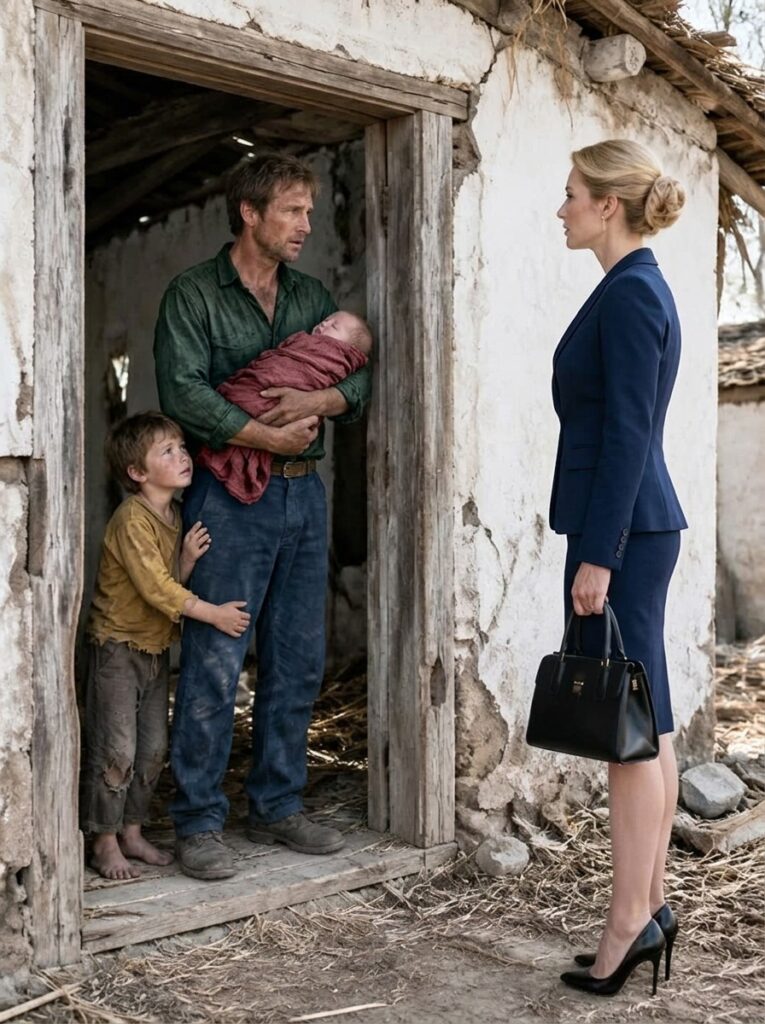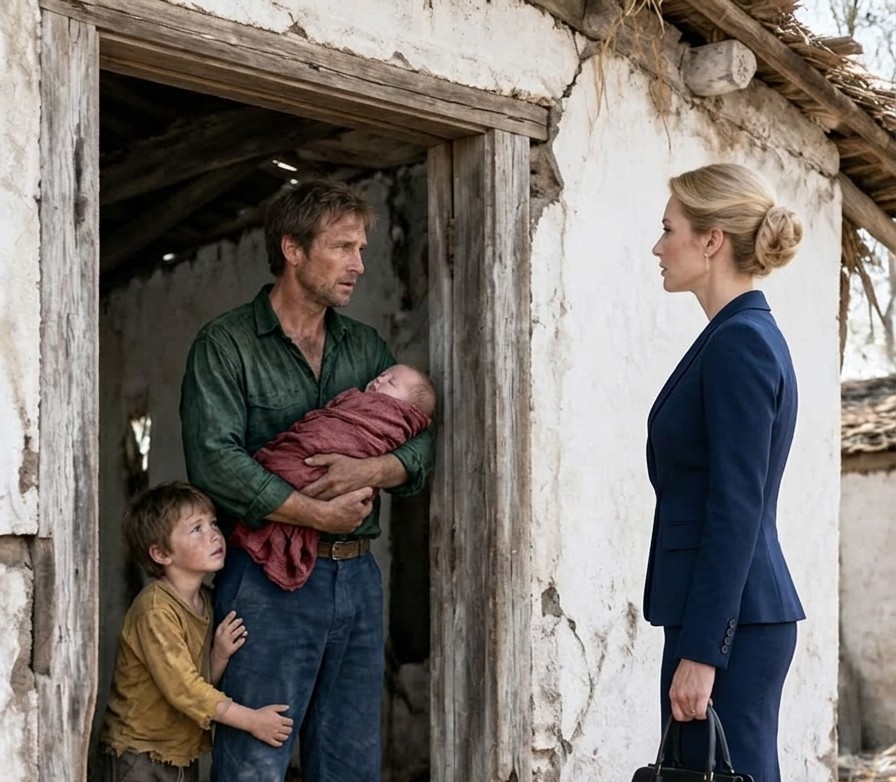
A wealthy businesswoman arrived at the doorstep of the most modest house owned by one of her employees. What she discovered behind that door was a reality no amount of wealth had ever prepared her to face.
Cecilia Hawthorne had always believed the world operated the way her development projects did. Structured. Elegant. Predictable. And above all, under control.
She was one of the most powerful real estate developers on the East Coast. Before reaching forty, her name was already attached to waterfront towers, luxury shopping centers, and exclusive residential communities crafted from glass and steel.
Her home was a penthouse overlooking the Eastern Seaboard, filled with marble, floor-to-ceiling windows, and silence. Sophisticated silence. Expensive silence. In Cecilia’s world, excuses held no value. Delays were intolerable. Personal hardships were someone else’s concern.
That was why a seemingly minor issue that morning irritated her so deeply.
Samuel Hedges, the janitor responsible for cleaning her offices for more than three years, had missed work again. It was his third absence within a month.
“Family emergencies,” he kept telling them.
Cecilia pressed her lips together as she adjusted her tailored blazer in front of the mirror.
“Interesting,” she remarked coolly. “In three years, he has never once mentioned having children.”
Her assistant, Melanie, tried to reason with her.
“Ma’am, Samuel has always been dependable. He’s punctual, hardworking, and never complains…”
But Cecilia had already made up her mind. To her, it looked simple. Irresponsibility disguised as misfortune.
“Give me his address,” she said. “I’d like to see this emergency for myself.”
Within minutes, the information appeared on her screen. Willow Creek Terrace, Apartment 4C, North Ridge.
A working-class neighborhood. Worlds away from her gleaming developments.
A faint smile crossed Cecilia’s face. She expected to teach Samuel a lesson. What she did not know was that stepping into that home would tear apart everything she believed about success, only to rebuild it from the ground up.
Thirty minutes later, her black sedan rolled along cracked streets. Mud-filled potholes. Stray dogs wandering freely. Children without shoes chasing a worn-out soccer ball.
Small homes lined the road, patched together with faded paint and years of repairs. Residents stared at her vehicle as though it had arrived from another universe.
She stepped out in flawless heels, posture straight, determined not to show any discomfort.
The faded blue house stood quietly ahead, its weathered front door barely hanging on its hinges.
She knocked firmly. Silence. Then the cry of an infant. Quick footsteps. The sound of children whispering.
The door opened slowly. The man standing there barely resembled the Samuel she saw every morning. Dark circles shadowed his eyes. His shirt was worn and thin. A baby rested against his chest while another child clung to his leg, watching her cautiously.
It took him a second to recognize her. When he did, the color drained from his face.
“Ms. Hawthorne…”
Cecilia paused. This was not the scene she had expected.
There was no act. No excuse. Only exhaustion.
“May I come in?” she asked softly.
After a brief hesitation, he stepped aside. The house was painfully cramped. Two bedrooms. A tiny improvised kitchen. Old furniture that had been carefully maintained. A crib assembled from mismatched pieces. School notebooks stacked beside prescription medication.
The sound of her heels echoed across the concrete floor, making her feel even more out of place.
“I’m sorry about the mess,” Samuel said quietly. “It’s been a difficult night.”
The baby began crying harder.
“How many children do you have?” she asked, surprised by the question herself.
“Four. The oldest is nine. The youngest is three months old.”
For a moment, she struggled to process it.
“And your wife?”
He remained silent for a few seconds.
“She passed away six months ago. Cancer.”
Cecilia blinked.
“I never mentioned it at work. I was afraid I’d lose my job.”
A harsh cough came from a nearby room.
“My oldest son has pneumonia,” Samuel continued. “He got worse last night. I couldn’t leave him alone.”
Without thinking, Cecilia moved toward the sound. A thin boy lay on the bed, struggling to breathe. His skin radiated heat. The bottle of cough medicine on the nightstand was nearly empty.
For the first time in many years, Cecilia came face-to-face with something wealth alone could not solve.
She felt helpless. In that moment, every certainty she had carried for decades seemed to collapse. Money meant nothing. Status meant nothing. Authority meant nothing.
What she decided to do next would transform both of their lives forever.
She pulled out her phone.
Not to call Melanie.
Not to call her driver.
She called the best pediatric urgent care clinic in the city and told them she was bringing a child in immediately.
Samuel shook his head.
“Ms. Hawthorne, I can’t afford—”
“I did not ask what you could afford. I asked if your son is ready to be moved.”
He stared at her.
Then he wrapped his boy in a blanket and carried him to the car.
At the clinic, the doctor examined the boy for forty minutes.
Bacterial pneumonia. Advanced. Another two days without proper treatment, and it could have reached his bloodstream.
They administered antibiotics through an IV. They gave him fluids. They told Samuel his son would need to stay overnight.
Samuel stood in the hallway, holding the baby against his chest with one arm. His other hand gripped the wall as if the floor might vanish beneath him.
“I missed three days of work,” he said, barely above a whisper. “You came to fire me.”
Cecilia did not answer right away.
Because he was right.
That was exactly why she had come.
“Yes,” she said.
He nodded. He did not look angry. He did not look hurt.
He looked like a man who had stopped expecting anything a long time ago.
“I am not going to fire you, Samuel.”
He looked up.
“Not today. Not any day.”
She turned and walked down the hallway before he could respond.
She did not want him to thank her.
Because what she had seen in that house was not something a single clinic visit could fix.
The next morning, Cecilia arrived at Samuel’s home again.
This time, she did not knock.
The door was already open.
The little girl, five years old, was sitting on the front step trying to braid her own hair. She had used a rubber band meant for vegetables.
Cecilia crouched down.
“Would you like some help?”
The girl studied her face the way children do when they are deciding whether an adult is safe.
Then she handed over the rubber band.
Cecilia had not braided anyone’s hair in over thirty years.
Not since her own childhood.
She had almost forgotten the motion.
Almost.
While her fingers worked through the girl’s tangled hair, she noticed something on the kitchen counter through the open door.
A framed photograph.
She finished the braid, stood, and walked inside.
The photograph showed a woman with warm brown eyes, holding the same baby Samuel now carried everywhere. She was smiling, but there was a tiredness behind the smile that Cecilia recognized instantly.
Beside the frame sat a folded piece of paper, yellowed and creased from being opened and refolded dozens of times.
Samuel appeared behind her.
“That’s Rebecca,” he said. “My wife.”
Cecilia nodded.
“She was beautiful.”
“She worked two jobs while I cleaned your offices at night,” Samuel continued. “Dayshift at a textile warehouse on Broad Street. Evenings at a laundromat.”
Cecilia felt the words land somewhere behind her ribs.
“When she got sick, she kept working for three months before she told me. She said we couldn’t afford for both of us to stop.”
He paused.
“The warehouse didn’t offer health insurance for part-time workers. She was four hours short of full-time status.”
Four hours.
A woman had died four hours short of a policy that might have caught the cancer before it spread.
Cecilia said nothing.
She picked up the folded piece of paper beside the photograph.
Samuel watched her but did not stop her.
It was a letter.
Addressed to no one.
Written in a woman’s handwriting.
“If something happens to me, please don’t let Sam lose himself. He will try to carry everything alone. He will not ask for help. He will not tell anyone he is drowning. He will smile at work and fall apart at home. Don’t let him. He deserves more than survival. So do my babies.”
Cecilia read it twice.
Then she folded it carefully and placed it back exactly where it had been.
“She wrote that the week before she passed,” Samuel said.
“She knew?”
“She always knew more than she let on.”
That night, Cecilia sat alone in her penthouse.
The marble floors gleamed.
The city lights stretched out beneath her windows like a kingdom.
And for the first time, the silence did not feel sophisticated.
It felt empty.
She opened her laptop and pulled up the personnel files for every employee in her company. Not the executives. Not the managers. The cleaners. The security guards. The maintenance workers. The ones whose names she had never learned.
There were one hundred and forty-seven of them.
She did not know a single one.
The next morning, she called a meeting.
Not with her board.
Not with her investors.
With her head of human resources.
“I want full medical coverage extended to every employee in this company. Full-time, part-time, contract. Everyone.”
The HR director stared at her.
“Ms. Hawthorne, the annual cost alone would—”
“I heard you. Everyone.”
He opened his mouth.
“That includes dental. Vision. Mental health. And I want a family emergency fund established by the end of the month. Any employee with a documented hardship can apply. No one reviews it but me.”
“Ma’am, the board will need to approve—”
“I am the board.”
The room went quiet.
Cecilia leaned forward.
“A woman died four hours short of eligibility for insurance that my company could have provided. I will not sit in another living room and find another letter from another dead mother asking someone to save her family. Is that clear?”
No one spoke.
“Good.”
She stood and left the room.
That afternoon, she drove back to North Ridge.
She brought groceries. Medication. New bedding. A set of school uniforms still in their plastic wrapping.
She did not call ahead.
She did not send an assistant.
She carried the bags herself.
Samuel opened the door and looked at the supplies in her arms.
“Ms. Hawthorne, I can’t accept—”
“Your wife asked someone not to let you carry everything alone. I read the letter. You can be angry with me for that. But I am not leaving these in the car.”
He stepped aside.
The boy was home from the clinic. He was sitting up in bed, eating soup. His color had returned. When he saw Cecilia, he gave a small wave.
She waved back.
It was such a small thing.
A wave from a boy who had nearly died from a treatable illness in one of the richest cities in America.
And it broke something open inside her that she had kept sealed shut for decades.
Because Cecilia had her own letter she had never shown anyone.
She had her own story she had buried so deep even Melanie did not know it existed.
Cecilia Hawthorne had not always been Cecilia Hawthorne.
She had been Cecilia Medina.
Daughter of a janitor.
Her father had cleaned office buildings in Newark for twenty-two years.
He worked nights so she could attend school during the day.
He packed her lunch every morning at four a.m. before leaving for his shift.
And when she was fourteen, he had gotten sick.
The same kind of sick that no one catches early when you cannot afford a doctor.
He died in a public hospital hallway because there were no available beds.
Cecilia had been sitting beside him on a plastic chair, holding his hand, when the monitor flatlined.
No one came for six minutes.
She counted.
After his death, her mother worked three jobs. Cecilia earned a scholarship. Then another. Then another. She clawed her way out of a neighborhood that looked exactly like the one Samuel lived in now.
And somewhere along the way, she stopped looking back.
She changed her last name.
She erased every trace of the girl who had eaten rice and beans for dinner five nights a week.
She built towers of glass and steel on top of the memory of a man who had mopped floors so his daughter could dream.
And she had never once, in twenty-six years, gone back to visit his grave.
That was the truth she carried underneath the blazers and the penthouse and the authority.
She had not forgotten where she came from.
She had been running from it.
And now a janitor with four children and a dead wife had led her right back to the door she had sealed shut at fourteen years old.
That Sunday, Cecilia drove to Newark.
She had not been there in over two decades.
The cemetery was small. Overgrown. The headstones were chipped and faded.
She found her father’s grave in the third row.
The engraving was barely legible.
“Arturo Medina. Beloved father.”
She crouched down and placed her hand on the stone.
“I built everything you told me to build, Papa.”
She stayed silent for a long time.
“But I forgot who told me to build it.”
She cleaned the headstone with her bare hands.
The woman who had not touched anything without gloves in fifteen years knelt in the dirt and scraped moss off her father’s name with her fingernails.
When she finished, she sat on the ground beside him and stayed there until the sun began to set.
No one saw her.
No one needed to.
Over the following months, Cecilia did not become a different person.
She was still sharp.
Still demanding.
Still the woman who could silence a boardroom with a single look.
But something had shifted.
She learned the names of her maintenance staff.
She sat with the security team during their lunch break once a week.
She personally reviewed every application to the emergency fund and approved most of them.
Her competitors whispered that she had gone soft.
Her profits said otherwise.
Employee turnover dropped by half within a year.
Productivity rose.
The people who cleaned her buildings and guarded her lobbies no longer worked out of fear.
They worked because someone with power had finally looked at them.
Samuel returned to work the following week.
His son recovered fully.
A neighbor agreed to watch the younger children during his shifts.
Cecilia paid for a proper crib, new furniture, and repairs to the front door that had been hanging off its hinges.
Samuel told her she had done enough.
She told him that was not his decision to make.
One evening, months later, Samuel knocked on her office door after finishing his shift.
He was holding a small paper bag.
“My daughter made this for you,” he said.
Inside was a bracelet.
Plastic beads. Unevenly strung. The kind a five-year-old makes at the kitchen table with her tongue sticking out.
The colors were mismatched. One bead was cracked.
Cecilia held it in her palm.
It was the most expensive thing anyone had ever given her.
She put it on.
She wore it the next day to a meeting with investors worth more than some countries.
No one asked about it.
She did not care.
Two years later, Cecilia opened a foundation.
She did not name it after herself.
She named it after Rebecca Hedges.
The Rebecca Hedges Fund covered medical expenses for working families, provided childcare grants for single parents, and offered emergency housing support.
The foundation’s first office was on Broad Street.
The same street where Rebecca had worked in the textile warehouse.
The same street where she had been four hours short.
On opening day, Samuel stood in the back of the room with his four children.
The oldest boy, now eleven, stood straight, wearing a new shirt.
The five-year-old girl wore a dress she had picked out herself.
The baby was no longer a baby. She walked now, holding her brother’s hand.
And Samuel held the youngest boy on his hip the way he had held the infant against his chest the morning Cecilia first knocked on his door.
Cecilia stood at the podium.
Three hundred people waited for her to speak.
She looked out at the room.
She looked at Samuel.
She looked at the bracelet on her wrist.
“I built my career believing that weakness was something to be eliminated,” she said. “That personal hardship was a distraction. That the people who cleaned my floors were background noise in a building I owned.”
She paused.
“I was wrong.”
The room was silent.
“A man who earned less in a year than I spent on a single dinner was raising four children alone. He did not ask me for help. He did not ask anyone. He showed up every night and mopped my floors and went home and held his children and did it all again the next day.”
She looked directly at Samuel.
“And when I walked into his home expecting to fire him, he offered me a chair.”
Samuel looked at the floor.
His daughter tugged his sleeve.
“That chair,” Cecilia said, “was the most important seat I have ever been offered.”
She stepped down from the podium.
There was no applause at first.
Then Samuel’s daughter started clapping.
Alone.
Small hands hitting together in an uneven rhythm.
Then the boy beside her joined.
Then the rest of the room.
And for the first time in her life, Cecilia Hawthorne did not feel powerful.
She felt something far better.
She felt present.
After the ceremony, she drove back to Newark.
She parked outside the cemetery and walked through the overgrown grass to the third row.
Her father’s headstone was clean now.
She had been coming every month.
She crouched down, placed a small bouquet of yellow flowers against the stone, and rested her hand on the engraving.
“I remembered, Papa.
I finally remembered.”
Then she stood.
She brushed the dirt from her knees.
And she drove home wearing a plastic bracelet with mismatched beads and one cracked bead in the center.
People build empires to prove they have risen above where they started.
Cecilia had done exactly that.
But no tower she ever built taught her what a janitor’s daughter already knew at fourteen, sitting in a hospital hallway, holding her father’s hand.
That the people who mop the floors are holding up the building.
And the moment you forget that, you have not risen above anything.
You have just lost your way home.
If you have ever walked past someone and assumed their life was simple because their job was small, stop.
You do not know what they carry home at night.
You do not know whose letter sits folded on their kitchen counter.
You do not know how many hours stand between them and the help that could save their life.
And if you are the one with the power to close that gap, even by four hours, do it.
Before another letter has to be written.
Before another name has to be scraped clean from a forgotten headstone.
Before another child waves at you from a bed they almost did not get up from.
Cecilia locked her car, walked into her penthouse, and set the bracelet on her nightstand beside the only photograph she kept there now.
Not a skyline.
Not an award.
A photograph of a man in a janitor’s uniform, holding a lunchbox, smiling at a girl who had not yet learned to be ashamed of him.
She never was again.