PART 2
I sat in my car outside their house for forty-seven minutes because I had driven four hours and couldn’t make my legs move.
The house was a pale blue craftsman on a tree-lined street. Window boxes with late summer flowers. A porch light already on even though it was three in the afternoon. Two cars in the driveway — one with a hospital parking sticker, one with a faded bumper sticker I couldn’t read from the curb.
Fourteen years.
My daughter had built an entire life on this street while I sat in a house two hundred miles away convinced that I had been the one wronged.
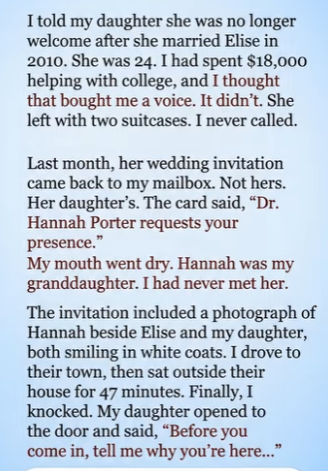
I looked at the wedding invitation on the passenger seat.
Dr. Hannah Porter requests your presence.
Hannah. My granddaughter was a doctor. My granddaughter had my daughter’s last name — Porter, not whatever name I had expected, not some hyphenated compromise, just Porter, the name I had given my daughter thirty-four years ago in a hospital room before I understood what it would mean to love someone conditionally.
I knocked on the door at 4:17.
My daughter opened it.
Fourteen years older. Her hair shorter. Glasses she hadn’t worn before. The particular posture of a woman who has been quietly successful for long enough that it sits naturally on her shoulders now rather than something she has to remind herself to carry.
She looked at me the way you look at something you prepared for but still weren’t entirely ready to see.
“Before you come in,” she said, “tell me why you’re here.”
I had rehearsed four different answers in the car during the forty-seven minutes.
Every single one of them evaporated.
“Because I never called,” I said. “And I should have. Fourteen years ago. And every year after that.”
My daughter held the door handle.
“That’s not enough,” she said. “Why today? Why the invitation?”
“Because a girl I’ve never met sent me an invitation to her wedding,” I said. “A girl who is apparently a doctor and who has my last name and who is getting married, and I realized that if I don’t walk through this door today I will spend the rest of my life knowing I missed everything. Not just the fourteen years I already missed. Everything.”
My daughter looked at me for a long time.
Then she stepped back from the door.
Not wide. Not welcoming. Just enough.
“Elise is at the hospital,” she said. “Hannah is in the kitchen.”
I stepped inside.
The house smelled like coffee and something baking and the particular smell of a home that has been lived in happily for a long time — layers of ordinary days accumulated into something warm and permanent.
Photographs on the hallway wall. My daughter and Elise at what looked like a beach, laughing at something outside the frame. A little girl at various ages — gap-toothed smile at maybe seven, school photo at ten, graduation photo in a cap and gown. A recent one: two women in white coats, both smiling, my daughter’s arm around a young woman who had her jawline and Elise’s eyes.
I stopped at that last photograph.
My granddaughter.
A doctor.
I had missed every step of that.
“She’s twenty-eight,” my daughter said from behind me. “She graduated from Johns Hopkins. She’s a cardiologist. She’s getting married in October to a man named David who teaches high school history and coaches cross country and who, for the record, adores her completely.”
I couldn’t take my eyes off the photograph.
“She sent you the invitation herself,” my daughter said. “I didn’t ask her to. Elise didn’t ask her to. She found your address through a search and decided on her own that she wanted you there.”
“Why?” I asked.
“You’d have to ask her that,” my daughter said.
I turned around.
My daughter was standing in the hallway with her arms crossed — not aggressively, more like she was holding herself steady.
“Before we go any further,” she said, “I need you to understand something. That woman in the kitchen has never once asked me why her grandmother doesn’t know her. She has never once complained about your absence. She has only ever treated it as a fact of her life rather than a wound.” She paused. “But it is a wound. Whether she names it or not. And I need you to know that before you walk into that kitchen and meet her for the first time.”
“I know,” I said.
“Do you?” she asked. “Because fourteen years ago you told me I was no longer welcome in your home because of who I loved. You spent eighteen thousand dollars on my education and decided that bought you a vote on my life. It didn’t. It never did.”
“I know,” I said again.
“I’m not ready to forgive you,” she said. “I want to be honest about that. I am letting you in this door because my daughter asked me to, and because I believe people can change, and because I have spent fourteen years building a life so full that your absence, while painful, did not define me.” She looked at me steadily. “But I am not going to pretend this is simple. Or fast. Or easy.”
“I’m not asking for simple,” I said. “Or fast. I’m asking for the chance to start.”
My daughter held my gaze for a long moment.
Then she turned and walked toward the kitchen.
“Hannah,” she called. “Someone’s here.”
I heard the sound of a chair scraping. Footsteps. The particular rhythm of a person moving through a familiar house without thinking about it.
And then my granddaughter appeared in the kitchen doorway.
Twenty-eight years old. White coat still on over her clothes, hospital badge clipped to the pocket, a coffee mug in one hand. Her grandmother’s jawline. Elise’s eyes. A steadiness in her face that reminded me, painfully, of the way her mother used to look at me before I gave her a reason not to.
She looked at me for a long moment.
“You came,” she said.
“You invited me,” I said.
“I didn’t know if you would.”
“I almost didn’t,” I said. “I sat outside for forty-seven minutes.”
Something shifted in her expression. Not quite a smile. The beginning of one.
“I know,” she said. “I saw you from the upstairs window.”
PART 3 — THE FINAL CHAPTER
Hannah let me stand in the kitchen doorway for a moment before she said, “Do you want coffee?”
It was such a simple question. The kind of question you ask someone who belongs there. The kind of question that contains, inside it, a decision about whether to let someone in — not just through the front door but into the ordinary rhythms of a life they forfeited the right to be part of.
“Yes,” I said. “Please.”
She poured it without asking how I took it, then slid the cream and sugar across the counter and let me decide for myself. I noticed that. The small courtesy of not assuming she knew me well enough to know my preferences. The honest acknowledgment that she didn’t.
My daughter sat at the kitchen table. Not beside me. Across from me. The position of someone who was present but not yet ready to close the distance.
I understood. I had earned that distance. All of it.
“Why did you send the invitation?” I asked Hannah.
She wrapped both hands around her mug and thought about the question with the genuine seriousness of someone who had clearly thought about it many times before and was now deciding how much of that internal conversation to share.
“Because I’m getting married in October,” she said. “And I’m a cardiologist, which means I spend a lot of time thinking about the fact that hearts are simultaneously the most resilient and most fragile things in the human body.” She paused. “And I decided I didn’t want to stand at my wedding knowing that there was a door I hadn’t tried to open.”
“Even if I hadn’t deserved the invitation?” I asked.
“Especially then,” she said. “Because the invitation wasn’t for you. It was for me. I needed to know I had tried. Whatever you did with it afterward was your choice.”
I looked at this young woman sitting across the kitchen table from me. This person who had grown up without me and had somehow, despite that, developed the kind of grace that takes most people a lifetime to learn and some people never manage at all.
“Your mother said you’ve never asked her about me,” I said.
Hannah nodded.
“Weren’t you angry?”
“I was,” she said simply. “For a while. When I was about twelve, I went through a period where I was furious. I didn’t understand why my grandmother didn’t know me. I didn’t understand what I had done wrong.”
“You didn’t do anything wrong,” I said immediately.
“I know that now,” she said. “But twelve-year-olds don’t always know what they know. I thought maybe I was the reason. Maybe if I was different. Maybe if I was easier. Maybe if I was the kind of grandchild people wanted.”
I pressed my hand flat against the kitchen table.
“You were exactly the kind of grandchild I should have wanted,” I said. “I was the one who was wrong. Not about you. About your mother. About what love is supposed to look like.”
Hannah looked at me carefully.
“What changed?” she asked.
“The invitation,” I said. “Seeing your name. Seeing that you had my last name. Seeing that you had become a doctor and were getting married and had built this whole life that I knew nothing about.” I looked at my daughter. “And understanding, for the first time in fourteen years, that the person I thought I was protecting when I closed that door was me. Not anyone else. Just me.”
My daughter’s expression shifted. Not warm yet. But less guarded.
“I’m not asking to walk you down the aisle,” I said to Hannah. “I haven’t earned that. I’m not asking for fourteen years back. I’m not asking your mother for forgiveness before she’s ready to give it.” I looked between them. “I’m asking if I can come to the wedding. And sit in a pew. And watch you marry someone who loves you. And start from that.”
Hannah looked at her mother.
Something passed between them. The particular silent conversation of two people who have lived closely enough together that full sentences become unnecessary.
My daughter looked at me.
“You can come to the wedding,” she said. “One condition.”
“Name it.”
“You meet Elise first,” she said. “Before October. You sit across a table from the woman I have been married to for fourteen years and you treat her with the basic respect you owed her in 2010 and never gave.”
“Yes,” I said. Without hesitation. Without qualification.
My daughter studied me for a moment.
Then she nodded once.
Elise came home from the hospital at six thirty. She walked in the front door still in her scrubs, set her bag on the bench by the door, and stopped when she saw me sitting at her kitchen table.
She had every right to ask me to leave.
She had every right to say the things I should have heard fourteen years ago and hadn’t.
Instead, she stood in the doorway of her own kitchen and looked at me with the measured calm of a woman who has spent fourteen years building something solid and knows that nothing in this room can take it from her.
“You’re here,” she said.
“I am,” I said.
“About time,” she said.
And she walked to the cabinet, took out a glass, and poured herself water like I was simply a guest who had arrived slightly later than expected.
I met David, Hannah’s fiancé, the following week. He shook my hand and said, “She talks about you, you know. Not often. But she does.”
“What does she say?” I asked.
“She says she hopes you get to meet her someday,” he said. “She says she has her grandmother’s jawline and she always wondered if you’d notice.”
I noticed.
The wedding was in October.
A small ceremony in a garden. Hannah in a dress that made my daughter cry from the second row. David at the altar with the expression of a man who could not believe his extraordinary good fortune.
I sat in the fifth row.
Not at the front. Not beside the family.
In the fifth row, where I had earned to sit, with a clear view of my granddaughter’s face and the beginning of a road that was going to take longer to travel than the four hours I had driven to get here.
But I was on it.
Finally.
After fourteen years of standing at the wrong end of a door I had closed myself.