PART 2
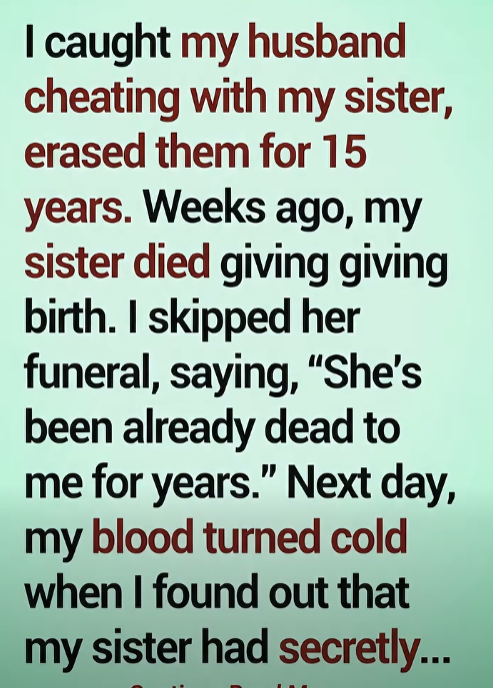
My sister had been secretly sending me money.
Not once. Not occasionally.
Every single month for fifteen years.
I found out the way you find out things you were never supposed to know — through an accident, through a piece of paper left in the wrong place at the wrong time by someone who assumed the secret would be kept forever because the person keeping it was still alive.
My niece called me the morning after the funeral I hadn’t attended.
She was fourteen years old and she called from her grandmother’s phone because she didn’t have my number in her own, and she said, “Aunt Carol? I don’t know if you remember me. I’m Lily. Sandra’s daughter.”
Sandra. My sister’s name. The one I hadn’t said out loud in fifteen years.
“I remember you,” I said, though I didn’t, not really, because the last time I had seen Lily she was a toddler at a family gathering before everything fell apart and I made the decision to cut every thread connecting me to my sister and the man who had been my husband.
“Mom left you something,” Lily said. “In her papers. She said if anything ever happened to her, I was supposed to make sure you got it.”
My hand tightened on the phone.
“What is it?” I asked.
“A letter,” Lily said. “And a bank book.”
I drove three hours to my mother’s house, where Lily was staying with relatives who looked at me with the complicated expressions of people who understood why I had stayed away and couldn’t entirely blame me for it but were grieving too much to sort through the complexity.
Lily met me on the porch.
Fourteen years old. Dark hair. A quietness about her that belonged to a child who had already learned that the world could take things from you without warning.
She handed me a sealed envelope and a small bank passbook held together with a rubber band.
“She said you’d understand when you read the letter,” Lily said. “She said not to open the bank book first.”
I read the letter sitting in my car in my mother’s driveway.
Sandra’s handwriting. Loopy and slightly uneven, the way it had always been since we were children sharing a bedroom and doing homework at the same desk.
Carol,
I know you won’t come to the funeral. I wouldn’t either, if I were you. What I did was unforgivable and I knew it the moment I did it and I kept doing it anyway, which makes it worse, and I have no excuse that would hold up under honest examination.
But I need to tell you something before this letter reaches you, and I need you to hear it without the anger you have every right to carry.
I have been sending you money every month since 2010.
Not from Marcus. He doesn’t know. From me. From the business I built after he left — and he did leave, Carol. Two years after you cut us off. He left me the same way he left you, which I probably deserved and which taught me something I should have understood the first time I watched him do it to you.
The account number is in the passbook. The deposits go back fifteen years. I won’t tell you what to do with it. Keep it, donate it, throw the passbook in the trash. But I want you to know that every month when I made that deposit I was thinking about you. Not trying to buy forgiveness. I knew I couldn’t. Just trying to make sure that whatever I had taken from you, I was giving something back, even if you never knew.
There’s one more thing.
Lily knows you exist. She has always known. I told her the truth about what I did because I didn’t want her to grow up not understanding why her aunt wasn’t in her life. I told her it was my fault. Not yours.
She asked me once if she could meet you someday.
I told her that was your decision to make.
I’m sorry, Carol. Not for the first time. But for the last time, because I won’t get another chance to say it.
Sandra
I sat in the car for a long time after I finished reading.
Then I opened the passbook.
Fifteen years of monthly deposits. Small at first. Larger as time went on. Consistent. Uninterrupted.
The total was more than I had expected.
Considerably more.
I looked at the amount for a long time.
Then I looked at the porch, where Lily was sitting on the steps watching my car with the patient stillness of a fourteen-year-old who had just lost her mother and was now waiting to find out if the aunt she’d been told about her whole life was going to get back in her car and drive away.
I got out of the car.
Walked to the porch.
Sat down beside her on the steps.
We didn’t say anything for a while.
“She talked about you,” Lily finally said. “A lot. Especially when I asked why things were the way they were.”
“What did she say?”
“She said she made a choice when she was young and selfish and too stupid to understand what it would cost,” Lily said. “She said she spent fifteen years trying to figure out how to say sorry in a way that would actually mean something.” She paused. “She said she never figured it out.”
“She wrote me a letter,” I said.
“I know. She wrote it three months ago. She said she had a feeling.” Lily’s chin trembled. “She always said she had feelings about things.”
I thought about my sister at seventeen. At twenty. At whatever age she had made the choice that ended our relationship. I had spent fifteen years reducing her to that choice, the way you reduce a person to the worst thing they ever did because it’s easier than holding the whole complicated truth of who they were.
The whole complicated truth, it turned out, included fifteen years of monthly deposits and a letter she had written while pregn:ant and a daughter she had raised to know that the estrangement was her fault and not mine.
“I skipped the funeral,” I said.
“I know,” Lily said.
“I shouldn’t have.”
Lily was quiet.
“She wouldn’t have blamed you,” she said finally. “She told me not to, if you did.”
I pressed my hands against my knees and looked at the street in front of my mother’s house — the same street Sandra and I had learned to ride bikes on, the same street we had walked to school on every morning for twelve years before our lives diverged into people we couldn’t have imagined becoming.
“What happens to you now?” I asked.
“Dad isn’t in the picture,” Lily said. “Grandma is here. There are aunts on Mom’s side.” She paused. “I’m okay. I have people.”
“Good,” I said.
We sat for another few minutes.
“Can I ask you something?” Lily said.
“Yes.”
“The money she sent you. Are you going to keep it?”
I thought about it.
“No,” I said.
Lily looked at me.
“I’m going to put it in an account for you,” I said. “For college. For whatever you need. It was hers. It should go to you.”
Lily’s eyes filled. She pressed her lips together the way her mother used to press hers when she was trying not to cry in front of people.
“You don’t have to do that,” she said.
“I know,” I said. “That’s why I’m doing it.”
PART 3 — THE FINAL CHAPTER
I went home that evening and sat in my kitchen for a long time.
Fifteen years is a long time to be certain about something. Certain about who wronged you and how badly and what it cost and what it meant to cut that person out of your life and not look back. Certainty feels like strength when you’re inside it. It feels like you’re protecting something important.
What you’re sometimes actually doing is making yourself the curator of a wound, preserving it carefully so that nothing and no one can get close enough to complicate it.
Sandra had complicated mine.
Not with an apology. She had known an apology would cost me nothing to reject. She had complicated it with fifteen years of quiet, invisible action — money I didn’t know about, a daughter raised with the truth, a letter written by a woman who knew she might not survive childbirth and used her remaining preparation time to make sure her sister received something she couldn’t argue with.
You can reject an apology.
You cannot easily reject fifteen years of someone trying to make it right in the only way they believed you might eventually accept.
I called my mother that night.
“She sent me a letter,” I said.
“I know,” my mother said. “She told me she’d written it.”
“You knew about the money?”
A pause.
“I found out two years ago,” my mother said. “She made me promise not to tell you. She said if you found out before she was ready to tell you herself, you’d refuse it and she needed to know it was actually helping you.”
I closed my eyes.
“Was it?” my mother asked. “Helping you?”
I thought about the months it had arrived. The lean years after the divorce when my finances were tight and I had never been able to explain to myself why things had always worked out just slightly better than they should have. The deposits I had attributed to my own budgeting. The breathing room I had assumed was simply good fortune.
“Yes,” I said. “It was.”
My mother cried then. Quietly. The particular crying of a woman who has been holding the weight of two estranged daughters for fifteen years and has now lost one of them permanently and is trying to figure out how to carry what remains.
“Come home for a while,” she said. “Not for the funeral. Just come home.”
I went the following weekend.
Lily was still there. She was sleeping in Sandra’s old room, the one across the hall from the one I had grown up in, and on the second morning she knocked on my door at seven and asked if I wanted to walk to the bakery we used to go to as children.
We walked four blocks in the early morning and bought coffee and pastries and sat at the same table by the window where Sandra and I used to sit on Saturday mornings when we were young enough that neither of us understood how completely a life could change.
“Did you love her?” Lily asked.
“Yes,” I said. “Even when I was erasing her. You can love someone and still decide you can’t be near them.”
“Does it stop hurting?”
“The loving or the erasing?”
“Either,” Lily said.
“No,” I said honestly. “But it changes. The hurt changes shape over time. It gets less sharp. More like weather than like injury.”
Lily turned her coffee cup in her hands.
“I’m angry at her,” she said quietly. “For d!eing. I know that’s not fair.”
“It’s completely fair,” I said. “Grief doesn’t follow rules about what’s reasonable.”
“Are you angry at her?”
I thought about it honestly.
“I’m angry that we wasted fifteen years,” I said. “I’m angry that she didn’t find a way to reach me sooner. I’m angry at myself for making it impossible for her to try.” I paused. “But the anger at what she did — to me, to my marriage — that’s quieter now. Quieter than I expected, given how loud it used to be.”
“Because of the letter?”
“Because of the letter,” I said. “And because of you.”
Lily looked at me.
“She could have told you nothing about me,” I said. “She could have let you grow up believing I was simply absent, simply indifferent, simply the aunt who chose not to be there. She didn’t. She told you the truth. She told you it was her fault. She raised you to know me by name and to understand why we were estranged and to believe that meeting me someday might still be possible.”
I looked at this fourteen-year-old girl across a bakery table on a Saturday morning.
“That’s not nothing,” I said. “That’s actually quite a lot.”
Lily’s eyes filled for the second time in two days. She pressed her lips together again, the same gesture, her mother’s gesture.
“She would have really liked to see you figure things out together,” she said.
“I know,” I said. “I’m sorry she didn’t get to.”
The account for Lily’s future is funded and growing. I set it up the week I got home. I didn’t tell her the amount. I just told her it was there and that the only condition was that she use it for something that mattered to her.
She said she wants to be a midwife.
I didn’t say anything about the symmetry of that. Some things are better left as private understanding between a woman and whatever she believes arranges these coincidences.
I see Lily once a month now. Sometimes at my mother’s house. Sometimes I drive to where she’s living with her aunt and we walk or have coffee or she shows me whatever she’s reading. She talks about Sandra the way people talk about someone they loved and lost too soon — freely, specifically, without the self-consciousness that comes when grief is still too raw to share.
I listen.
I don’t have stories to offer yet. Fifteen years of absence means fifteen years of stories I don’t have. But I’m accumulating them now, one visit at a time, one Saturday morning bakery run at a time, one phone call at a time.
Marcus I have not thought about in years. He is, as far as I know or care, living somewhere with his choices. The anger I once carried for him is so old it has composted into something unrecognizable. He was the beginning of the story but he is not the point of it.
The point of it is a fourteen-year-old girl who knocked on my door at seven in the morning and asked if I wanted to walk to the bakery.
The point of it is a letter written by a woman who knew she might not survive and used her last preparation to make sure a door that had been closed for fifteen years had at least a chance of opening.
The point of it is that some people say sorry with words and some say it with fifteen years of monthly deposits and a daughter raised to know the truth and a letter that arrives exactly when it’s supposed to.
I skipped her funeral.
I will carry that.
But I did not skip the morning walk.
And I will not skip the next one.
Share this for everyone who received a sorry they almost didn’t find in time, and for every person who said it in the only language they had left. ❤️👇