The Fall
My son hit me because I told him no. It was that simple and that devastating. He wanted me to pay off the men who had threatened to break his hands over a gambling debt he had hidden behind the word “business,” and when I refused, his hand connected with my shoulder hard enough to send me into the marble floor. He stood over me, crouched down slowly, and whispered, “You should’ve stayed useful, Mom.” Then he stepped over me and walked out the front door.
I lay there for a long time. Not because I couldn’t move, but because I needed to feel the exact weight of what had just happened before I decided what to do with it. The chandelier above me blurred through tears I refused to let fall. My ribs burned. My shoulder throbbed. And somewhere deep inside, something that had been bending for thirty-one years finally stopped bending and became something else entirely.
The Boy With the Fire Truck
His name was Caleb, and once he had been the kind of child who made you believe the world was still gentle. He slept with a toy fire truck under his pillow. He picked dandelions from the yard and called them flowers for Mama. He cried when the neighbor’s dog limped, and he held my hand in parking lots long after other boys had decided that holding your mother’s hand was something to outgrow.
I don’t know exactly when that boy disappeared. It happened slowly, the way rot works through wood — invisible until the structure gives way. Bad friends became bad habits. Bad habits became expensive mistakes. Expensive mistakes became the kind of desperation that makes a person look at the woman who raised him and see nothing but a bank account with a heartbeat.
His father saw it before I did. Henry Whitmore had built Whitmore Logistics from two trucks and a leaking warehouse into a company that spanned three states. He was tough in the way that quiet men are tough — never loud, never cruel, but absolutely immovable when it mattered. Before cancer took him, he sat me down at the kitchen table and handed me a sealed letter. “Don’t open this until you need it,” he said. “And when you need it, you’ll know.”
Three Bailouts and a Breaking Point
I bailed Caleb out three times after Henry passed. The first was for bad investments — two hundred thousand dollars vanished into a venture that existed only on a PowerPoint slide and in the promises of men who drove leased cars. The second was for a wrecked sports car he had bought with credit he couldn’t cover. The third was for a casino debt hidden so carefully that I only discovered it when a collections agency called my home phone at eleven o’clock at night.
Each time, I told myself it was the last time. Each time, Caleb promised he had changed. Each time, I believed him — not because the evidence supported it, but because believing your child is the last thing a mother surrenders.
This time was different. Two men came to my front door with photographs of Caleb signing loan papers beside a known bookmaker. They were polite the way predators are polite before they stop being polite. And the document they showed me had my name listed as collateral — a signature Caleb had forged without my knowledge.
The Camera He Forgot
What Caleb didn’t know — what he had never bothered to notice — was the small security camera Henry had installed in the staircase alcove after my hip surgery three years earlier. Henry had worried about me falling. He never imagined the camera would one day capture our son knocking me down.
At midnight, with ice pressed against my bruised ribs, I made two phone calls. The first was to Dr. Levin, our family physician for twenty years, who agreed to come the next morning to photograph and document my injuries. The second was to Mr. Graves, Henry’s estate attorney — a man who had sat across from senators and CEOs without blinking, but whose voice cracked slightly when he heard what had happened.
“Mrs. Whitmore,” he said carefully, “are you safe?” I looked at the empty staircase where my son had stood over me. “Safe enough,” I told him. “Come tomorrow. Bring witnesses. Bring a notary. And bring the documents Henry and I discussed five years ago.” There was a long pause. Then he asked, “It’s time?” I closed my eyes. “Yes,” I whispered. “It’s time.”
The Table
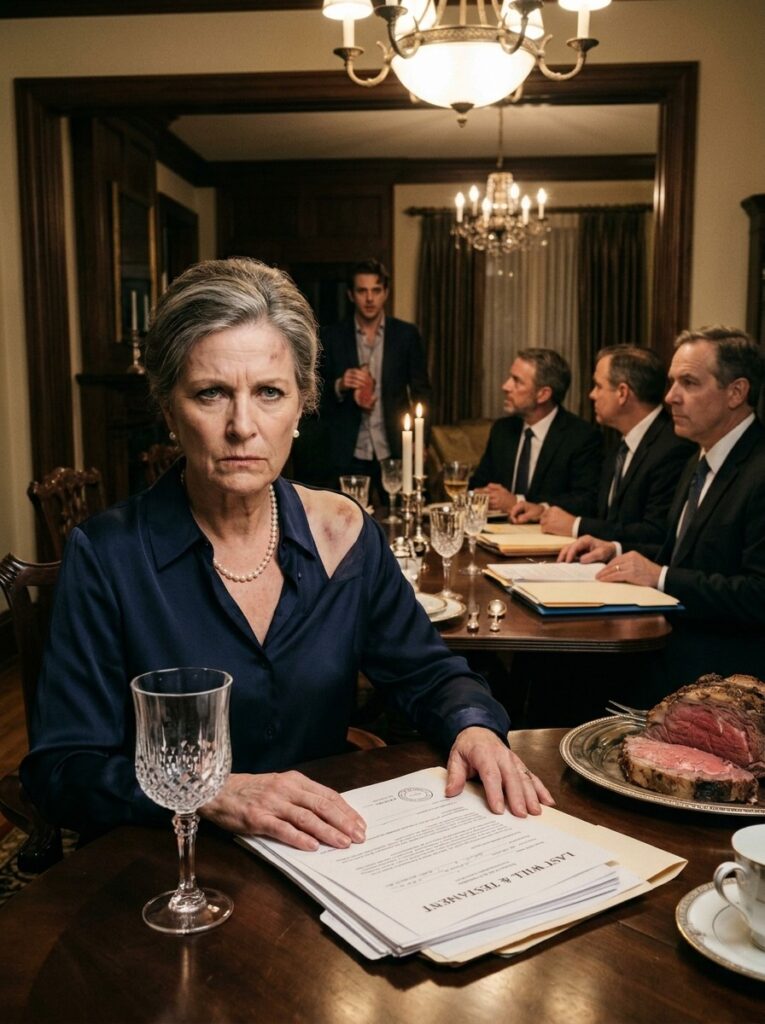
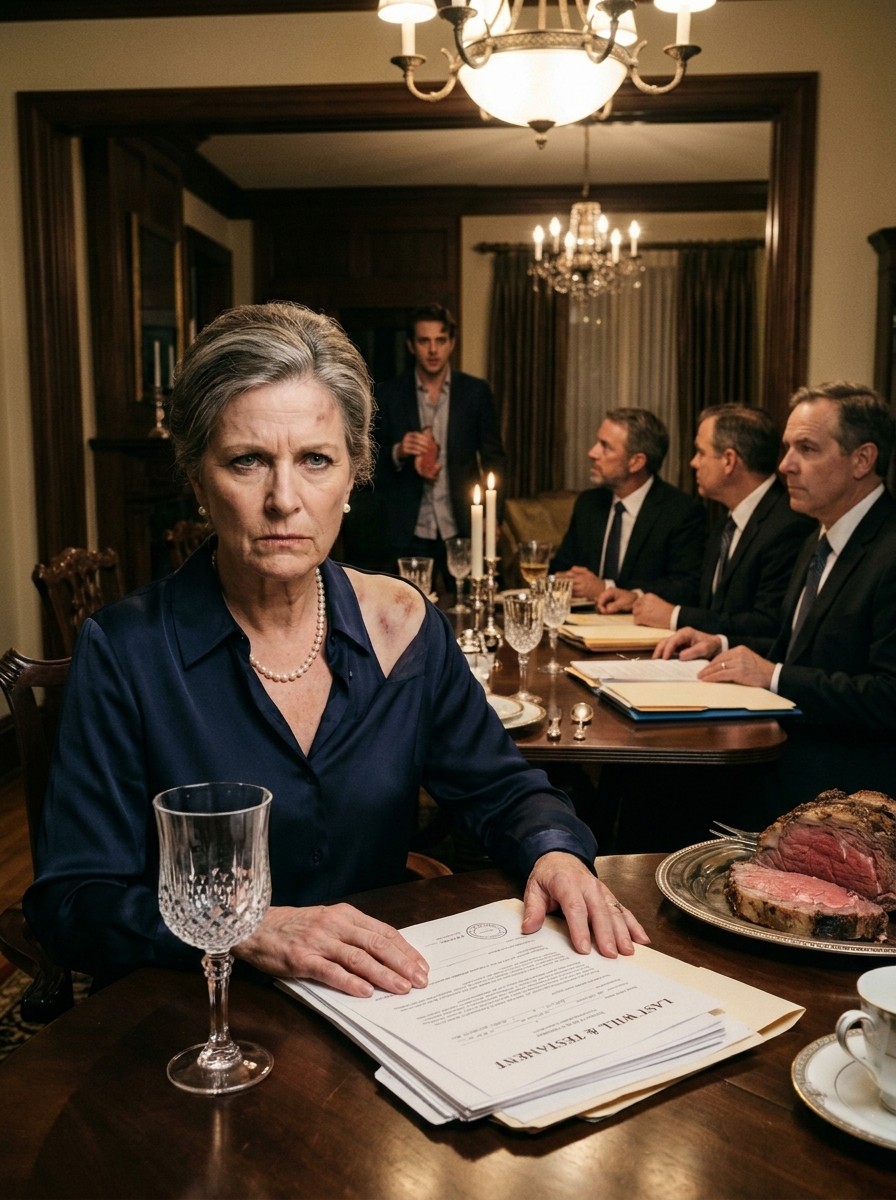
The next afternoon, I roasted a prime rib. I polished Henry’s crystal glasses — the ones he had saved for anniversaries and the births of grandchildren he never got to meet. I set the dining room table with linen napkins, candles, and the good silver, the way I used to when this house still felt like a home instead of a battleground.
Mr. Graves arrived at four with two associates: a notary public and a witness from the firm. They sat at the far end of the table with their folders open, their faces professionally neutral, and waited. I served them coffee in Henry’s cups.
Caleb walked in at six. He didn’t knock — he never knocked. He looked at the table, the candles, the carved prime rib, and he laughed the way people laugh when they believe they have won something. He grabbed a piece of meat with his bare hands, shoved it in his mouth, and said two words that told me everything I needed to know about the man my son had become: “Good girl.” Then he dropped into Henry’s chair — the chair at the head of the table — and grinned. “Now go get my checkbook.”
The Men in Suits
That was when the three men at the far end of the table turned around. Caleb’s hand froze. The meat was still in his fist. His smirk collapsed in stages — confusion first, then recognition, then the slow, sickening understanding that the dinner he had walked into was not an apology. It was an ending.
“Caleb Whitmore,” Mr. Graves said, adjusting his glasses with the calm of a man who had already won before the meeting started, “your mother has formally initiated proceedings for your complete and irrevocable disinheritance from the Whitmore estate.” Caleb shot up so fast that Henry’s crystal glass toppled and shattered across the table. “You can’t do this,” he said, pointing at me. “This is Dad’s money. This is my money.”
“It was never your money,” Graves replied. Then he opened the red folder. Inside was a printed still from the security camera — Caleb standing over me on the marble floor, his hand still raised, the timestamp glowing in the corner. Next to it: Dr. Levin’s medical photographs, a police report filed that afternoon, three prior bailout records totaling one point four million dollars, evidence of the forged signature, and a sworn affidavit confirming Caleb’s involvement with illegal gambling operations.
Caleb looked at me. For one terrible second, I saw the little boy behind his eyes — not the cruel one, but the frightened one who used to climb into my bed during thunderstorms. “Mom,” he whispered. “Please.” I felt the pull. Thirty-one years of love pulled at my chest like a riptide. But then I felt my shoulder throb beneath the fabric, and I remembered what Henry had written.
The Letter
I had opened Henry’s letter on the worst night of my life — the night after the first bailout, when I sat alone at the kitchen table wondering whether saving my son from his own choices was love or cowardice. The letter was short. Henry’s handwriting was steady. And the last line, the one I carried with me for five years without telling a soul, said this: “If you ever have to choose between saving him and saving yourself — save yourself. He’ll either find his way back or he won’t. But you, my love, you must survive.”
I looked at Caleb across the table. “I am protecting what your father built,” I said quietly. “Sit down and sign, or Mr. Graves will proceed without your cooperation.”
He didn’t sign. He threw what was left of the crystal against the wall, called me a word no son should ever say to his mother, and stormed out of the dining room like the house would still be waiting for him when his anger cooled. It wouldn’t.
What Came After
The restraining order was filed the next morning. The police report followed. Caleb’s gambling contacts were forwarded to a federal investigator Mr. Graves had known for years. Within a week, the men who had come to my door with photographs were facing charges of their own. And Caleb — the boy with the fire truck — was served papers at a motel off the highway, alone, with nothing left to gamble except the consequences of believing his mother’s love meant his mother’s silence.
I did not celebrate. That night I sat in the kitchen with a cup of tea and Henry’s letter folded in my lap, and I let myself cry for the first time — not because I had lost my son, but because I finally understood that I had lost him years ago. I had been carrying a ghost, pretending the boy I loved was still inside the man who knocked me to the floor.
The Truth About Love and Limits
Some people will read this and say a mother should never give up on her child. I understand that. I carried him for nine months. I nursed his fevers. I packed his lunches until he told me to stop. But love without boundaries is not love — it is permission. And the moment your child raises a hand to you, the contract changes. Not because you stopped loving them, but because you finally loved yourself enough to stop bleeding for someone who mistook your kindness for weakness.
If you take anything from my story, let it be this: boundaries are not betrayal. Saying no to someone you love is not cruelty. And sometimes the most powerful thing a mother can do is set the table one last time — not to feed her son, but to show him that the woman he underestimated has been ten steps ahead of him the entire time.
Henry’s letter sits in my bedside drawer. I read it on difficult nights. And I survive. Every single day, I survive.