PART 2
The next morning I woke up early, the way I always did, and I cooked.
Not because I was afraid. Not because I was performing submission. But because I had spent thirty years building a life inside this house and I was not going to let my own son’s behavior turn me into someone who hid in her bedroom waiting for permission to use her own kitchen.
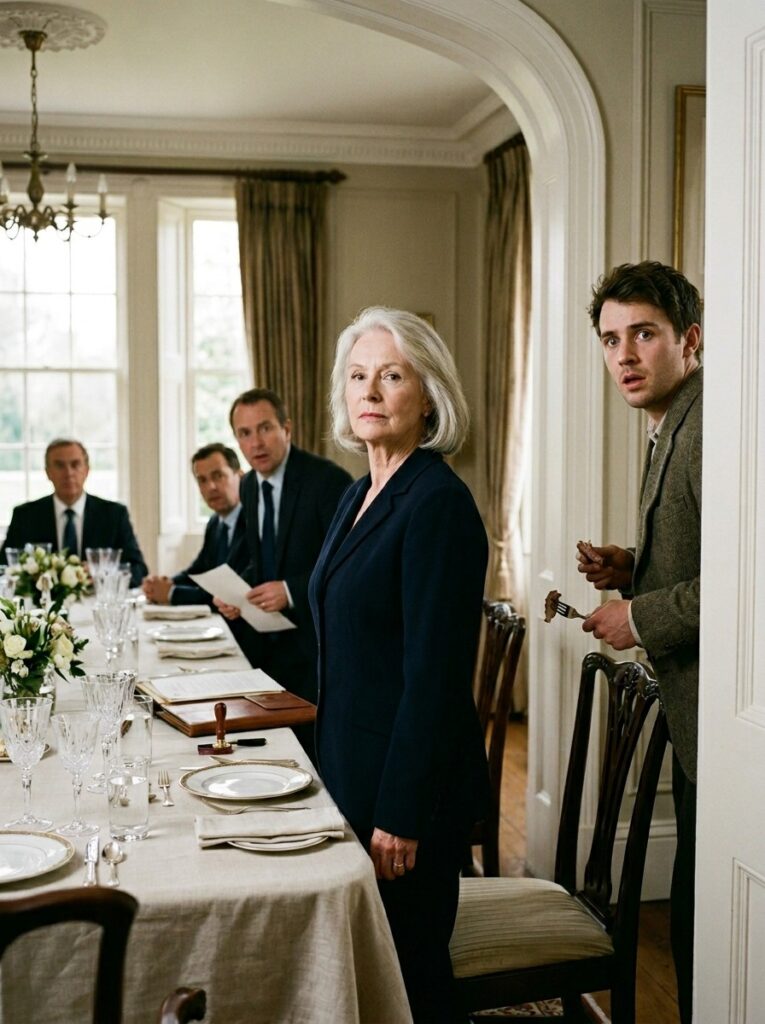
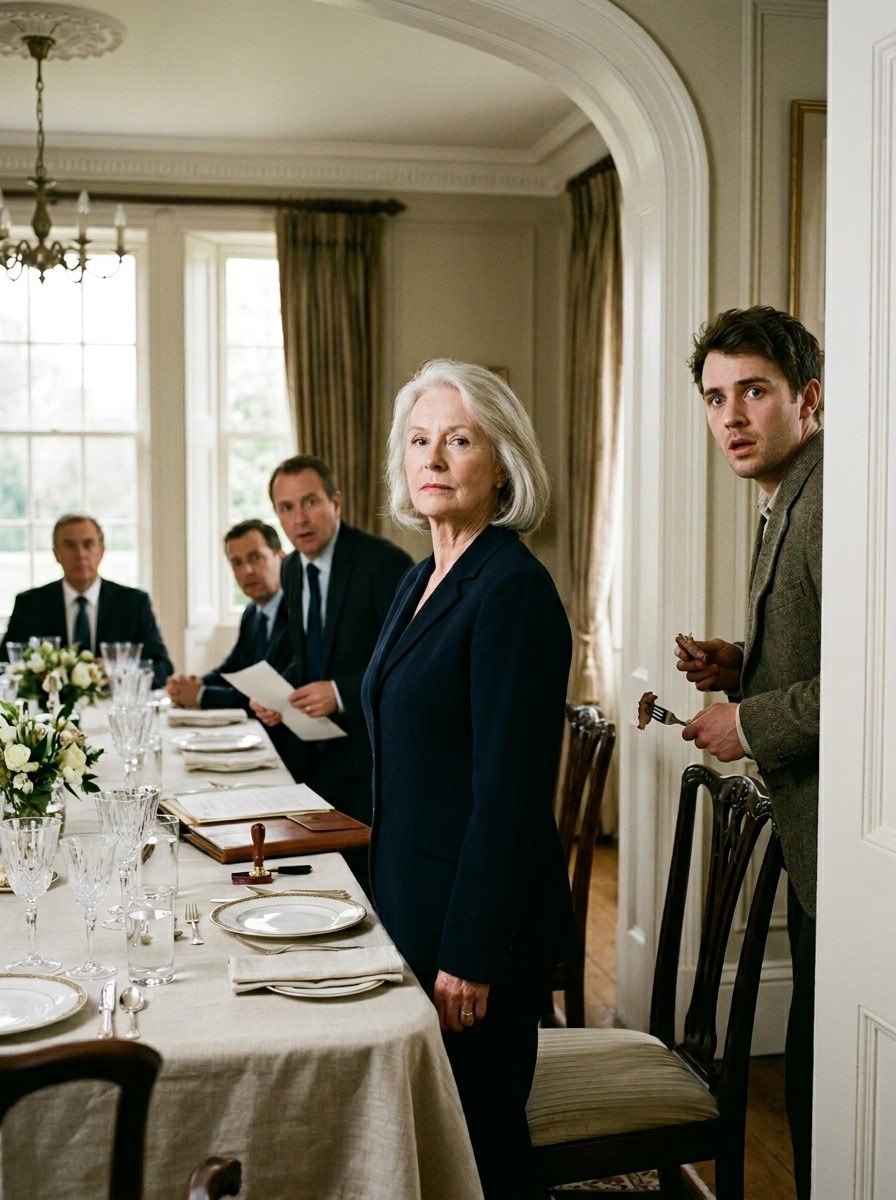
I roasted a prime rib the way Arthur used to request it for holidays, slow and low, seasoned with rosemary and garlic, the smell filling every room of the house by noon. I took out Arthur’s crystal glasses, the ones we’d received as a wedding gift forty-one years earlier and only used on occasions that genuinely mattered. I set the dining room table with the good china, pressed linen napkins, and the silver candlesticks that had belonged to Arthur’s mother.
The table looked like something from a magazine. Six place settings, though Garrett would only expect two.
At one fifteen, Mr. Hartwell arrived through the back entrance with two associates, both younger attorneys from his firm who specialized in estate restructuring. A notary arrived separately, a quiet woman named Ms. Chen who set up her materials at the far end of the dining table with the efficient calm of someone who had done this many times before.
I showed Mr. Hartwell the security footage from the previous evening on my laptop. He watched it once without speaking, then watched it a second time, then closed the laptop gently and looked at me with an expression I had known him long enough to read clearly.
“Eleanor,” he said. “I want you to understand that what I’m about to help you do is entirely within your legal rights, and Arthur anticipated this possibility specifically when we drafted these documents six years ago.”
“I understand,” I said.
“And I want you to know,” he continued, more quietly, “that Arthur told me, the last time we met before he passed, that he hoped you would never need to use them. But that he trusted your judgment completely if the day ever came.”
I pressed my lips together and nodded once.
They began working through the documents at the dining table. The disinheritance was not a simple signature on a single page. It was a comprehensive restructuring of the Calloway family trust, removing Garrett as a beneficiary, redirecting his share into a charitable foundation Arthur and I had discussed establishing years earlier, and formally documenting the grounds for the change, which now included timestamped security footage of the previous evening’s assault alongside a physician’s written report documenting the injuries.
By two forty-five, everything was signed, witnessed, and notarized. Ms. Chen placed her seal on the final page and quietly packed her materials. Mr. Hartwell’s associates organized the documents into a thick leather folder and placed it at the head of the table, beside Arthur’s crystal glasses, right where the centerpiece would normally sit.
Then I asked them all to stay.
“He’ll be here by three,” I said. “He always comes by on Saturdays to check whether I’ve done what he told me to do.”
Mr. Hartwell looked at me carefully. “You want him to see us.”
“I want him to understand,” I said, “that the conversation he thinks he’s walking into is not the conversation that’s actually waiting for him.”
The three men in suits took their seats at the dining table. I poured water into Arthur’s crystal glasses. The prime rib rested on the serving platter, perfectly carved, the rosemary still fragrant in the warm afternoon air.
At three twelve, the front door opened without a knock.
Garrett’s voice carried from the hallway before he was even visible.
“Something smells good,” he called out, the casual confidence of a man who believed his mother had spent the night reconsidering her position and had prepared this meal as a peace offering, an apology, an acknowledgment that he was right and she had been foolish to resist.
He walked into the dining room, reached across the table, tore a piece of prime rib off the platter with his bare fingers, and grinned at me while chewing.
“Good girl,” he said. “Now go get my checkbook. We’re settling this today.”
Then he noticed the three men in suits sitting at the far end of the table.
His hand stopped halfway to his mouth.
Mr. Hartwell stood slowly.
“Good afternoon, Garrett,” he said. “Please sit down. We have some documents to discuss.”
Garrett looked at Mr. Hartwell. Then at the two associates. Then at the thick leather folder sitting at the head of the table beside his father’s crystal glasses.
Then he looked at me.
For the first time in years, I saw something in my son’s face that wasn’t entitlement or anger or the easy contempt he had learned to wear like cologne.
It was fear.
PART 3 — FINAL
Garrett didn’t sit down right away. He stood at the edge of the dining room with a piece of his father’s prime rib still in his hand and looked between the three attorneys and me with the rapidly shifting expression of a man trying to determine which version of charm or aggression would work best in a room where neither was going to help him.
“What is this,” he said, not quite a question, more a demand dressed up as one.
Mr. Hartwell opened the leather folder and turned it toward Garrett without sitting back down.
“This is a formal amendment to the Calloway Family Trust,” he said, his voice carrying the particular calm of an attorney who has spent decades delivering news that people do not want to hear. “As of two forty-seven this afternoon, signed, witnessed, and notarized, you have been removed as a beneficiary of the trust, the estate, and all associated holdings, including any future claim to this property.”
The piece of meat dropped from Garrett’s hand onto the linen tablecloth.
“You can’t do that,” he said, his voice climbing. “That’s my inheritance. Dad built that for me.”
“Your father built Calloway Freight for his family,” Mr. Hartwell said evenly. “He also built in specific provisions allowing your mother, as the surviving trustee, to restructure beneficiary designations at her sole discretion, under circumstances that included but were not limited to financial exploitation, documented abuse, or conduct that endangered the integrity of the estate.” He paused. “All three conditions have now been met.”
Garrett turned to me, and for one brief second, I saw the version of him I had been holding onto for twenty-nine years, the boy who needed his mother, the child underneath the man who had pushed me to the floor the night before.
“Mom,” he said, his voice dropping. “You can’t be serious.”
“I am serious, Garrett.”
“Because of last night? I barely touched you.”
One of Mr. Hartwell’s associates reached across the table and opened a laptop, tilting the screen toward Garrett without a word. The security footage played in silence, clear enough that every detail was unmistakable, the push, the fall, the way he’d stepped over me, the words he’d said while I lay on the marble floor.
Garrett watched himself for approximately four seconds before looking away.
“That’s not what it looks like,” he said.
“It is exactly what it looks like,” I said. “And Dr. Paulson has already filed a medical report documenting the injuries, which is also included in the amendment filing as supporting evidence.”
Something shifted in Garrett’s posture then. The charm was gone. The anger was gone. What remained was something rawer and more desperate, the particular helplessness of a person who has spent their entire adult life assuming that the safety net beneath them was permanent and has just watched it disappear in the space of a single conversation.
“Mom,” he said. “Please. I’ll pay you back. I’ll get help. I’ll do whatever you want.”
I had heard those words before. Three times, in fact. Each one followed by a period of careful behavior that lasted exactly long enough for me to lower my guard before the next crisis arrived.
“I believe you mean that right now,” I said honestly. “I believe that standing in this room, at this moment, you genuinely want to change. But I also believed that the last three times, and the last three times ended with someone at my door showing me photographs of documents you’d signed with my name attached to them.”
I stood up from my chair, slowly, because my side still ached from the night before.
“This is not punishment, Garrett,” I said. “This is protection. Your father asked me to protect what we built. I should have done it sooner. I should have done it the first time you used my name on a loan application without my knowledge. I waited too long because I kept choosing to believe you over the evidence, and last night you showed me what that belief actually cost me.”
Garrett’s eyes were wet now, though whether from genuine remorse or from the particular grief of losing access to money he had always assumed would be there, I could no longer tell the difference, and I had decided I no longer needed to.
“What happens to me?” he asked quietly.
“You’re a twenty-nine-year-old man,” I said. “You figure that out yourself. For the first time in your life.”
Mr. Hartwell closed the folder. His associates began packing their materials. Ms. Chen had already left.
Garrett stood in the dining room for a long moment, looking at the table his mother had set with his father’s crystal, at the prime rib he had torn apart with his bare hands, at the leather folder that had just erased every assumption he’d built his entire adult identity on top of.
Then he left.
He didn’t slam the door. He didn’t shout. He just walked out, quietly, which was somehow worse than anger would have been, because it meant some part of him understood that there was nothing left to argue about.
I stood alone in the dining room for a while after everyone had gone. The candles were still burning. Arthur’s crystal glasses still caught the afternoon light. The prime rib sat half-carved on the platter, growing cold.
I thought about Arthur. About the letter in the safe. About the sentence he had written knowing, even then, that this day might eventually come.
Protect what we built, Eleanor. Even from our own son if it comes to that.
I had waited too long to follow that instruction. I knew that. Some part of me would always carry the guilt of not acting sooner, of choosing hope over evidence three times too many, of lying on a marble floor at midnight before I finally picked up the phone.
But I had picked it up.
And the dining room table was still set with his father’s crystal, and the documents were signed, and the house was quiet in the way it used to be quiet before Garrett started treating it like something he was owed rather than something that had been built, carefully and slowly, by two people who had loved each other and loved him and had simply, finally, run out of ways to pretend that love alone was enough to fix what was broken.
I blew out the candles.
Washed the crystal glasses by hand.
Put the leftover prime rib in the refrigerator.
And sat in the living room with the security footage deleted from the laptop but saved permanently on a drive Mr. Hartwell had taken with him, because some evidence should be kept even after the decision has already been made, in case the decision ever needs defending again.
Share this for every parent who loved their child enough to finally stop enabling them, and for every mother who set the table one last time before changing the terms of her own life. ❤️👇
— Update: Garrett checked himself into a treatment program eleven weeks later. I found out through his cousin, not from him directly. I haven’t visited yet. I’m told that’s normal at this stage, and that when he’s ready, if he’s ready, the conversation will look different than any one we’ve had before. I’m willing to wait for that version. But I’m not willing to go back to the old one.