PART 2
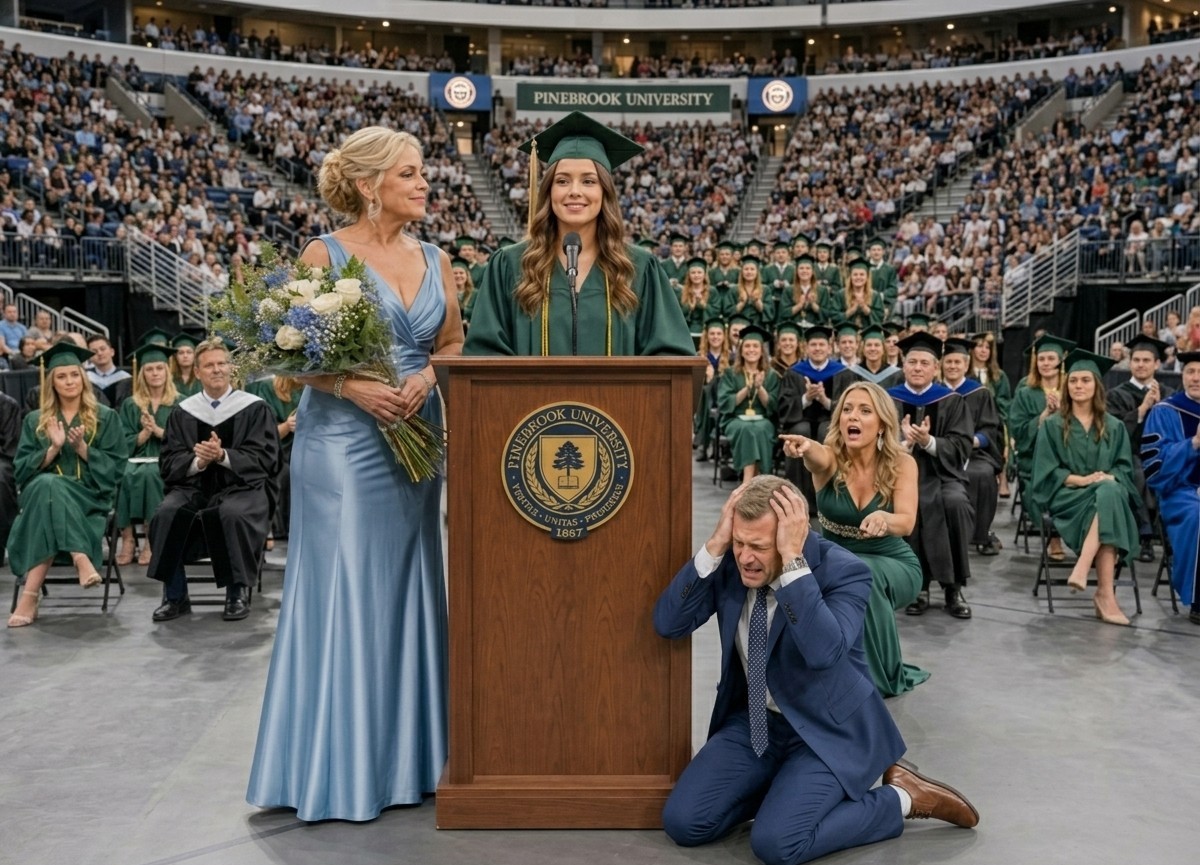
The Dean’s voice carried across Madison Square Garden like something inevitable.
“Dr. Emily Hart.”
I walked onto the stage.
Not fast. Not slow. The measured pace of a woman who had spent fifteen years arriving at this exact moment and was not going to rush through a single second of it.
Fourteen thousand people applauded.
I didn’t hear most of them.
I heard Olivia.
Even in an arena that size, I found her immediately — second row, emerald dress, yellow roses crushed against her chest because she was pressing them so hard. Her face was completely wrecked with tears and pride and the particular joy of a woman who had taken a terrified thirteen-year-old with a chemotherapy port in her chest and said I want to bring her home and had spent every day since making sure that home was real.
Then I found them.
Two seats away from Olivia.
My mother — Karen Parker — was holding the program open to the page with my name on it. Her lips were moving silently. Reading it. Rereading it. Trying to reconcile the words Dr. Emily Hart, Valedictorian with the girl she had left in a hospital bed fifteen years ago because saving her life would have cost the same as her sister’s college fund.
My father — Richard Parker — was completely still. His hands were flat on his knees. His face carried the expression of a man doing math he didn’t want to finish. The kind of math where the answer makes you the villain of your own story.
Hart.
Not Parker.
I had shed their name the way a body sheds d!ed cells. Quietly. Completely. Without ceremony.
I reached the podium. The Dean shook my hand. The audience settled.
I had a prepared speech. Twelve minutes of gratitude, inspiration, and the standard encouragement that valedictorians deliver to their classmates while everyone’s parents take photographs.
I set it aside.
“I was diagnosed with acute lymphoblastic leukemia when I was thirteen years old,” I said.
The arena went quiet.
“My biological parents were given a choice. Pay for my treatment or protect their other daughter’s college fund. They chose the fund.”
A murmur moved through the crowd.
“They signed emergency custody papers before sunset. They left the hospital without saying goodbye. That night, while I lay alone in a room that smelled like antiseptic and fear, a woman walked in.”
I looked at Olivia.
“Her name is Olivia Hart. She was my night nurse. She stayed past the end of her shift because she could not leave a child alone on the worst night of her life. She stayed through every treatment, every setback, every morning I woke up too sick to believe I would survive the afternoon.”
Olivia pressed the roses against her face.
“And then she adopted me.”
The arena responded. Not with polite applause. With the deep, full-throated sound of fourteen thousand people recognizing something real.
“She took out a second mortgage,” I continued, “so I would never feel like a burden. She drove me to every appointment. She held my hand during every scan. And when I told her I wanted to become a doctor so no child would ever feel as alone as I did, she said four words.”
I paused.
“‘We’ll prove them wrong.'”
I looked at Richard and Karen Parker.
They were frozen.
My mother’s hands were gripping the program so tightly the paper had torn at the edges. My father’s jaw was locked in the rigid position of a man who understands, in front of thousands of witnesses, that the daughter he called ordinary has just become the most extraordinary person in the room.
“I am not telling you this for sympathy,” I said. “I am telling you this because somewhere in this arena, someone is carrying a version of what I carried. Someone has been told they are not worth the investment. Someone has been called ordinary by people who were supposed to love them unconditionally.”
I looked out at the graduating class.
“You are not ordinary,” I said. “You never were. And the people who couldn’t see that were never qualified to make that judgment.”
The standing ovation began before I finished the sentence.
THE FINAL CHAPTER
After the ceremony, the receiving area was packed with families embracing their graduates, taking photographs, exchanging flowers and tears and the particular joy of an ending that is actually a beginning.
Olivia reached me first.
She didn’t say anything. She just held on, roses crushed between us, her face pressed into my shoulder, crying the way she had cried the night she told the hospital she wanted to bring me home — not politely, not quietly, with the full unguarded force of a woman who loved someone so much she had restructured her entire life around keeping them alive.
“You did it, baby,” she whispered.
“We did it,” I said.
Then I saw them approaching.
Richard walked first. Karen trailed behind, clutching the torn program, her face arranged into an expression I recognized from fifteen years ago — the particular blend of manufactured warmth and strategic tears she had used at church gatherings whenever someone asked about her “other daughter.”
Richard stopped four feet from me.
“Emily,” he said. “That was remarkable.”
I looked at him.
The last time I had heard him say my name, I was thirteen years old, sitting in a hospital bed with an IV in my arm, watching him sign paperwork that made me someone else’s responsibility.
“Thank you,” I said. Nothing more.
“We should talk,” he said. “Privately. There are things we need to discuss.”
“Such as?”
He glanced at Olivia, then back at me, with the careful calculation of a man who has noticed the cameras nearby and wants this conversation to happen somewhere without witnesses.
“Family matters,” he said.
“You’re not my family,” I said. “You made that decision fifteen years ago when you chose Ashley’s college fund over my chemotherapy.”
Several nearby guests heard that sentence. One woman stopped walking. A photographer lowered his camera.
Karen stepped forward, tears streaming now, the performance fully committed.
“Emily, sweetheart, we were scared. We didn’t know what to do. We thought the state could help you better than we could. We never stopped thinking about you—”
“You never called,” I said. “Not once. Not on my birthday. Not when I finished treatment. Not when I was adopted. Not when I graduated high school, or college, or applied to medical school.” I looked at her steadily. “You contacted the university two weeks ago because you saw my name in a press release about the valedictorian. That is not thinking about me. That is recognizing an opportunity.”
Karen’s tears shifted from performed to genuine, though I couldn’t be certain where one ended and the other began.
“We made a mistake,” Richard said. “A terrible mistake. But we are still your parents—”
“Olivia is my parent,” I said. “She held my hand during chemotherapy. She refinanced her house so I could eat during treatment without feeling guilty. She sat in the waiting room of every scan for three years, and every time I came out she said the same thing — ‘Whatever it says, we face it together.’ That is a parent.”
I looked at both of them.
“You are two people who decided I was too expensive to love.”
The receiving area had gone very quiet around us.
Richard’s composure finally cracked. Not into remorse. Into the thing underneath remorse that he had been carrying the entire time.
“Ashley never finished college,” he said abruptly. “She dropped out after two years. The fund — we spent most of it. We’re not — things aren’t what they were.”
There it was.
The real reason they had contacted the university.
Not pride. Not guilt. Not the sudden resurrection of parental love after fifteen years of silence.
Money.
Their other daughter, the promising one, the one whose future was worth more than my life, had dropped out. The college fund was gone. And now they were standing in front of the daughter they had abandoned, the one who had become a doctor at one of the most prestigious medical schools in the country, hoping that her success might somehow become their retirement plan.
“I’m sorry that happened to Ashley,” I said. “Genuinely. She was my sister once. But I am not your financial recovery strategy.”
Karen made a sound.
“And I want to be very clear about something,” I said. “I do not hate you. Ha:ting you would require me to still care about your opinion of me, and I stopped caring about that the night Olivia walked into my hospital room and chose me when you wouldn’t.”
I reached into my bag and pulled out a small envelope.
Richard’s eyes widened slightly, likely expecting a check, or an offer, or some bridge back into the life I had built without them.
I handed it to Karen.
Inside was a photograph. Me at thirteen, bald from chemotherapy, sitting up in a hospital bed, smiling at the camera because Olivia had just told me a joke that wasn’t even funny but I laughed anyway because she had stayed past midnight to make sure I wasn’t alone.
On the back, in my handwriting: This is the girl you left behind. She survived anyway.
Karen looked at the photo.
Her hand covered her mouth.
Richard stared at it over her shoulder.
For one moment — one honest, unperformed, human moment — I saw something real on their faces. Not the calculation I had grown up with. Not the strategic tears. Something that might have been genuine grief for a decision that could never be undone.
I didn’t wait to find out whether it was real.
“Goodbye,” I said.
Then I turned around, took Olivia’s arm, and walked out of Madison Square Garden with the woman who had chosen me when the people who created me decided I wasn’t worth saving.
We had dinner that night at a small Italian restaurant near Olivia’s apartment, the same restaurant where she had taken me after my final chemotherapy session eleven years earlier. She ordered the same pasta she had ordered then. I ordered wine because I was finally old enough to drink legally and because some milestones deserve their own celebration.
“Was it enough?” Olivia asked.
“Was what enough?”
“Saying it to their faces. Was it what you needed?”
I thought about it.
“I thought it would feel like victory,” I said. “It didn’t. It just felt like the truth finally being said out loud in a room where it belonged.”
Olivia nodded.
“That’s better than victory,” she said. “Victory runs out. Truth just sits there and waits.”
I raised my glass.
“To you,” I said. “For everything. For the second mortgage. For the midnight shifts. For proving them wrong.”
Olivia raised hers.
“To us,” she corrected. “I didn’t prove anything. You did. I just made sure you had a kitchen table to come home to while you did it.”
We clinked glasses.
The pasta was exactly as I remembered.
Some things, it turns out, survive everything.
Share this for every child who was told they weren’t worth the investment, and for every person who stepped in when a parent stepped out. ❤️👇
— Update: I started my pediatric oncology residency last month. My first patient was a twelve-year-old girl whose parents sat beside her bed every single day. When her mother asked me why I chose this specialty, I told her the truth. She held her daughter’s hand tighter for the rest of the visit. Olivia came to my white coat ceremony. She wore the same emerald dress. She brought the same yellow roses. Some traditions don’t need to be reinvented. They just need to be repeated by the right person.
