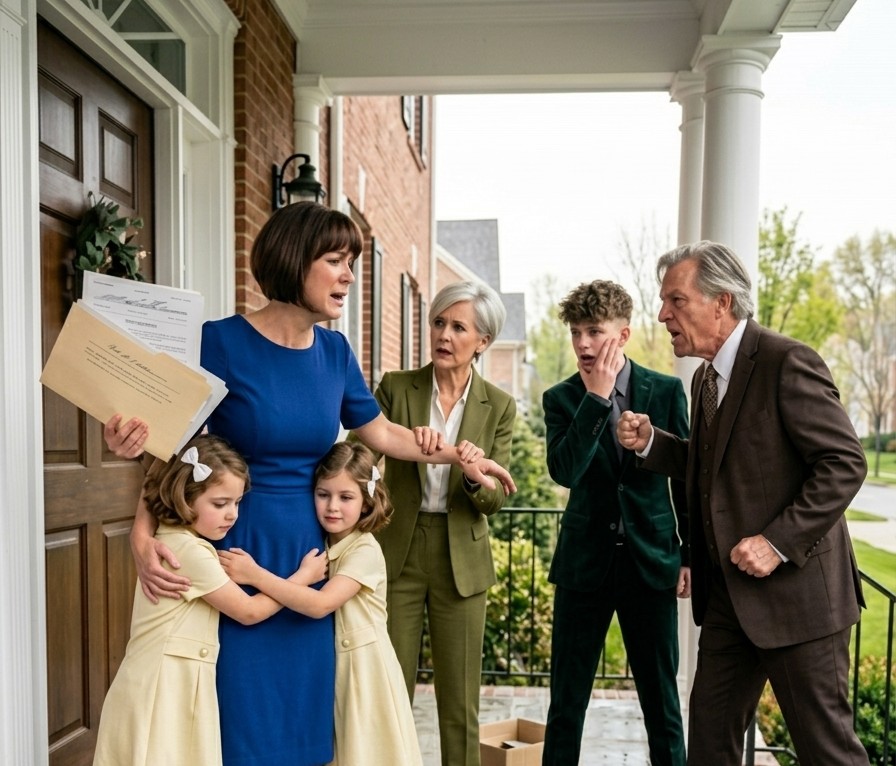
PART 2
Attorney Rebecca Hale answered on the second ring.
Not a receptionist. Not a voicemail. Rebecca herself, at four thirty on a Saturday afternoon, as though she had been sitting beside her phone waiting for exactly this call.
“Julia,” she said. “He told me you’d call today.”
My throat tightened. “He knew?”
“Mark came to my office eleven weeks ago,” Rebecca said. “He sat across from my desk for three hours. He told me everything — his parents’ temperament, their history of financial control, what he believed they would do within twenty-four hours of his passing.” She paused. “He was remarkably precise.”
I looked at Noah in the passenger seat, holding a cold water bottle against his cheek where Richard’s hand had left a red mark that was already darkening. Lily was in the back seat, silent, gripping her stuffed rabbit, her eyes wide and dry in the way children’s eyes get when they’ve moved past fear into something quieter and worse.
“They h!t my son,” I said.
Rebecca’s voice went sharp. “Document it. Photograph the mark. Time-stamp everything. I need you to do that right now before you do anything else.”
I took three photos of Noah’s face with my phone. He didn’t flinch. He just sat there, sixteen years old, holding ice against the place where his grandfather had struck him on the day he buried his father.
“Done,” I said.
“Good,” Rebecca said. “Now listen to me carefully, Julia. The house on Maple Drive is legally yours. Mark transferred the deed into your name fourteen months ago through a quiet title amendment. His parents were not notified. The lake property in the Poconos was placed in an irrevocable trust for you and the children eight months ago. And the business shares—”
“What business shares?” I asked. “Mark worked in logistics. He was a regional manager.”
A pause.
“Julia,” Rebecca said carefully. “Mark didn’t just work for Whitman Freight. He owned thirty-eight percent of it.”
The car felt suddenly very small.
“His parents hold the remaining shares,” Rebecca continued. “But Mark’s stake was transferred into a family trust with you as the sole trustee and your children as beneficiaries. Richard and Elaine have no access, no vote, and no authority over those shares.”
I looked through the rain-streaked windshield at nothing in particular.
Eleven years of marriage. Eleven years of watching Mark go to work in khakis and a company polo, eating packed lunches, driving a truck that was two years older than it needed to be. Eleven years of his parents treating us like we lived on their generosity, reminding me at every holiday that Mark “could have married better,” that I should be “grateful for what the Whitman name provides.”
And the entire time, Mark had been quietly, methodically, making sure that if the worst happened, the people who called me a burden would discover they had no power at all.
“There’s one more thing,” Rebecca said. “The letter in the folder. Did you read the second page?”
I flipped past Mark’s handwritten note.
The second page was a printed document. A restraining order petition, pre-drafted, requiring only my signature and a judge’s stamp. Mark had prepared it based on what he called “a pattern of verbal and emotional ab:use from Richard and Elaine Whitman toward Julia Whitman and minor children.”
He had listed eleven specific incidents spanning nine years. Dates. Locations. Witnesses.
Nine years of cruelty I had absorbed in silence because I thought that was what good wives did.
Mark had been writing it all down.
“He kept a record,” I whispered.
“He kept everything,” Rebecca said. “He told me that you would never protect yourself from his parents while he was alive because you loved him too much to force the confrontation. So he made sure that after he was gone, you wouldn’t have to fight. Just sign.”
Noah looked at me.
“Mom,” he said quietly. “What’s in the folder?”
I wiped my eyes.
“Everything your father wanted us to have,” I said. “And everything he knew they would try to take.”
I signed the restraining order petition in the parking lot of a gas station while my children ate the only dinner I could afford that night — two granola bars and a bottle of water split three ways.
Rebecca filed it electronically within the hour.
By nine that evening, Richard and Elaine received a legal notification informing them that they were prohibited from approaching, contacting, or entering the property of Julia, Noah, and Lily Whitman.
The property they had locked us out of four hours earlier.
The property that had been legally mine for fourteen months without them knowing.
PART 3 — THE FINAL CHAPTER
Richard called at six the next morning.
I was lying on a pull-out couch at my sister’s apartment, Noah asleep on the floor beside me, Lily curled against my side with her rabbit. I had slept maybe ninety minutes.
I answered because Rebecca had told me to. “Let him talk,” she’d said. “Record everything.”
“Julia,” Richard said. His voice carried the particular tone of a man who had spent the night discovering that the ground beneath him was not as solid as he had assumed. “We need to talk about this restraining order nonsense.”
“It’s not nonsense,” I said. “You struck my son.”
“I disciplined him. He was being disrespectful—”
“You h!t a sixteen-year-old boy on the day he buried his father,” I said. “And your wife ripped a ring off my hand hard enough to break the skin. I have photographs and I have witnesses.”
Silence.
“Julia, listen to me. That house belongs to the Whitman family—”
“The house belongs to me,” I said. “Mark transferred the deed fourteen months ago. Your name is not on it. It was never on it.”
A longer silence.
“That’s impossible,” Richard said. “I helped him with the down payment.”
“You gave him a gift,” I said. “Gifts don’t come with ownership, Richard. Mark’s attorney can walk you through the documentation if you’d like.”
I heard Elaine’s voice in the background, muffled but unmistakable: “She’s lying. Call Thomas.” Thomas was their attorney.
“Call Thomas,” I agreed pleasantly. “And while you’re at it, ask him to explain the trust structure on the Whitman Freight shares. Because I’m told that’s going to be a very interesting conversation.”
The line went dead.
Thomas called Rebecca by noon. What followed, according to Rebecca, was forty-five minutes of an attorney slowly explaining to two people in their seventies that their d!ed son had spent the last year of his life legally transferring every significant asset away from their control and into his wife’s name, quietly, precisely, and with the kind of meticulous documentation that left absolutely no room for challenge.
The house. The lake property. The business shares. Even the life insurance, which Richard had apparently assumed would flow through the family estate, had been redirected to a policy naming me as sole beneficiary eighteen months earlier.
Mark had planned for everything.
Because Mark had watched his parents treat me like an outsider for eleven years, and he had loved me too much to believe they would stop simply because he was no longer there to stand between us.
Elaine showed up at my sister’s apartment two days later.
She came alone. No Richard. No attorney. Just a woman in a dark coat standing on a doorstep with an expression I had never seen on her face before.
She held out her hand.
In it was my wedding ring.
“I shouldn’t have taken it,” she said.
I looked at the ring. At the diamond she had called her mother’s. At the scratch on my finger where she had torn it free.
“No,” I said. “You shouldn’t have.”
I took it.
She stood there for a moment, clearly waiting for something — an invitation inside, a softening of my face, the kind of quiet forgiveness she had grown accustomed to receiving from a daughter-in-law who had spent eleven years choosing peace over confrontation.
“Julia,” she said. “We were grieving. We weren’t thinking clearly—”
“You were thinking very clearly,” I said. “You changed the locks. You brought a plan. You knew exactly what you were doing, and you did it while his body was still warm.”
Her face crumpled slightly.
“Elaine,” I said. “I am going to say something to you that I should have said years ago, and I need you to hear every word.”
She waited.
“Mark loved you,” I said. “Despite everything. He loved you both so much that he spent the last year of his life building a legal wall around me and the children, not to punish you, but because he knew that without that wall, you would do exactly what you did. And the fact that he was right — the fact that you proved him right within hours of his fun:eral — is something I think you should sit with for a very long time.”
Elaine’s eyes filled with tears.
“The restraining order stands,” I said. “If you want to see your grandchildren eventually, that process begins with Rebecca Hale, not with my doorstep. And it begins with an apology to Noah. Not to me. To the boy your husband struck across the face while he was still wearing the suit he buried his father in.”
I closed the door.
We moved back into our house the following weekend. Rebecca had the locks changed and a security system installed. Noah chose to keep his father’s old office exactly as it was — the desk, the lamp, the framed photo of our family at the lake property that was now held in trust for him and his sister.
Lily asked me once, a few weeks later, why Grandma and Grandpa had been so mean.
I thought about it carefully.
“Because they were afraid,” I said. “And afraid people sometimes do terrible things to the people who remind them of what they’ve lost.”
“Are you afraid, Mommy?”
I looked at the ring back on my finger. At the folder still sitting on the kitchen counter. At the letter in Mark’s handwriting that had saved us.
“Not anymore,” I said.
Richard and Elaine contested the trust through Thomas. The challenge was dismissed within six weeks. Mark’s documentation was, as Rebecca put it, “the most thorough estate protection she had seen from a non-attorney in twenty years of practice.”
Richard never apologized to Noah.
Elaine sent a letter three months later. It was addressed to both children. It did not mention the porch, the ring, or the slap. It talked about missing them and wanting to be a family again.
Noah read it once and set it on his desk without comment.
Lily drew a picture of a house with a locked door and four stick figures inside and wrote underneath: Our house. Our family. Dad keeps us safe.
She was nine years old and she understood something her grandparents still hadn’t figured out: you don’t get to h!t someone and then ask to be let back in as if nothing happened.
I hung the drawing on the refrigerator.
Right next to the letter from Mark that had changed everything.
Some men protect their families with their presence.
Mark protected his with preparation.
And the folder in the glove compartment, the one I almost didn’t open, turned out to be the last and most important thing he ever gave me.
Share this for every person who was underestimated at their lowest moment, and every partner who loved someone enough to plan for the fight they knew was coming even when they wouldn’t be there to fight it. ❤️👇
— Update: Noah turned seventeen last month. He asked to visit the lake house for his birthday. Just the three of us. We sat on the dock and he told me he remembers everything his father said during the last two months. Every conversation. Every piece of advice. Every time Mark said, “Take care of your mom and your sister.” He said he’s been doing that every day since. I told him I know. Because I do. Mothers always know.
