Paola
I was twenty-eight weeks pregnant when my sister-in-law locked me outside in the cold. Her name was Paola, and from the moment I married her brother Alejandro, she had treated me like an unwelcome intruder. Nothing I did was ever good enough. She criticized my cooking, mocked my clothes, complained about the way I spoke. When I became pregnant, her attitude only grew worse. According to Paola, I wasn’t experiencing pregnancy symptoms — I was being dramatic. Lazy. Attention-seeking. Every ache, every doctor’s appointment, every moment of exhaustion became another reason for her to roll her eyes.
My husband always dismissed it. “That’s just Paola,” Alejandro would say. “Don’t let it get to you.” But after a while, it was impossible not to. There is a specific kind of exhaustion that comes from being in a room with someone who has decided to dislike you and is committed to making that decision visible. I felt it every time the family gathered. I felt it at every meal, every holiday, every ordinary afternoon that Paola turned into a referendum on whether I deserved to be there.
Thanksgiving
That Thanksgiving weekend, Alejandro’s family gathered at our apartment because his mother’s kitchen was being remodeled. I spent the entire day cooking with a back that ached and feet that were swollen and a baby who seemed determined to kick every few minutes. Still, I pushed through — because that was what I always did, because saying I couldn’t would give Paola exactly the ammunition she was always looking for.
When she arrived, late as usual, she surveyed the dining table, the decorations, and everything I had spent hours preparing. A smug smile appeared. “Well,” she said, dropping her purse on the counter, “I’m surprised you managed to stay on your feet long enough to cook all this.” I forced a smile. Inside, I was already exhausted before the real night had even started.
After dinner, while Alejandro and his father carried trash bags downstairs, Paola followed me into the kitchen. “You missed a spot,” she said, pointing at the stove. “I’ll clean it,” I replied. She folded her arms. “You know, women in this family don’t act helpless every time they’re pregnant.” I turned toward her. “I’m not helpless. I’m tired.” She laughed. “Tired has been your excuse for months.”
Click
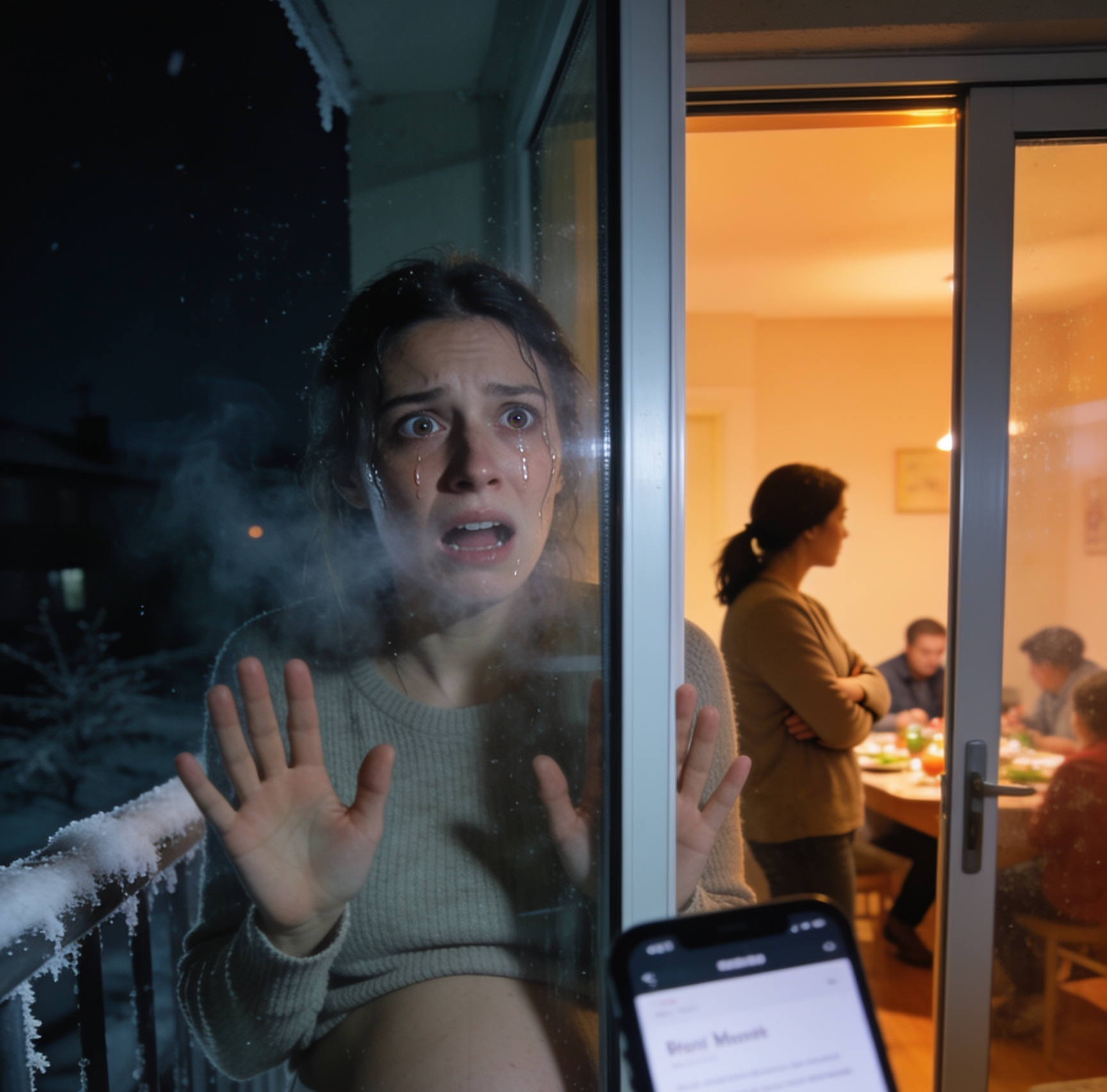
I didn’t want an argument. So I grabbed a tray and stepped onto the balcony to retrieve the soda bottles we had been chilling outside in the cold. The second I stepped through the sliding door, it slammed shut behind me. Then I heard it. Click. The lock. At first I thought it was accidental. I reached for the handle. It wouldn’t move. My stomach dropped.
On the other side of the glass stood Paola. Watching me. Arms crossed. Expression cold. “Paola!” I shouted. “Open the door!” She walked closer. Then she smiled. “Maybe a little discomfort will teach you to stop acting so weak.” For a moment I couldn’t believe what I was hearing. “Are you serious?” I yelled. “I’m pregnant!” She rolled her eyes. “You’ll survive a few minutes.” Then she turned around and walked away.
The cold hit me immediately. The thin sweater I was wearing offered almost no protection. I began pounding on the glass — harder, louder, screaming Alejandro’s name while music played inside and people laughed and plates clattered and no one noticed. The wind grew stronger. My fingers lost feeling first. Then my toes. Minutes felt like hours. My breathing became uneven. Fear wrapped itself around my chest.
The Cramps
Then I felt it. A sharp cramp deep in my abdomen — stronger than anything I had experienced before. I froze. Another cramp followed, even worse. My knees nearly buckled. I wrapped both arms around my stomach, terrified for my baby, and in that moment I realized this was no longer about discomfort. Something was very wrong.
I don’t know exactly how long I was out there. Ten minutes. Maybe twenty. In the cold, time lost meaning. My hands had stopped hurting because I could barely feel them anymore, which terrified me more than the pain had. My breath came out in weak bursts. I put both hands over my belly and whispered “please, please be okay” but my voice was shaking so badly I could barely hear myself.
I pounded the glass again, weaker this time, and watched the warm bright apartment on the other side like it was a different world — Doña Victoria carrying dishes, laughter through the glass, and once, Paola walking past the door without even glancing at me. That was the moment I understood. This wasn’t careless. She knew I was there. She was choosing to leave me outside.
Doña Victoria
The cramps kept coming, each one sharper than the last. When another one twisted through my lower abdomen so hard that I cried out, I banged both fists against the glass and screamed Alejandro’s name with everything I had left. Doña Victoria finally turned toward the balcony. Her face changed instantly. She dropped the dish towel, rushed to the door, and yanked at the handle — but it wouldn’t open from inside either.
She started screaming for Alejandro, for help, for anyone. The room erupted. I heard running, shouting, the crash of something being knocked over. I had stopped pounding by then. I couldn’t anymore. My legs had given out beneath me, and I was on my knees on the balcony floor with my hands still pressed against the glass and my eyes already starting to close.
By the time the door was opened from outside, I was unconscious on the floor. The paramedics arrived within minutes. I came back to awareness in an ambulance, with an oxygen mask on my face and a paramedic speaking to me in a calm, focused tone, asking me to stay with him. I could hear the equipment. I could feel the movement. I kept asking about my baby, but I couldn’t tell if the words were making it out of my mouth.
The Hospital
At the hospital, the doctors worked quickly. The diagnosis that came back was not a small thing. Hypothermia and severe cold exposure at twenty-eight weeks of pregnancy had caused significant physiological stress. My core temperature had dropped to a level that triggered preterm labor contractions — the cramps I had felt on the balcony were my body beginning to go into labor nine weeks early. The baby’s heart rate had been compromised during the exposure.
They managed to stop the contractions. My daughter stayed. But the next forty-eight hours were the most frightening of my life — monitoring, medications, a fetal specialist brought in to assess whether the cold exposure had caused any neurological impact on a brain that was still developing. The waiting was the worst part. Every reading on every monitor felt like a verdict.
Alejandro did not leave my bedside. He held my hand through the night and through the next day and through every ultrasound and every specialist consultation, and I could see in his face the exact moment he stopped making excuses for his sister. Nobody in that family said “you’ll survive a few minutes” after what the doctors showed them. Nobody said dramatic or lazy or attention-seeking. The medical reports had a different vocabulary.
What Happened to Paola
Paola was not at the hospital. She had left the apartment in the confusion after the ambulance was called, and none of Alejandro’s family had gone after her. By the next morning, she had not called or texted or sent any message through anyone. That absence said more than any apology could have, because it meant she understood what she had done — and had chosen to disappear rather than face it.
Alejandro’s mother, Doña Victoria, the woman who had dropped a dish towel and saved my life by noticing me through the glass, did not speak to Paola for months. When she finally did, the conversation — as Doña Victoria described it to me much later — was not a reconciliation. It was an accounting. A reckoning delivered by a mother who had watched her daughter-in-law collapse on a balcony floor and understood that her own silence over the years had been a form of permission.
Alejandro filed a police report. The lock on the balcony door and the security camera footage from the building hallway — which showed Paola entering and exiting the apartment in the relevant timeframe — were submitted as evidence. The case was reviewed by the district attorney’s office. Paola was charged with reckless endangerment. The case moved slowly, the way these cases do, but it moved.
My Daughter
My daughter was born eight weeks later, at thirty-six weeks, slightly early but healthy. She cried immediately and loudly, which the doctor said was exactly what she wanted to hear. I cried too — not because I had been scared, though I had been more scared than I had words for, but because she was here and she was loud and she had made it through the cold that her aunt had decided would be “good for” her mother.
We named her Elena. She has dark eyes and a serious expression that occasionally breaks into a smile so sudden it startles you. She has never met Paola, and she will not until she is old enough to understand why, and to decide for herself whether she wants to. That will be her choice, made with full information, when she is ready. I will not make it for her.
I don’t write this story to describe Paola as a monster, because the truth is more complicated and also more common than that. She was a woman who had decided I was weak and had been allowed to act on that decision without consequence for years, until the moment she acted on it in a way that nearly killed two people. The balcony was not an aberration. It was the logical end of something that had been building for a long time, in a family that had learned to call cruelty “just how Paola is.”
Nobody says that anymore. Some changes happen because of conversations and growth and time. And some changes happen because a woman pounds on a glass door in the cold until she can’t feel her hands, and the family on the other side of that glass finally has to look at what their looking away has cost. I almost died on a balcony at six months pregnant. My daughter almost never took her first breath. And the lesson the family learned was not about me being strong enough to handle suffering. It was about what happens when the people who are supposed to protect you decide, for long enough, that you don’t need protecting.
