11:47 p.m.
My name is Daniel Mercer. To most people, I am simply a retired military veteran living quietly in Illinois — spending my days repairing things around the house, drinking more coffee than I should, and calling my daughter Lily more often than she believes is necessary. She is nineteen years old, a sophomore at Bradley University, and the brightest part of my world. On a rainy Thursday night, everything changed.
The phone rang at exactly 11:47 p.m. Unknown number. Something told me to answer. “Am I speaking with Daniel Mercer?” “Yes.” “This is Mercy General Hospital. Your daughter has been brought into the emergency department.” My stomach clenched. “What happened?” A pause. Then the words that froze my blood: “She was attacked.”
Room 214
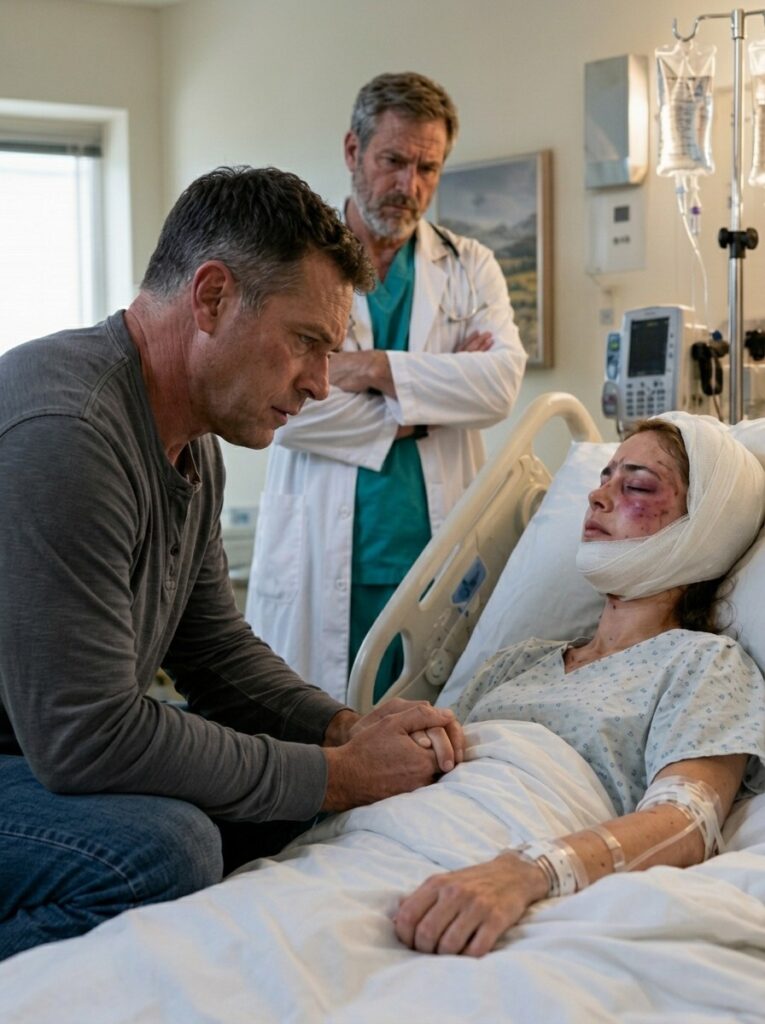
The drive to the hospital felt endless. Rain slammed against the windshield. My knuckles went white around the steering wheel. Every horrific possibility tore through my mind. When I reached room 214, nothing I had seen in my military career had prepared me for the image waiting inside.
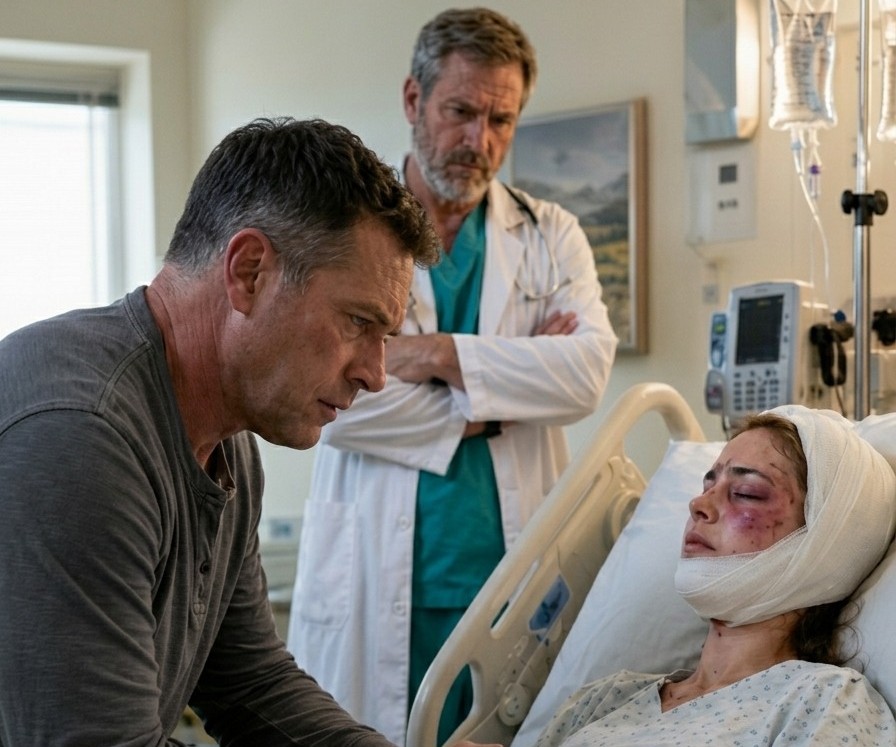
Lily lay still beneath white hospital blankets. Bandages covered her head and jaw. One eye was swollen completely shut. Bruises spread across her cheeks and forehead. A tube ran into her arm. On a nearby chair sat a clear evidence bag holding her favorite blue hoodie — the one I had bought her for Christmas. I moved closer. “Lily?” Her fingers moved faintly. That was all. I lowered myself into the chair beside her bed. “Sweetheart, I’m here.” A tear slid down her bruised cheek. Something inside my chest split apart.
Six Fractures
A surgeon came in carrying X-ray films. The exhaustion on his face told me the truth before he spoke. He placed the films on the light board, and I stared at fractures crossing my daughter’s jaw like cracks through broken glass. “Six separate fractures,” he said softly. “One near the hinge. Several along the lower jaw. Serious trauma.” His voice dropped. “Whoever did this hit her with extreme force.”
I understood what he wasn’t saying. This had not been an accident. Someone had meant to hurt her. Badly. “Will she recover?” “We believe she will. But she’ll require multiple surgeries.” I asked the only question that mattered: “Who did this?” The doctor exhaled. “We don’t know. Campus security found her unconscious near the science building.” A university campus full of students. No witnesses. That was when something felt very wrong — because campuses have students, students have phones, and attacks like this don’t happen without someone knowing the truth.
Three Phone Calls
I didn’t sleep that night. I sat in the chair beside Lily’s bed until five in the morning, and then I made three phone calls I hadn’t made in years — to people from my old unit who now worked in fields that made them very useful when someone needed answers the authorities weren’t providing.
The first was to Marcus Webb, a former intelligence analyst who now ran a private security firm. “Someone nearly killed my daughter,” I told him. “Campus security says no witnesses. I don’t believe them.” Marcus was quiet for three seconds. “Send me the university name. I’ll have camera access mapped within the hour.” The second was to Janet Torres, a former JAG officer. “I need to know what the university is hiding. If they’re protecting someone, I need it documented before they can scrub it.” The third call was to a man I will only refer to as Cole. He didn’t ask what happened. He just asked: “How far do you need me to go?” “As far as the truth takes us,” I said.
Non-Functional
By noon the next day, Marcus had something. The campus security footage from the science building had been reviewed by the university — but only partially. Three cameras covering the east stairwell and the loading dock had been marked as “non-functional” in the incident report. Marcus pulled the maintenance logs. Those cameras had been working perfectly forty-eight hours before Lily’s attack. Someone had changed their status to offline the morning after.
“Danny,” Marcus said, “someone inside the university altered the security system after the assault.” My hands tightened around the phone. “Who has access to do that?” “The campus security director. And one other person — the Dean of Student Affairs.” Janet filed a preservation order before the university could touch the footage. Within a day, a forensic IT specialist recovered the recordings from all three cameras.
The Name on the Building
What the footage showed made me sit in the hospital corridor and press my fists against my eyes until I could breathe again. Two male students followed Lily from the science building at 10:38 p.m. One grabbed her backpack. She turned. Words were exchanged. Then the larger one struck her — not once, but repeatedly, with a violence the forensic specialist later described as sustained aggravated assault. The smaller one stood watch.
Neither wore masks. They didn’t need to. The larger one was Tyler Ashworth — the son of the university’s single biggest donor. The Ashworth family had funded the new athletic center, the engineering wing, and three endowed professorships. The smaller one was his roommate, whose father sat on the university’s board of trustees. That was who the campus was protecting. Not a mystery attacker. The son of the man whose name was carved into the side of the building where my daughter was beaten unconscious.
Seven Figures
When the Dean learned what Marcus had recovered, she called the university’s general counsel within eleven minutes. They did not call the police. They called a crisis management firm. Janet intercepted the communication. “They’re preparing to offer you a settlement,” she told me. “Confidential. Probably seven figures. In exchange for the footage never going public.”
I looked through the window of room 214, where Lily was scheduled for her second jaw surgery the next morning. “They want to buy my daughter’s silence,” I said, “before she can even open her mouth.” I didn’t take the settlement. Instead, I did what I had been trained to do — I waited until every piece was in position before I moved.
The Grand Jury
Janet filed a criminal complaint with the county prosecutor, bypassing campus police entirely. Marcus delivered the recovered footage, the altered maintenance logs, and the internal communications showing the university had concealed evidence. Cole had spent the week quietly reaching out to three other young women who had reported incidents involving Tyler Ashworth over the past two years. All three complaints had been buried by the Dean. All three women agreed to come forward.
The county prosecutor convened a grand jury within a week. Tyler Ashworth was indicted on charges of aggravated battery causing great bodily harm. His roommate was indicted as an accessory. The Dean was placed on administrative leave pending an investigation into obstruction. And the university’s crisis management plan — designed to make my daughter’s beating disappear behind a confidential check — was entered into evidence as proof of institutional cover-up.
“Good”
Lily’s surgeries took four months. Titanium plates. Wire fixation. Specialists who rebuilt her jaw the way engineers rebuild bridges — carefully, precisely, knowing the structure had to hold for a lifetime. She couldn’t eat solid food for twelve weeks. She communicated through a whiteboard for the first month. The first full sentence she wrote after surgery was: “Did they get him?” I showed her the indictment. She read it twice. Then she wrote one more word and held it up for me to see: “Good.”
The trial took place the following spring. Tyler Ashworth was convicted. His roommate pleaded guilty. The Dean resigned. The university settled with all four women — and this time, there was no confidentiality clause. The settlements were public. The names were on record. The cameras that had been marked non-functional were entered into evidence as proof that the institution had chosen a donor’s money over a student’s safety.
The Hardest Battle
On the day the verdict was read, I sat in the back of the courtroom in the same jacket I had worn to the hospital that rainy Thursday night. Lily sat in the front row — her jaw wired, her back straight, her eyes steady. She didn’t look at Tyler when the word “guilty” was spoken. She looked at me.
And I understood something no military training had ever taught me: the hardest battle I would ever fight wasn’t in a war zone. It was in a hospital room at midnight, holding my daughter’s hand, promising her that the people who hurt her would be held accountable — and spending every hour afterward making sure that promise was kept.
If you take anything from this story, let it be this: institutions will protect their donors before they protect your children. Cameras will be marked as broken. Reports will be buried. Settlements will be offered before your daughter can open her mouth. The only thing standing between a cover-up and the truth is someone who refuses to stop asking questions — even when every door is closed, every witness is silent, and the name on the building belongs to the family that wants your daughter to disappear. Be that someone. Your child is counting on you.