My Mother-in-Law H.i.t My Two-Year-Old Daughter Over a Sausage, and I Finally Snapped: “My Daughter Was Not Born to Endure Your Contempt”
PART 1
“You spoiled little glutton! That’s why I h.i.t her!”
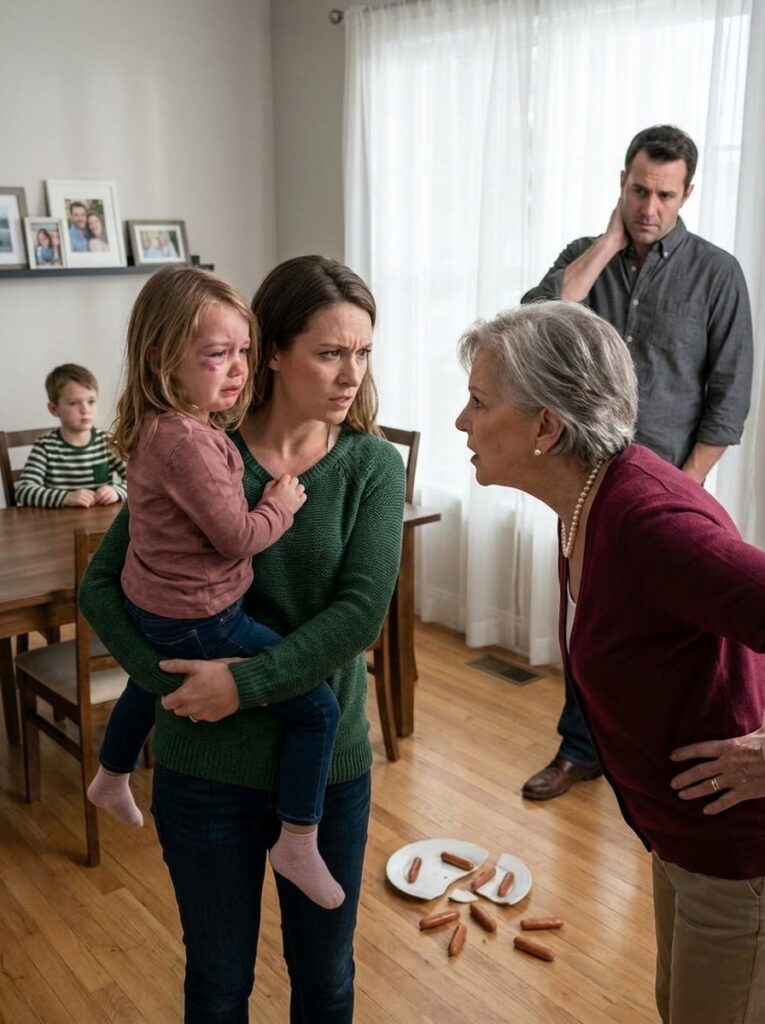
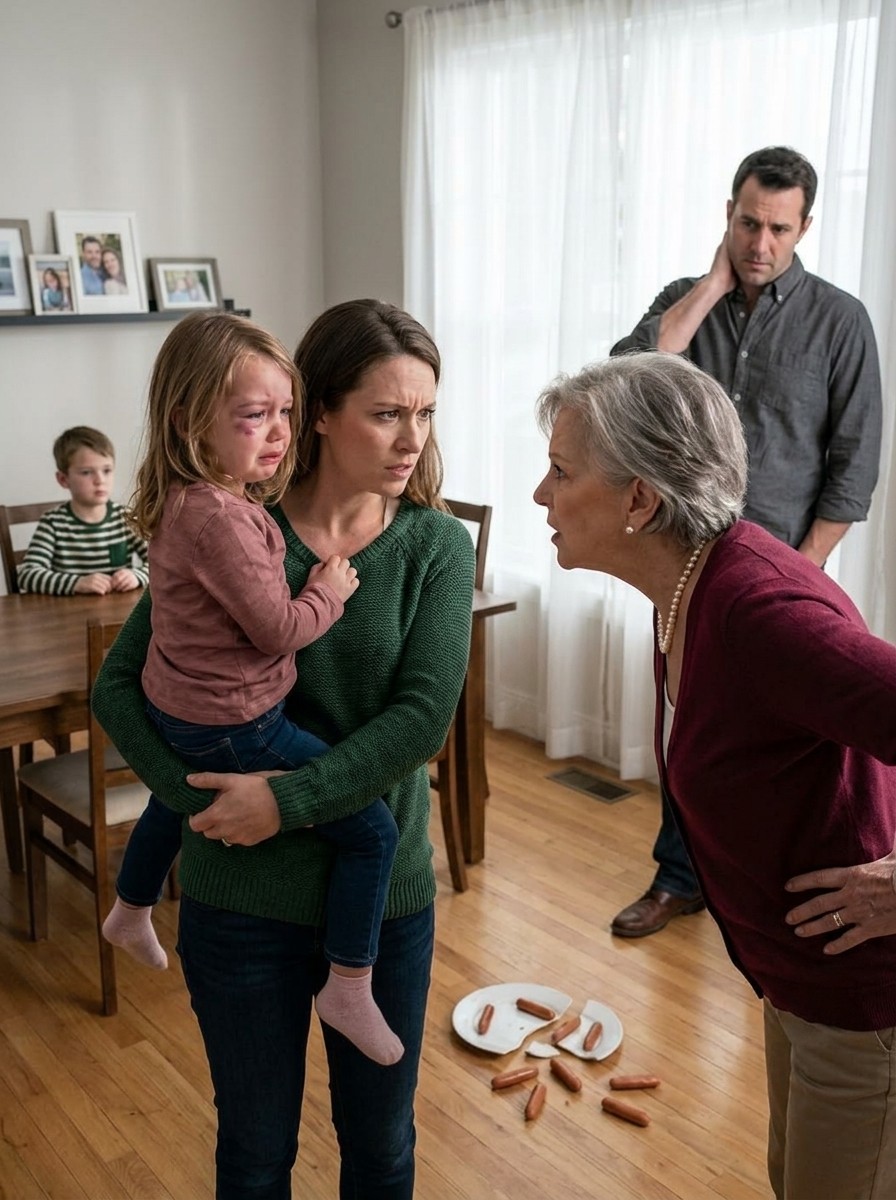
That was the first thing my mother-in-law screamed when I ran into the living room and saw my two-year-old daughter lying on the floor, her nose bl/ee/ding and the imprint of five red fingers on her cheek.
It happened on a Sunday afternoon in my apartment in the neighborhood of Asheville.
It was supposed to be a peaceful family meal.
My husband, Thomas, was away on a business trip in Reno, so the only people at home were my mother-in-law, Carol, my nephew Jackson, and my daughter Zoey.
I was in the kitchen making chicken soup with vegetables because Carol had spent days complaining about her aches, her bl00d pressure, her dizziness, and how “nobody took care of her anymore.”
Even though she lived in my home, ate my food, slept in a bedroom I paid for, and used a private medical card I had given her, she always found a way to make herself the victim.
Jackson, the son of Thomas’s older brother, had been living with us for a year.
Carol insisted on bringing him from their hometown so he could attend an expensive school because, according to her, “he was the family’s boy and needed to go far in life.”
I paid for his tuition, uniforms, tablet, English lessons, and even his designer sneakers.
Zoey, my little girl, was still just a sweet, curious toddler, the kind who walks with clumsy little steps and hugs her doll while she sleeps.
While sautéing vegetables, I told her: “Sweetheart, go play in the living room for a little while. Mommy will give you dinner soon.”
Less than five minutes later, I heard a sharp sound.
Smack!
It wasn’t a toy falling.
It was a s/lap.
Then came my daughter’s muffled crying.
I ran out with my heart in my throat.
Zoey was on the floor, trembling, bl00d running from her nose. Her pink shirt was already stained red.
Carol stood over her with her hands on her hips. Jackson remained on the couch, eating a sausage and watching cartoons on his tablet.
“What did you do to her?” I shouted, picking up my daughter.
“I taught her a lesson,” my mother-in-law replied without lowering her eyes. “That girl grabbed a sausage that belonged to Jackson. If you don’t correct her now, tomorrow she’ll steal the whole house.”
Something inside me broke.
“She’s two years old.”
“So what? Girls need to learn their place. Jackson is a boy. He’s the grandson who will carry on the family name. Your daughter will grow up and leave with another man. She’s a burden.”
For four years, I had endured her contempt.
I endured her calling my daughter “another useless female in the family.”
I endured her hiding the best food for Jackson.
I endured her treating every dollar I earned through my natural cosmetics business as if it were Thomas’s achievement.
But seeing my daughter’s bl00d on my hands destroyed every ounce of patience I had left.
I sat Zoey down in a chair, asked her to close her eyes, and walked toward Carol.
“What are you staring at?” she said. “When Thomas gets home, he’ll put you in your place.”
I s/lapp/ed her.
Carol staggered backward, stunned.
“You h.i.t me! You raised your hand against your mother-in-law!”
I s/lapp/ed her again.
This time she fell onto the rug.
“The first one was for my daughter’s bl00d,” I said.
“The second was for believing a girl is worth less than a boy.”
Jackson started crying.
Carol screamed that she was going to sue me, that I was a savage daughter-in-law, that nobody had raised me properly.
I pulled out my phone, called my bank representative, and turned on speaker mode.
“I want to cancel the additional medical card ending in 8809, issued to Carol Swift. Yes, the black card. Effective immediately, it is blocked.”
Carol stopped screaming. The color drained from her face.
“You can’t do that,” she stammered. “I have gallbladder surgery next month. That card has a massive limit.”
“Then ask your son for the money,” I replied. “Or your precious heir grandson.”
She looked at me as if I had b:uri:ed her alive.
“Jade, don’t be cruel. I’m sick. I’m an ill woman.”
“And my daughter is a child you as:sault:ed.”
I picked up Zoey and walked toward my bedroom.
Before I closed the door, I heard my mother-in-law call Thomas in tears.
“Your wife h.i.t me! She took away my hospital coverage! She wants me d/ea/d!”
I held my daughter close, pressed ice against her cheek, and cried silently.
Outside, the storm was only beginning. Because Thomas was on his way home, and I still had no idea that this s/lap was about to expose a much bigger lie.
PART 2
Thomas arrived at eleven o’clock that night.
He didn’t knock.
He didn’t call ahead.
He unlocked the front door and walked straight into the bedroom where I was lying beside Zoey, who had finally fallen asleep with dried tear stains on her bruised cheek.
“You s/lapp/ed my mother?” he said.
Not a whisper.
Not a question.
A statement wrapped in disbelief.
“Your mother s/lapp/ed our daughter,” I replied without sitting up. “Look at her face.”
He didn’t look.
He didn’t walk over to the bed.
He didn’t check his own child’s cheek.
“My mother is sixty-three years old, Jade. You could have h:ur:t her.”
“She h:ur:t a two-year-old.”
“Kids get disciplined. That’s how it works.”
I sat up slowly.
“Disciplined? There’s bl00d on her shirt, Thomas. Your mother s/lapp/ed her so hard she fell to the floor. Over a sausage.”
He crossed his arms.
“My mother says Zoey grabbed Jackson’s food and wouldn’t let go. She was being greedy.”
“She’s two.”
“And my mother was trying to teach her.”
I stared at him.
For four years, I had made excuses for that look on his face. The look that said his mother’s word weighed more than mine. The look that said my anger was an inconvenience. The look that said I should endure, adapt, adjust, and be grateful.
That night, the excuses ran out.
“Thomas, your mother told me our daughter is a burden. She said girls are worth less than boys. She called Zoey a useless female.”
“She’s old-fashioned. That’s just how she talks.”
“Old-fashioned people don’t draw bl00d from toddlers.”
He rubbed his face.
“Fine. I’ll talk to her. But you need to apologize.”
“Apologize?”
“You s/lapp/ed her. Twice. And you canceled her medical card. She’s crying in there right now saying you want her to d:ie.”
“I want her to understand that h.i.tting my daughter has consequences.”
“And I want you to understand that she is my mother.”
“And Zoey is your daughter.”
Silence.
He looked at the floor.
Not at Zoey.
Not at me.
At the floor.
And in that silence, I heard everything he wasn’t saying.
That his mother mattered more.
That his daughter’s bl00d was a minor inconvenience.
That the woman who paid every bill in this house was expected to apologize to the woman who had never contributed a single dollar.
“I’m not apologizing,” I said.
“Then we have a problem.”
“We already had a problem, Thomas. It just took bl00d for me to see it.”
He walked out.
He slept on the couch.
And I stayed awake all night, holding my daughter, listening to Carol whisper on the phone in the next room.
I couldn’t hear everything.
But I heard one sentence clearly.
“Don’t worry. She doesn’t know anything about Jackson.”
My entire body went cold.
What about Jackson?
The next morning, Carol packed a suitcase.
She announced to the whole house that she was leaving.
“I refuse to stay in a place where I’m ab:us:ed,” she declared, dragging her bag toward the front door with the performance of a woman who had rehearsed this scene many times.
Thomas begged her to stay.
“Mom, please. I’ll fix this.”
“Fix what? Your wife is v:io:lent. She’s dangerous. She canceled my surgery card. She doesn’t respect your family.”
She looked at me.
“You’ll regret this, Jade. Mark my words. When Thomas finally opens his eyes, you’ll be the one leaving this house. Not me.”
She walked out.
Jackson went with her.
He didn’t say goodbye to Zoey.
He didn’t say goodbye to me.
He just followed Carol the way he always had.
Quietly.
Obediently.
Like a child trained never to ask questions.
After they left, Thomas turned to me.
“Are you happy now?”
“Your mother h.i.t our daughter.”
“And you escalated it.”
“I protected her.”
“You could have handled it differently.”
“How? By watching my daughter bl/ee/d and saying nothing?”
He didn’t answer.
He grabbed his car keys.
“I’m going to bring my mother back.”
“If she comes back,” I said, “I will leave this house. And I’ll take Zoey.”
He stopped at the door.
“You wouldn’t.”
“Try me.”
He left.
And I was alone.
With a bruised toddler sleeping in the next room and the echo of one sentence playing over and over in my head.
“She doesn’t know anything about Jackson.”
That afternoon, while Thomas was gone, I made a phone call.
Not to a friend.
Not to my mother.
To Thomas’s older brother, David.
David lived three hours away. He had always been quiet. Distant. We spoke maybe twice a year. But Jackson was supposedly his son, and I needed to hear him say it.
The phone rang four times.
“David, it’s Jade.”
“Hey, Jade. Everything okay?”
“I need to ask you something, and I need you to be honest with me.”
Silence.
“Is Jackson your son?”
A longer silence.
“Why are you asking me that?”
“Because Carol said something last night that didn’t make sense. And because in the entire year Jackson has lived in my house, you have never once called to check on him.”
David exhaled.
“Jade—”
“Is he your son?”
“No.”
The room tilted.
“Jackson isn’t mine,” David said. “He never was. My mother asked me to go along with it when Thomas got married. She said it would be easier.”
“Easier for whom?”
“For Thomas.”
“David. Whose child is Jackson?”
He paused so long I thought the call had dropped.
“He’s Thomas’s.”
I sat down on the kitchen floor.
The same floor where I made soup. The same floor where I had picked up Zoey’s bl00dy shirt. The same floor where I had lived my entire married life believing I knew the people I lived with.
“Thomas had a relationship before you,” David continued. “A girl from our hometown. She got pregnant. Carol convinced Thomas it would r:ui:n his career if anyone found out. So they told everyone the baby was mine. The mother signed over custody to Carol.”
“And the mother?”
“She left town. Nobody’s heard from her since.”
“You went along with this?”
“I was twenty-two. My mother told me it was for the family. I didn’t know how to say no to her back then.”
I hung up.
I sat on that floor for forty minutes.
Jackson was not Thomas’s nephew.
He was Thomas’s son.
For a year, I had fed, clothed, and paid tuition for a child my husband had secretly fathered before our marriage.
Carol had brought Jackson into my home not out of generosity.
She brought him to make sure her real grandson — the boy — got everything.
While my daughter, the girl, was treated like a stain on the family name.
That was why Carol favored Jackson.
That was why she called him “the family’s heir.”
That was why she s/lapp/ed Zoey for touching his food.
Because in Carol’s mind, Jackson was the real grandchild.
Zoey was the lesser one.
And I was the wife who was never supposed to find out.
PART 3
Thomas came home that evening.
Alone.
Carol had refused to return unless I apologized in person, reinstated her medical card, and promised never to raise my voice at her again.
Thomas relayed the demands as if they were reasonable.
“She just wants respect, Jade.”
I was sitting at the kitchen table.
Zoey was in her high chair beside me, eating applesauce.
The bruise on her cheek had turned purple.
Thomas still hadn’t looked at it.
“Sit down, Thomas.”
“I don’t need to sit down.”
“Sit. Down.”
Something in my voice made him obey.
He sat.
I placed my phone on the table between us.
“I called David today.”
The shift in his face was instant.
Not confusion.
Recognition.
The kind of recognition a man shows when a door he locked years ago suddenly swings open.
“Why would you call David?”
“Because I heard your mother say something last night. She said I don’t know anything about Jackson.”
Thomas said nothing.
“So I asked David. And David told me the truth.”
He still said nothing.
“Jackson is your son, Thomas.”
His hands gripped the edge of the table.
“It’s not what you think.”
“Your mother brought your biological son into my home, told me he was your nephew, had me pay for his school and his clothes and his tablet, and the entire time she made sure he was treated like royalty while your daughter was s/lapp/ed across the face for touching his food.”
“Jade, that happened before us—”
“The lie didn’t happen before us. The lie happened every single day for the past year. Every time you watched me pack Jackson’s lunch. Every time you let your mother compare my daughter to that boy. Every time you looked at me across this table and said nothing.”
He pressed his fist against his mouth.
“I was going to tell you.”
“When?”
He didn’t answer.
“When, Thomas?”
“I don’t know.”
“You don’t know. You brought a secret child into my house. You let your mother ab:us:e our daughter to elevate him. And you don’t know when you were planning to tell me.”
Zoey dropped her spoon.
I picked it up, wiped it, and handed it back to her.
Even in the middle of a life falling apart, someone still had to feed the baby.
That’s what mothers do.
We keep going.
“Here is what happens next,” I said.
Thomas looked up.
“You have forty-eight hours to tell your mother that I know everything. If she contacts me before then, I will file a police report for the as:sault on Zoey. Photographs have already been taken. A pediatrician examined her this morning.”
He blinked.
“You already took her to a doctor?”
“At eight a.m. The report is documented. The bruise. The bl/ee/ding. The fingermark. All of it.”
“Jade—”
“I’m not finished.”
He went quiet.
“I want Carol out of our lives. Not out of the house. Out of our lives. She does not see Zoey again. She does not enter this apartment again. She does not call me, text me, or speak about my daughter. If she does, I use the medical report.”
“She’s my mother.”
“And Zoey is my daughter. Your mother made her choice when she s/lapp/ed a two-year-old and called her a burden. Now I’m making mine.”
“And Jackson?”
I paused.
Not because I didn’t know the answer.
Because the answer was the part that would h:ur:t me the most to say.
“Jackson is a child. He didn’t choose any of this. If you want to be his father — openly, honestly, without lies — then be his father. But not behind my back. Not under a fake story. And not at the expense of our daughter.”
Thomas stared at the table.
“You’re asking me to choose.”
“No. I’m asking you to stop hiding.”
He sat there for a long time.
Then he said something I wasn’t expecting.
“She’s the one who told me not to tell you.”
“Your mother?”
“She said if you found out about Jackson, you’d leave. She said the only way to keep everything together was to keep it quiet.”
“And you believed her.”
“I didn’t know what else to do.”
“You could have trusted your wife.”
He closed his eyes.
“You’re right.”
Two words.
They didn’t fix anything.
But they were the first honest words he had spoken in years.
The next six months were not a fairy tale.
Thomas told Carol.
She did not take it well.
She called me twenty-three times in one day.
She left voicemails calling me a de:str:oyer of families, a w:it:ch, a woman who had turned her son against her.
She told relatives I had as:sault:ed her and k:ic:ked her out onto the street.
She posted on social media that I was keeping her grandson from her.
She never once mentioned s/lapp/ing Zoey.
That part she left out.
Thomas, for the first time in his life, did not go running back to her.
He sat in our living room, read the pediatrician’s report, looked at the photographs of his daughter’s bruised face, and said, “I should have seen this sooner.”
“You should have,” I said.
I didn’t soften it.
He didn’t deserve softness on that one.
He told his mother she was not welcome in our home until she acknowledged what she had done.
Carol said she would rather d:ie than apologize to me.
Thomas told her that was her choice.
It was the first time I saw him choose us over her.
It was painful.
Necessary.
And four years overdue.
He also told Jackson the truth.
Not all of it.
Jackson was only eight.
But Thomas sat across from him at a park bench and said, “I’m not your uncle, buddy. I’m your dad. And I should have told you that from the beginning.”
Jackson looked at him with the confused expression of a child trying to rearrange everything he thought he knew.
“Then who’s my mom?”
Thomas told him as much as an eight-year-old could carry.
“She loved you. She just wasn’t able to stay.”
“Does Aunt Jade know?”
“She knows now.”
“Is she mad?”
Thomas looked at the ground.
“She’s h:ur:t. But not at you. Never at you.”
That evening, Jackson came back to our apartment.
He walked through the door slowly, the way children walk when they aren’t sure if they’re still welcome.
Zoey ran to him in her clumsy toddler steps.
She grabbed his leg and looked up at him.
“Jack! Jack!”
She had always called him Jack.
He looked down at her.
He looked at the fading bruise on her cheek.
And for the first time since he had been living in this house, he knelt down and hugged her.
I stood in the kitchen doorway and watched.
Two children.
One who had been lied about.
One who had been h.i.t.
And neither of them had done anything to deserve any of it.
I made them both dinner that night.
Chicken soup.
The same soup I had been making the day Carol s/lapp/ed my daughter.
I served Jackson first.
Then Zoey.
And I placed a sausage on each of their plates.
Jackson looked at me.
“Is it okay if she eats it?”
“Of course it is. Food in this house belongs to everyone.”
He nodded.
He pushed his plate closer to Zoey.
“You can have mine too, Zoey.”
She grabbed it with both hands and bit into it with her tiny teeth, laughing with her mouth full.
And sitting at that table, watching two children share a meal that should never have been a battlefield, I finally cried.
Not from sadness.
Not from anger.
From the relief of knowing that the lie was over.
That my daughter would never again be treated as less than.
That the boy who had been hidden and disguised his entire life finally knew who he was.
And that the woman who had s/lapp/ed a two-year-old over a sausage would never sit at my table again.
Carol never apologized.
Not once.
She moved in with a cousin two states away.
She told everyone who would listen that I had de:str:oyed her family.
She never mentioned the s/lap.
She never mentioned the bl00d.
She never mentioned calling a two-year-old girl a burden.
People like Carol never do.
They rewrite the story.
They edit out their own cr:uel:ty.
They keep the version where they are the victim.
And they expect the world to agree.
Some people did.
Some relatives stopped speaking to me.
Some friends of Thomas told him he had “abandoned his mother for a woman.”
I didn’t defend myself to any of them.
Because the people who believe a s/lap across a toddler’s face is acceptable discipline are not people whose opinions I need in my life.
Thomas and I are still together.
It has not been easy.
Trust does not rebuild overnight.
There are still nights I look at him across the dinner table and think about every day he watched his mother treat our daughter like she was less, and said nothing.
But he is trying.
He is present.
He reads Zoey bedtime stories every night now.
He takes Jackson to school three mornings a week.
He no longer disappears when conflict arrives.
And he has never once asked me to apologize to his mother.
That is not everything.
But it is a beginning.
Last Sunday, I made chicken soup again.
Zoey climbed into her chair and banged her spoon on the table.
Jackson sat beside her and showed her a drawing he had made at school.
It was a picture of four people standing in front of a house.
Two adults. Two children.
Underneath, in a child’s messy handwriting, it said:
“My Family.”
He had drawn all four of us.
Not Carol.
Not the cousin.
Not the woman who had spent years calling him “the heir.”
Us.
I put the drawing on the refrigerator.
It’s still there.
Thomas looked at it that night.
He didn’t say anything.
He just stood in front of the refrigerator for a long time.
And I knew he saw the same thing I did.
That family is not about bl00d.
It is not about last names.
It is not about which child carries the family legacy.
Family is about who shows up at the table.
Who shares the food.
And who would never, ever, s/lap a child for reaching for something she was hungry for.
If someone in your family treats your child as less — less important, less loved, less valuable — because of their gender, their birth order, or someone else’s secret, do not stay silent.
Silence does not keep the peace.
Silence keeps the ab:us:e alive.
Speak.
Even if your voice shakes.
Even if they call you cr:uel.
Even if every person in the room looks at you like you are the problem.
You are not the problem.
You are the wall between your child and the people who were supposed to love her but never learned how.
I turned off the kitchen light, looked at the drawing on the refrigerator one last time, and walked to Zoey’s room.
She was asleep.
Hugging her doll.
The bruise was gone.
But I still remembered exactly where it had been.
A mother always does.
I kissed her forehead, closed the door quietly, and whispered the same thing I had said the day Carol s/lapp/ed her.
“My daughter was not born to endure anyone’s contempt.”
She wasn’t.
And she never will again.