PART 2
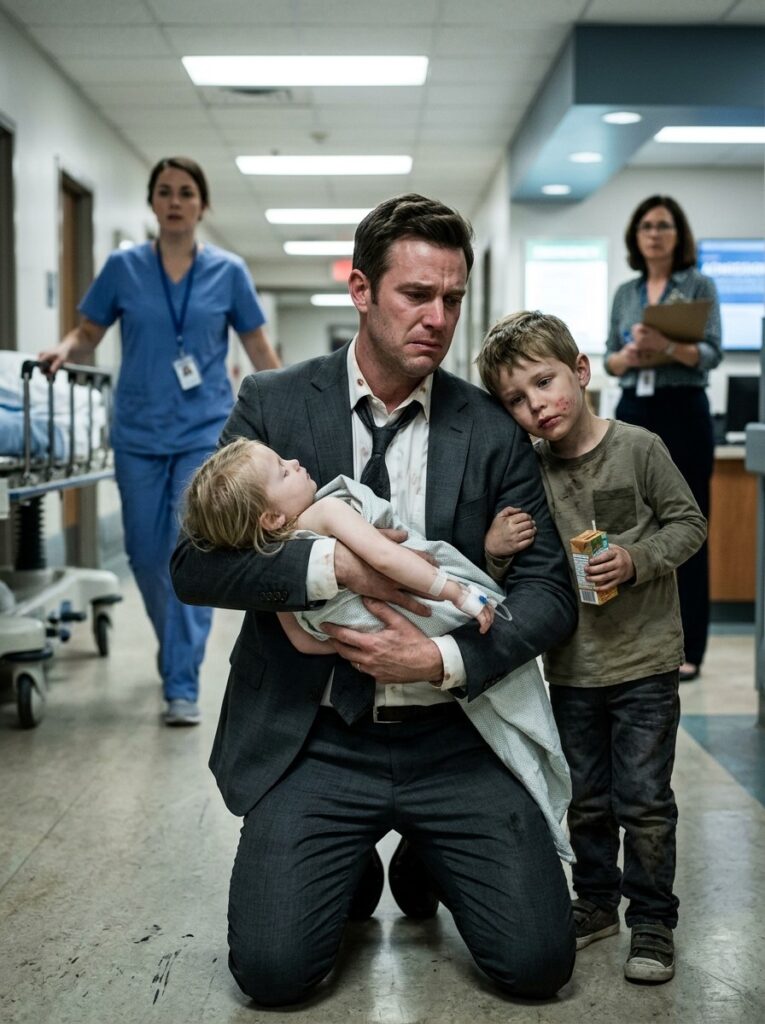
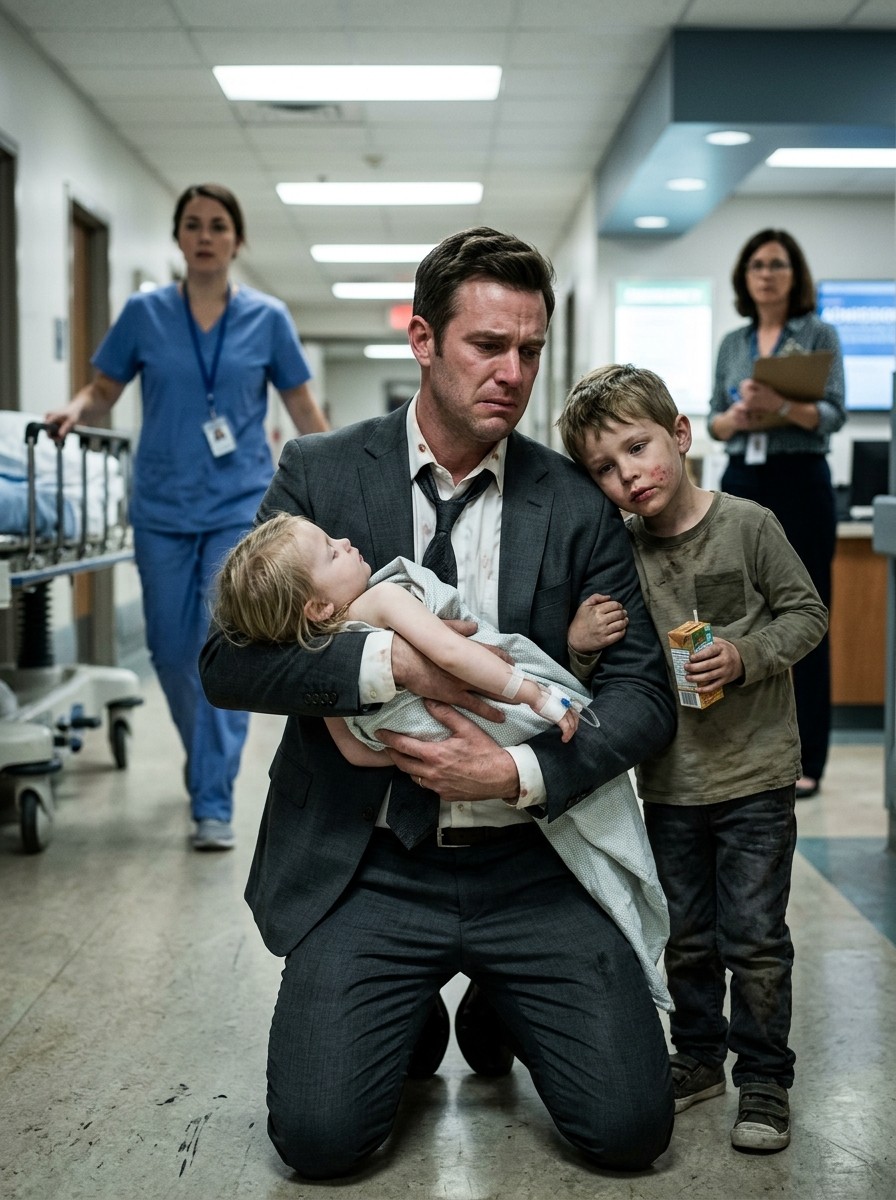
The emergency room moved faster than I had ever seen a hospital move.
A nurse had Sophie on a gurney and an IV started within four minutes of our arrival. A second nurse crouched beside Lucas in the waiting area, speaking softly, handing him a juice box and a granola bar while checking his eyes and skin for signs of dehydration. A social worker appeared within twenty minutes, clipboard in hand, asking questions I could barely process while watching Sophie’s monitor through the glass partition.
“How long were they alone?” the social worker asked.
“Three days,” I said. “Based on what my son told me.”
“And their mother?”
“Phone is off. I’ve called eleven times. No answer.”
She wrote something down without looking up. “Has this happened before?”
“No,” I said. Then I stopped. Reconsidered. Thought about the co-parenting app with its green checkmarks and polite messages, the drop-offs that always seemed slightly rushed, the way Lucas had started calling me during Rachel’s custody days just to “say goodnight” in a voice that never quite sounded like a child who was simply saying goodnight.
“I don’t know,” I amended. “I thought everything was fine. The paperwork said everything was fine.”
The social worker looked at me with the particular expression of someone who had heard that sentence many times before from many different parents in many different waiting rooms.
“I need to tell you something,” I said. “I found a note.”
I pulled it from my jacket pocket. Folded twice, written in Rachel’s handwriting on a piece of paper torn from a legal pad. I had found it under the mattress in the master bedroom, tucked between the mattress and the box spring, hidden the way people hide things they know will be damning if found but cannot bring themselves to destroy entirely.
The social worker read it silently. Her expression didn’t change dramatically, but her pen stopped moving, and she read it a second time before looking up.
The note said:
I can’t do this anymore. I know that makes me a monster but I can’t. The house is paid through the end of the month. There is bread and peanut butter in the cabinet. I told Lucas I would be back after one sleep. I know that’s a lie. I’m sorry. Don’t look for me. I’m not coming back. Don’t tell James. He’ll use this to take them permanently. Let them think I went on a trip. It’s better that way.
— R.
I had read it four times in the car before coming inside. Each time, a different sentence hit hardest. The first time it was I can’t do this anymore. The second time it was I told Lucas I would be back after one sleep. I know that’s a lie. The third time it was Don’t tell James. The fourth time, the one that settled into my chest like something with weight and permanence, was Let them think I went on a trip. It’s better that way.
Better for whom.
Not for Lucas, who had spent three days rationing bread and trying to wake his sister with sink water and a six-year-old’s desperate understanding that something was very wrong but not knowing what to do about it except call the one person his mother had specifically told him not to call.
“Daddy,” Lucas had whispered in the car on the way to the hospital, tugging my sleeve from the back seat. “Mommy told me not to call you.”
“Why not?” I had asked, keeping my voice as steady as I could manage.
“She said you’d be too busy,” he said quietly. “She said important daddies don’t have time for small problems.”
I had to pull over for a moment after that. Not because I couldn’t drive. Because I needed thirty seconds to breathe through something that felt less like anger and more like the kind of grief that arrives when you realize your child has been carrying a lie designed specifically to keep him from reaching the one person who would have come immediately.
To be continued… 👇
PART 3 — FINAL
Sophie stabilized by the following morning, though the doctors kept her for four days total, treating dehydration, a respiratory infection that had gone untreated for longer than three days based on how advanced it was, and malnutrition that the pediatrician described, carefully, as “consistent with inconsistent feeding over a period of weeks, not days.”
That sentence changed the shape of everything I thought I understood about my custody arrangement.
Weeks. Not days.
Which meant this hadn’t started on Thursday when Rachel left. It had started long before that, quietly, in a house that looked perfectly normal from the outside, behind green checkmarks on a co-parenting app and polite drop-off messages and a mailbox with an American flag sticker.
The police found Rachel nine days later in a motel two states away. She was alone, uninjured, and, according to the officer I spoke with, “cooperative but largely unresponsive to questions about the children’s welfare during the period in question.” She was not arrested immediately, though charges were filed the following week, and the case was assigned to a prosecutor who specialized in child welfare cases.
I was granted emergency sole custody within seventy-two hours of the hospital admission. The judge who signed the order did so after reviewing the note, the hospital records, the social worker’s report, and the security footage from the house showing Rachel leaving on Thursday afternoon with a single suitcase and not returning.
Lucas asked about his mother exactly once during the first week. We were sitting at my kitchen table, the one in the house he’d only ever known as his “weekend house,” eating pancakes I’d made at six in the morning because neither of us could sleep.
“Is Mommy coming back?” he asked.
I set down my spatula.
“I don’t know yet, buddy,” I said. “But I need you to hear something, and I need you to really hear it.”
He looked up at me with eyes that carried more weight than any six-year-old’s eyes should.
“You did the right thing,” I said. “Calling me. Even though Mommy told you not to. You saved your sister’s life. Do you understand that?”
He didn’t answer right away. He just looked at his pancake.
“She said you’d be too busy,” he said quietly.
“I will never,” I said, “be too busy for you. Not for one second. Not for the rest of my life. You call me anytime, from anywhere, about anything, and I will answer. Do you understand?”
He nodded slowly.
Then he ate his pancake.
The legal proceedings took almost a year to resolve fully. Rachel’s attorney argued that she had experienced a mental health crisis, which may have been true, and which I chose not to contest publicly, because whatever had happened to Rachel as a person was separate from what had happened to my children as a result, and the court needed to focus on the second thing without getting lost in the first.
She was not granted unsupervised visitation. That may change someday, depending on treatment compliance and court review, but for now, Lucas and Sophie live with me full-time, in a house where the refrigerator is always full and the front door is always locked from the inside and nobody leaves without saying exactly where they’re going and exactly when they’re coming back.
Sophie doesn’t remember the three days. She was too young, too sick, too deep inside whatever fever had been consuming her small body while her brother tried to keep her alive with sink water and a six-year-old’s understanding of what it means to take care of someone.
Lucas remembers all of it. We talk about it sometimes, carefully, with the therapist he’s been seeing every other week since the hospital, a woman named Dr. Reeves who has a way of making hard conversations feel less like examinations and more like two people simply sitting together and being honest about difficult things.
Last month, Lucas brought home a drawing from school. A house with a big sun above it and two stick figures standing in front of it, one tall and one small, holding hands.
Underneath he had written, in his careful first-grade handwriting: Me and Daddy. Our house. Safe.
I have it on the refrigerator now.
Right next to the emergency contact card I filled out the week they came home, the one with my phone number written in three places, because some things are worth repeating until they become the truth a child believes without question.
Share this for every parent who dropped everything the moment the call came, and for every child who was brave enough to reach for the phone when someone told them not to. ❤️👇
— Update: Sophie started preschool last month. On her first day she held Lucas’s hand the entire walk from the car to the front door. He didn’t let go until she was ready. I watched from the parking lot and thought about a boy sitting on a floor with a borrowed phone, calling the one person he’d been told wouldn’t come. He came home that afternoon and said, “She did great, Dad. I made sure.” He’s seven now. He still makes sure.