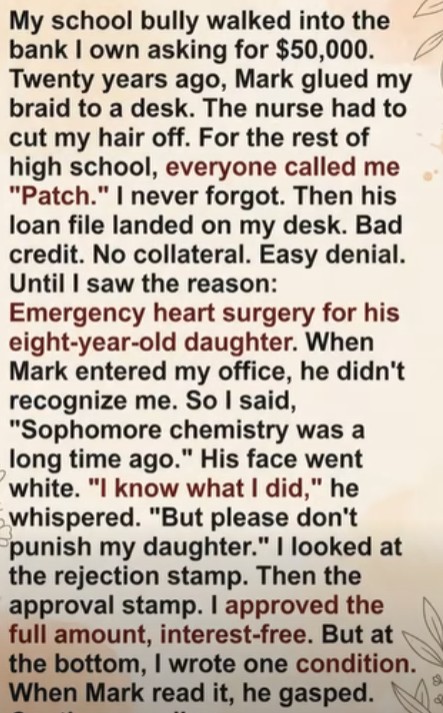
When Mark Jensen walked into my bank asking for a $50,000 emergency loan, he had no idea who I was.
To him, I was just the owner sitting behind a polished oak desk, reading his file with professional calm. A woman in a tailored navy blazer, a neat gold watch, and a nameplate that simply said Evelyn Hart, President.
To me, he was the boy who glued my braid to a chemistry desk in tenth grade and laughed while the entire class watched me panic.
The school nurse had to cut my hair off to get me free.
For the rest of high school, everyone called me Patch.
It didn’t matter that I cried in the bathroom until my eyes swelled shut.
It didn’t matter that I stopped raising my hand in class after that.
It didn’t matter that I spent the rest of that year trying to disappear behind scarves, hats, and excuses.
What mattered was that the nickname stuck.
Patch.
Like humiliation should be funny if enough people repeat it.
Like cruelty becomes harmless once time passes.
I hadn’t seen Mark in nearly twenty years, but the second his loan application landed on my desk that morning, I recognized the name immediately.
Then I opened the file.
Bad credit.
No collateral.
Existing debt.
Irregular cash flow.
On paper, it was an easy denial.
The kind junior loan officers are trained to reject without hesitation.
I almost passed it down the chain like any other file.
Then I saw the reason for the request.
Emergency pediatric cardiac surgery.
His daughter.
Eight years old.
There was a scanned letter from a specialist attached to the application. Without the procedure, they risked losing critical time. The language was clinical, but the fear behind it was obvious. Someone had highlighted the estimated cost in yellow, as if trying to make the number more real by framing it in bright color.
I leaned back in my chair and stared at the paper for a long time.
For twenty years, I had imagined different versions of justice.
Not dramatic revenge fantasies.
Just ordinary moments of reversal.
Seeing him fail where I had once been powerless.
Watching him need something and hearing myself say no.
Life rarely gives you those scenes.
But that morning, it had.
At eleven-fifteen, my assistant buzzed my office.
“Mr. Jensen is here,” she said.
I told her to send him in.
When he stepped through the door, he looked older than I expected.
Not old, exactly. Just worn in the way people look when life has pushed them harder than they thought it would. His hairline had receded, his shoulders slumped forward, and his face carried the dull gray exhaustion of a man who had not slept well in weeks.
He smiled politely at first.
He didn’t recognize me.
Why would he?
Bullies rarely remember the details of the people they damage. For them, it was a joke. A moment. A passing amusement. For the person on the receiving end, it can split life into before and after.
He sat down across from me and started explaining his situation in the careful voice people use when dignity is hanging by a thread.
He had tried other lenders.
He had run out of options.
The surgery couldn’t wait much longer.
He knew his file wasn’t strong, but he was asking me to consider the circumstances.
I listened without interrupting.
Then I folded my hands over the file and said, “Sophomore chemistry was a long time ago.”
The silence that followed was immediate and absolute.
All the color drained from his face.
His mouth opened slightly, then closed again.
He looked at me harder, searching my features for the girl he had once laughed at. I watched recognition arrive in pieces — the eyes first, then the mouth, then the faint shift in posture that comes when memory turns physical.
“Evelyn?” he said finally, barely above a whisper.
I nodded.
For a second he looked like he might stand up and leave.
Instead, he lowered his eyes.
“I know what I did,” he said.
It was not a full apology. Not yet. Just an admission dragged to the surface by fear.
I said nothing.
He swallowed and tried again.
“I was a cruel kid,” he said. “I know that doesn’t fix anything.”
Still I said nothing.
Then his voice cracked.
“But please don’t punish my daughter for what I was.”
That was the sentence that landed.
Not because it excused him.
Because it didn’t.
It was the first truly honest thing he had said.
He wasn’t begging for himself anymore.
He was begging for a child who had done nothing wrong.
I looked down at the file again.
The rejection stamp was sitting on the far side of my desk.
Right beside it was the approval stamp.
For a moment, both felt heavy.
I thought about the girl who had come home from school with half her hair hacked off because a boy wanted an audience.
I thought about the woman who had built a career so solid that the same kind of people who once laughed at her now sat across from her asking for mercy.
I thought about an eight-year-old child with a damaged heart who had absolutely nothing to do with the ugliness of her father’s past.
Then I reached for the approval stamp.
Mark made a strangled sound, almost like he didn’t trust what he had just seen.
I stamped the application.
Approved.
He stared at it like the word itself had become unreal.
Then I picked up my pen and wrote one condition at the bottom.
When I slid the paper across the desk, his hands shook as he read it.
The condition said this:
Loan approved in full, interest-free, provided borrower signs a written agreement to volunteer 300 hours over the next two years with the hospital’s family support program for parents of children in long-term care. In addition, borrower will fund an annual anonymous scholarship in the amount of $2,500 for a student affected by bullying, to be administered through the local school district.
He looked up at me with tears standing in his eyes.
Not because it was cruel.
Because it wasn’t.
I had not chosen to crush him.
I had chosen to make the debt mean something larger than his desperation.
He read the condition again.
Then again.
“You’d still help her?” he asked, voice shaking.
“Yes,” I said.
He pressed his hand to his mouth and looked down.
“I don’t deserve this,” he whispered.
“No,” I said evenly. “But your daughter deserves a chance. And maybe it’s time you spend part of your life repairing something instead of just regretting it.”
He cried then.
Not dramatically.
Not theatrically.
Just quietly, with the exhausted shame of someone who had finally run out of ways to hide from himself.
He signed everything.
Every page.
Every condition.
Before he left, he stopped at the door and turned back.
“I never apologized,” he said.
“No,” I replied.
“I should have.”
“Yes.”
He nodded slowly, as if accepting that there are some sentences too late to erase anything but still necessary to say.
“I’m sorry,” he said.
This time, I believed he meant it.
After he left, I sat alone in my office for a long time.
The room was quiet except for the soft hum of the air vent and the faint sounds of printers from outside the door.
I expected to feel triumphant.
I didn’t.
I expected to feel healed.
I didn’t.
What I felt was something harder to name.
Not forgiveness.
Not revenge.
Something steadier than both.
Maybe dignity.
Maybe closure.
Maybe just the strange calm that comes when life finally hands you the scene you once thought you needed — and you realize the real victory is not becoming the worst version of yourself in it.
Over the next year, I heard updates through the proper channels.
The surgery went well.
His daughter recovered.
Mark started volunteering exactly where the agreement required. At first he did it because he had to. Later, according to the hospital coordinator, he stayed longer than necessary, helped more than expected, and never once asked for special treatment.
The scholarship fund was established on time.
He paid every installment exactly as promised.
Sixteen months later, I received a handwritten note in the mail.
It wasn’t from Mark.
It was from his daughter.
She thanked the bank for helping her family when they were scared.
She said her dad smiled more now.
She said he volunteered at the hospital and always told her to be kind because people carry things you can’t see.
I folded that note and kept it in my desk drawer.
Not because it erased what happened to me.
It didn’t.
High school humiliation has a long afterlife.
Some wounds harden into personality before they ever become memory.
But that note reminded me of something I had almost forgotten:
Pain can travel downward through generations.
So can mercy.
When people talk about power, they usually imagine control.
The ability to deny.
To punish.
To settle old accounts.
But real power is quieter than that.
It is the moment you finally have the right to hurt someone back and decide that hurting them is too small for the person you fought to become.
Mark came into my bank asking for $50,000.
He left with the money, a contract, and a reckoning.
As for me, I kept something too.
Not his shame.
Not his apology.
Just the knowledge that the girl they once called Patch had grown into a woman who could look cruelty in the face, recognize it, and still choose not to pass it forward.