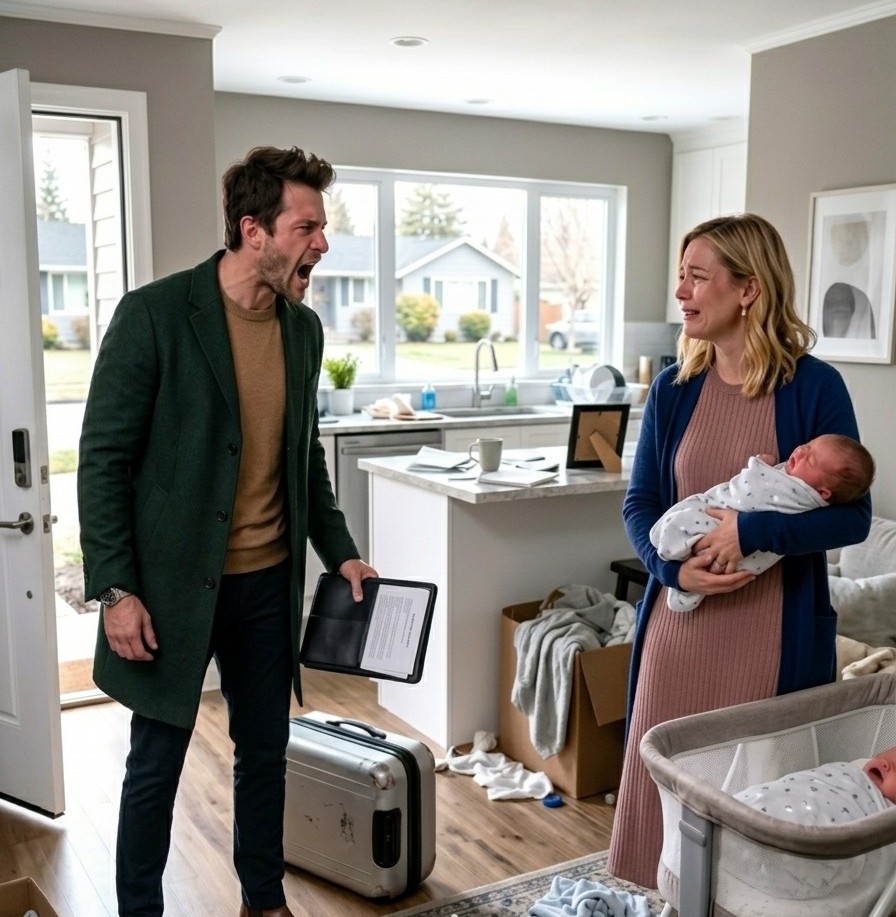
“The crying of these two babies is driving me crazy. I need some space!” My husband, Daniel Whitmore, stood in the middle of our small house in Portland, Oregon, with a suitcase in his hand and fury on his face, while our one-month-old twins screamed from their bassinets.
I was still bleeding from childbirth. My stitches hurt when I walked. I had slept maybe two hours in three days. My hair was greasy, my hands shook from exhaustion, and I had just finished feeding Lily when Noah started crying again. “Daniel, please,” I whispered. “I can’t do this alone.” He laughed like I had insulted him. “Women have babies every day, Claire. You’ll survive.”
Then his phone buzzed. His friends were waiting outside in a black SUV, laughing, honking, excited for their month-long Europe trip — a trip he had never told me was still happening. “You’re seriously leaving?” I asked, holding Noah against my chest. Daniel avoided my eyes. “I paid for it months ago.” “We have newborn twins.” “And I have a life too.” The front door slammed so hard a picture fell from the hallway wall. And I sat on the nursery floor that night between two crying babies and cried with them.
For the first week, I barely functioned. I forgot meals. I forgot showers. I forgot who I was outside of feeding, changing, rocking, and surviving on a body that was still torn open from bringing two lives into the world. The stitches pulled every time I stood. My breasts ached. My back felt like it might snap in half from hunching over bassinets at three in the morning.
Meanwhile, Daniel posted photos from Paris. Smiling in front of the Eiffel Tower. Drinking wine in Rome. Standing on a rooftop in Barcelona with his arm around a woman I had never seen. Then Ibiza — a beach photo, his shirt off, tanned, grinning, holding a cocktail. And in one photo his friend tagged him in but quickly deleted, Daniel was kissing a woman who wasn’t me.
He never called. Not once in the first week. Not to ask about Lily. Not to ask about Noah. Not to ask if his wife, who had begged him not to leave, was still standing. I existed only in the silence between his vacation posts — the person he had decided was strong enough to handle everything alone because admitting otherwise would mean he couldn’t have his trip.
On the eighth day, something inside me went very quiet. It wasn’t rage. It wasn’t grief. It was the specific clarity that arrives when you stop waiting for someone who isn’t coming. I stopped checking his Instagram. I stopped hoping he would call. I stopped imagining the conversation where he apologized and I forgave him and we pretended this had never happened.
Instead, I called my older sister, Marianne. She drove from Seattle that same night — four hours through rain — and found me pale, shaking, and half-asleep in the nursery rocking chair with Noah in my arms and Lily crying in her bassinet. Marianne didn’t say a word about Daniel. She took Noah gently from my arms, settled him in his bassinet, picked up Lily, and said, “Go shower. I’m here.”
By morning, she had taken control. She made a list. She helped me document everything: every text Daniel had sent before leaving, every travel photo he had posted, every bank withdrawal for the trip, the unpaid utility bills, the medical appointments he had missed, the pediatrician visit he had skipped, every single ignored call logged with a timestamp. “This isn’t just a bad husband,” Marianne said, looking at the pile of evidence on the kitchen table. “This is abandonment. And a family court judge will see it exactly that way.”
Then she called a family lawyer named Victor Hayes. Victor was the kind of attorney who spoke softly and carried precedent like a weapon. Within twenty minutes of hearing my story, he said three sentences that changed everything: “You have grounds for emergency custody. You have documented abandonment during a medical recovery period. And the social media posts are the strongest evidence I’ve seen in years, because he photographed his own neglect and published it for the world to see.”
By the second week, I had opened a separate bank account and moved the funds I needed to survive with two newborns. By the third week, I had filed for legal separation and emergency custody. Victor submitted the documentation — the travel photos, the ignored calls, the bank withdrawals, the unpaid bills, the medical records showing I was still in postpartum recovery when Daniel left — and the family court judge reviewed the filing within forty-eight hours.
By the fourth week, Daniel’s name was removed from the nursery savings account my parents had funded. The emergency custody order was granted. And I began quietly packing the house — not in anger, not in haste, but with the calm, organized precision of a woman who had spent thirty days alone with two newborns and no longer had the luxury of falling apart.
On the morning Daniel finally came home — tanned, rested, carrying a suitcase covered in airline tags from five countries — I was not in the house. Neither were the babies. When he opened the front door, he froze. The living room was stripped bare. The wedding photos were gone from the walls, leaving faint rectangular outlines on the paint. The twins’ bassinets were gone. The nursery was empty — no blankets, no mobiles, no tiny pajamas hanging from the closet door. Even the rocking chair was gone.
On the kitchen counter, arranged with deliberate care, sat three items: divorce papers, a court summons for the emergency custody hearing, and a printed photograph of Daniel kissing a woman on a beach in Ibiza — the photo his friend had deleted but that Marianne had screenshotted before it disappeared. His face turned white. “No. No way. This can’t be happening.”
Then his phone rang. It was his mother, Patricia. “Daniel,” she said, and her voice was the coldest he had ever heard it, “what did you do?” Because Marianne hadn’t just called a lawyer. She had called Daniel’s mother — a retired family court clerk who understood exactly how abandonment looked in front of a judge — and told her everything. Patricia had already called Daniel’s father, his brother, and the pastor of their family church. By the time Daniel put down the phone, he realized that the woman he had called dramatic, the wife he had told to survive, hadn’t just left. She had spent four weeks building a case so complete that his own family was already on her side.
Daniel tried calling me. Voicemail. He tried Marianne. Blocked. He drove to my parents’ house in the rain, still in his travel clothes, still carrying his passport. My father met him at the front door and said six words: “You’re not welcome here, Daniel.” He tried calling Victor Hayes’s office, pretending to be a potential client. The receptionist told him the firm didn’t take both parties in the same case. He called his own attorney — a friend from college who practiced corporate law and had no experience in family court — and was told to “get a real family lawyer immediately, because this filing is airtight.”
Daniel retained three attorneys over the following weeks. None of them could undo what had already been documented. The social media posts were timestamped and archived. The bank withdrawals were logged. The pediatrician’s office confirmed that the father had missed every single newborn checkup. The emergency custody order was already in effect. And the Ibiza photograph — the one his friend had tried to delete — was exhibit seven in the filing.
The custody hearing took place six weeks after Daniel came home to the empty house. He arrived in a suit, clean-shaven, trying to project the image of a responsible father. Victor Hayes presented the evidence without raising his voice — the travel itinerary, the ignored calls, the vacation photos, the unpaid bills, the postpartum medical records, the bank withdrawals for a European trip taken while his wife was recovering from a twin delivery.
Then Victor played a voicemail Daniel had left me on day three of his trip — the only message he had sent in thirty days. In it, his voice was slurred, music thumped in the background, and he said: “Stop calling me, Claire. I told you I needed space. Handle it.” The judge listened to the voicemail twice. Daniel’s attorney objected to its admission. The judge overruled. The custody ruling was decisive: full custody to me, supervised visitation for Daniel — two hours, every other Saturday, in a monitored facility — pending completion of a parenting course and a psychological evaluation.
Daniel’s face went gray. Not because of the legal outcome. Because the judge added one final note to the record: “The court finds that the respondent voluntarily abandoned his spouse and two newborn children during a period of acute medical vulnerability, and that his prolonged absence, lack of communication, and documented recreational activities during this period demonstrate a pattern of willful neglect inconsistent with the responsibilities of custodial parenthood.” Every word of that sentence would follow Daniel for the rest of his life.
The first time Daniel came to the supervised visitation center, Lily and Noah were three months old. They were sitting up with support, reaching for toys, making sounds that weren’t quite words but were close enough to feel like conversation. They looked at Daniel the way babies look at strangers — curious but uncommitted, willing to engage but not yet willing to trust.
He held Lily for six minutes before she started crying. Noah studied his face for a long time and then reached for the visitation counselor instead. Daniel sat in a plastic chair in a room with fluorescent lights and watched his children prefer anyone in the room over him, and I saw, through the observation window, the exact moment he understood what a month in Europe had actually cost.
Not the marriage. Not the house. Not the BMW or the bank account. His children’s recognition. The sound of their first real laugh. The morning Noah rolled over for the first time. The afternoon Lily grabbed my finger and wouldn’t let go. A thousand tiny, unrepeatable moments that happened in a nursery in Portland while their father was drinking wine on a rooftop in Barcelona.
What the Door Took
I am not writing this for revenge. Daniel is doing his parenting course. He shows up to visitation. He is trying, in the slow and painful way that people try when they finally understand what they lost. I don’t know if he will earn back more time with his children. That is up to a judge and a counselor and, eventually, up to Lily and Noah themselves.
But I am writing this because somewhere right now, a man is packing a suitcase while his wife holds a baby and asks him to stay. And he is about to say the same thing Daniel said to me: “Women have babies every day. You’ll survive.” I want that man to know exactly what happens after the door slams.
Your wife will survive. She will survive because she has no choice, because the babies don’t stop crying just because you left, because the stitches don’t heal faster when she’s alone, and because somewhere between the third sleepless night and the eighth day of silence, something inside her will go very quiet — and that quiet is not surrender. It is the sound of a woman who has stopped waiting for you and started building a life without you.
The front door you slam on your way out is the same door you won’t be able to open when you come home. The photos you post from Europe are the same photos that will appear on a screen in family court. And the babies you called “too much” will one day sit across from you in a supervised room and look at you like a stranger — because that is exactly what you chose to be.
Daniel slammed a door on a Tuesday morning. And everything that mattered walked out of it before he ever came back.