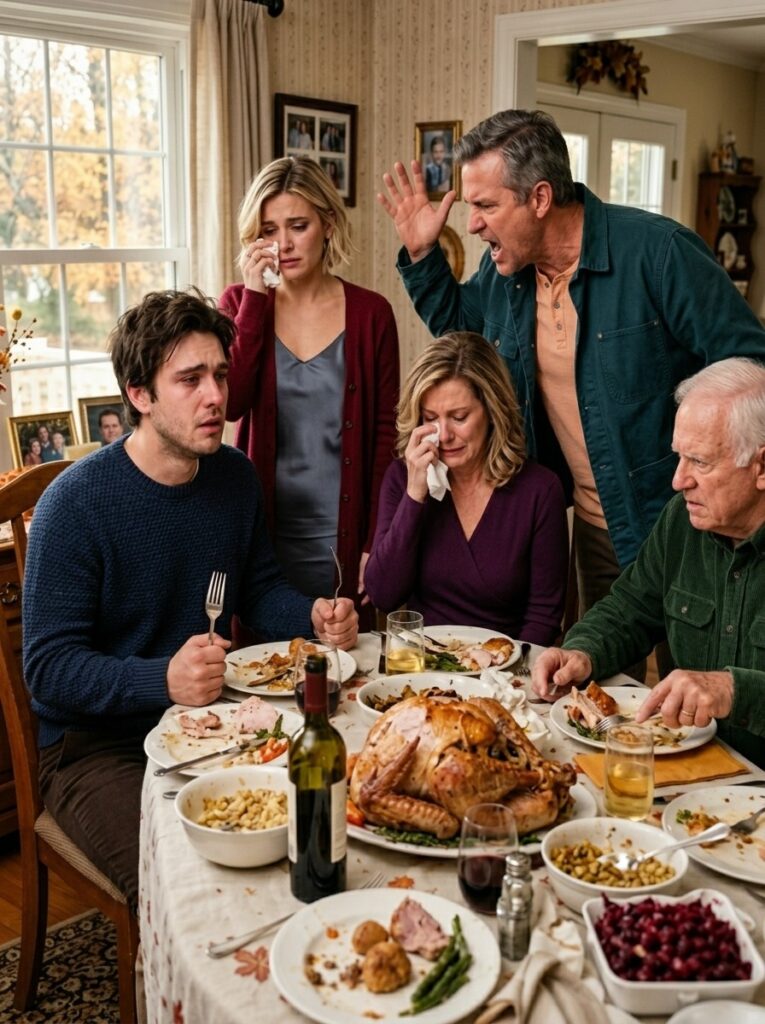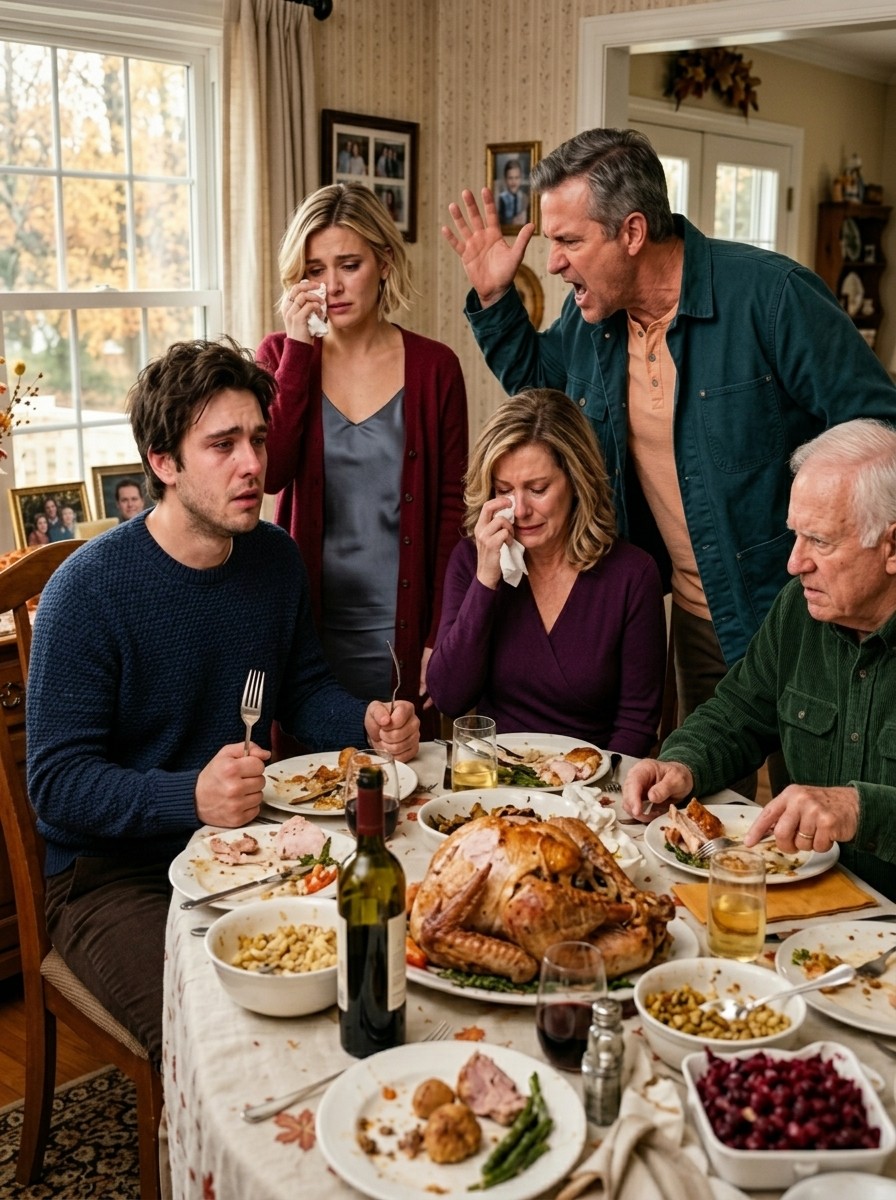
Grandpa stopped eating when he found out I was paying my parents rent while my sister lived there for free with her two kids. Dad said she needed help more, like my life didn’t matter. The whole table went silent when Grandpa put down his fork and finally said what no one expected.
Grandpa stopped mid-bite.
“Wait… you pay your parents rent?”
I froze with my fork halfway to my mouth. Across the Thanksgiving table, my mother’s face tightened. My sister, Claire, looked down at her plate like the mashed potatoes had suddenly become fascinating.
Before I could answer, my dad waved his hand like it was nothing.
“Your sister has two kids,” Dad said. “She needs help more.”
The table went silent.
Grandpa set down his fork.
Nobody expected what he said next.
“No,” he said quietly. “I asked Ethan.”
My stomach sank.
Dad leaned back in his chair. “Dad, don’t start.”
Grandpa’s eyes stayed on me. “How much?”
I swallowed. “Eight hundred a month.”
My grandmother whispered, “Eight hundred?”
Mom quickly said, “It’s not rent. It’s helping with household expenses.”
“I live in the basement,” I said before I could stop myself. “I buy my own groceries. I pay for my phone, car insurance, gas, and half the utilities.”
Claire’s head snapped up. “You make it sound like you’re being ab:us:ed.”
“I didn’t say that.”
“But you’re acting like it,” she said. “I have two children, Ethan. Do you know how expensive daycare is?”
I stared at her. “You don’t pay daycare. Mom watches them five days a week.”
Claire’s cheeks reddened. Dad s/lapp/ed his palm lightly against the table.
“That’s enough.”
But Grandpa was no longer eating. His face had gone still in a way I had only seen once before, at my uncle’s funeral.
“Claire,” he said, “do you pay anything to live here?”
Claire opened her mouth, then closed it.
Dad answered for her. “She’s rebuilding.”
Grandpa nodded slowly. “How long has she been rebuilding?”
Mom’s voice came out thin. “That’s not fair.”
Grandpa looked around the table. “No, what’s not fair is charging one child rent while giving the other a free room, free childcare, free meals, and then calling it family.”
My father’s jaw tightened. “Ethan is twenty-six. He should contribute.”
“And Claire is thirty-two,” Grandpa said. “With two children she chose to have and a man she chose to marry, divorce, and keep going back to whenever he knocks.”
Claire stood so fast her chair scraped the floor. “How dare you.”
Grandpa didn’t raise his voice. “Sit down.”
She sat.
Then Grandpa turned to me again.
“Ethan, where does your money go?”
I laughed once, but there was no humor in it. “To them.”
Mom’s eyes filled with tears. “We never forced you.”
“You told me if I moved out, I was abandoning the family.”
Dad pointed at me. “Because family helps family.”
Grandpa pushed his plate away.
“Then tonight,” he said, “family is going to tell the truth.”
The room went so quiet I could hear the oven ticking in the kitchen.
Grandpa folded his hands on the table the way he always did when he was about to say something that could not be taken back.
“How long has Ethan been paying rent?”
Dad didn’t answer.
Mom didn’t answer.
So I did.
“Four years.”
Grandpa looked at my father.
“Four years. Eight hundred a month. That’s thirty-eight thousand dollars, give or take.”
Nobody moved.
“And in those four years, what did Ethan get?”
Dad opened his mouth.
“I’ll tell you what he got,” Grandpa continued. “A basement with no window that works properly. A family that treats him like a tenant and his sister like a guest. And a guilt trip every time he thinks about leaving.”
“That’s not what happened,” Mom said.
“Then what happened, Linda? Because from where I’m sitting, you charged one child to live in your house and let the other one live for free. And the one paying is the one sitting at this table looking like he hasn’t slept in a year.”
He wasn’t wrong.
I hadn’t slept well in months.
I worked as a warehouse supervisor. Five days a week. Overtime every other Saturday. I woke up at 4:30 a.m. and came home at six. I ate dinner alone in the basement because by the time I got home, Claire’s kids had already used the kitchen and left it looking like a disaster zone that somehow became my job to clean.
I paid rent.
I paid utilities.
I paid for groceries I kept in a mini fridge downstairs because Claire’s kids ate everything in the main kitchen.
And every time I mentioned it, my mother said the same thing.
“They’re children, Ethan. They don’t know better.”
And every time I talked about moving out, my father said the same thing.
“You’re going to abandon your mother? After everything we’ve done for you?”
Everything they’d done for me.
I was still trying to figure out what that list included.
Grandpa stood from the table.
“Ethan, grab your coat.”
Dad’s face changed. “Where are you going?”
“Out.”
“Dad, sit down. We’re having Thanksgiving.”
Grandpa looked at the table. The turkey. The potatoes. The rolls my mother had spent all morning baking.
“I’ve lost my appetite,” he said.
He walked to the door.
I looked at my parents.
My mother was crying.
My father was furious.
Claire was staring at her phone.
Her two kids were in the living room watching cartoons, completely unaware that the family was falling apart in the next room.
I stood up.
“Ethan, if you walk out that door—” Dad started.
“What?” I said. “You’ll charge me extra?”
I grabbed my coat and followed Grandpa outside.
We sat in his truck for a long time without speaking.
The engine was off.
The windows fogged.
Grandpa stared straight ahead.
“How bad is it?” he finally asked.
“What do you mean?”
“Your savings. Your bank account. How bad?”
I didn’t want to answer.
“Ethan.”
“I have eleven hundred dollars.”
He closed his eyes.
“Twenty-six years old. Working full-time. And you have eleven hundred dollars because your parents have been draining you dry while your sister sits upstairs spending nothing.”
“It’s not that simple, Grandpa.”
“It is exactly that simple. Your father turned you into a piggy bank and called it responsibility. And your mother let it happen because it was easier than telling Claire to grow up.”
He started the truck.
“Where are we going?” I asked.
“My house.”
“Grandpa, I can’t just leave on Thanksgiving—”
“You can. And you are.”
He pulled out of the driveway.
I watched the house shrink in the side mirror.
Every light was on.
Nobody came to the door.
That night, I slept in Grandpa’s guest bedroom.
It had a window.
A real window.
With curtains and sunlight and a view of the backyard where Grandpa had built a birdhouse when I was seven.
I lay in bed staring at the ceiling and realized it was the first night in four years that I didn’t hear Claire’s kids running above me at midnight, or my mother vacuuming at six a.m. because she couldn’t sleep, or my father’s television blasting through the floor until two in the morning.
It was quiet.
Real quiet.
The kind of quiet that makes you realize how loud your life has been and how long you’ve been pretending not to hear it.
The next morning, Grandpa was already at the kitchen table when I came downstairs.
He had coffee ready.
Two cups.
And a yellow legal pad with notes written in his slow, careful handwriting.
“Sit down,” he said.
I sat.
“I made some calls this morning.”
“Calls?”
“Your father owes me money, Ethan.”
I stared at him.
“Fourteen years ago, your parents couldn’t make their mortgage payments. Your father came to me. I gave him sixty-two thousand dollars. No paperwork. No interest. Just a handshake and a promise that he’d pay it back when he could.”
He tapped the legal pad.
“He never paid back a dollar.”
I didn’t know that.
I didn’t know any of that.
“When I gave him that money, he was making half what he makes now. Since then, he’s gotten three promotions. Your mother went back to work part-time. Their household income doubled.”
He looked at me.
“And instead of paying me back, they started charging you rent.”
The room tilted.
“Eight hundred a month from you. For four years. That’s thirty-eight thousand, four hundred dollars. He collected almost two-thirds of what he owes me from his own son’s paycheck.”
“He never told me about the loan.”
“Of course he didn’t. Because if you knew he owed me sixty-two thousand dollars, you’d wonder why a man with a paid-off truck and a boat in the driveway was charging his twenty-two-year-old son rent to live in a basement.”
I put my coffee down.
“The boat.”
Grandpa nodded.
“He bought that boat three years ago. Twenty-eight thousand dollars. Cash.”
Three years ago.
I had been paying rent for a year at that point.
My father bought a boat with cash while I was handing him eight hundred dollars a month to sleep in a basement with a broken window.
“I’m going to your parents’ house this afternoon,” Grandpa said. “You don’t have to come.”
“What are you going to do?”
He picked up the legal pad.
“I’m going to do what I should have done fourteen years ago. I’m going to stop being generous with people who mistake kindness for weakness.”
I went with him.
We pulled into the driveway at two o’clock.
The boat sat in the side yard.
Grandpa looked at it for a long time before he turned off the engine.
We walked to the front door.
Dad opened it.
He looked at Grandpa. Then at me. Then back at Grandpa.
“You brought him back to apologize?”
“No,” Grandpa said. “I brought him back to collect.”
He walked inside.
Mom was in the kitchen washing dishes. Claire was on the couch. Her kids were playing on the floor.
Grandpa sat at the dining table.
The same table where Thanksgiving dinner had fallen apart the night before.
Dad stood across from him with his arms crossed.
“What is this about?”
“Sixty-two thousand dollars.”
The kitchen went silent.
Mom turned off the water.
Claire looked up from her phone.
Dad’s arms slowly uncrossed.
“That was a gift,” Dad said.
“It was a loan. You shook my hand. You looked me in the eye. You said, ‘I’ll pay you back, Dad. Every cent.'”
“That was fourteen years ago.”
“And you haven’t paid a cent. Not one. But you’ve managed to charge your son eight hundred a month to live in your basement. You’ve bought a boat. You’ve paid for Claire’s groceries, her phone, her car insurance. You’ve funded one child’s entire life while draining the other.”
Dad’s face went red.
“This is none of your business.”
Grandpa placed the legal pad on the table.
“I’m making it my business.”
He pulled out a single sheet of paper from a folder I hadn’t noticed him carry in.
“This morning, I spoke with my attorney. This is a formal demand letter for repayment of the sixty-two thousand dollar loan. You have ninety days.”
Dad stared at the paper.
“You’re joking.”
“I have never been less amused in my entire life.”
Mom walked into the dining room.
“Dad, please. We can’t afford—”
“You can’t afford to pay me back, but you can afford a boat? You can afford to let Claire live here for free while Ethan pays rent from a warehouse salary?”
He looked at my mother.
“Linda, I love you. You married my son and gave me two grandchildren. But you have spent the last four years watching Ethan hand over money he earned with his own hands while Claire contributes nothing. And you said nothing. Because it was easier.”
My mother sat down.
“Ethan never complained.”
“Because you raised him not to. You taught him that asking for fairness was the same as being selfish. And he believed you. Until last night.”
He turned to Claire.
“And you.”
Claire looked up.
“When’s the last time you worked?”
“I can’t work. I have two kids.”
“Your mother watches them five days a week. What are you doing with those five days?”
“I’m looking for jobs.”
“For how long?”
Claire didn’t answer.
“Two years,” I said quietly.
Everyone looked at me.
“She’s been ‘looking’ for two years. She goes to the gym three times a week. She gets her nails done every other Friday. She orders delivery twice a week. And she pays for all of it with money from Derek.”
“That’s none of your business,” Claire snapped.
“Derek. The ex-husband. The one who shows up every three months, stays for a week, and leaves again.”
“He’s trying to change.”
“He’s not trying to change, Claire. He’s keeping you available.”
Claire stood.
“You don’t know anything about my life.”
“I know you haven’t paid a bill in this house in two years. I know Mom cooks for your kids, bathes them, puts them to bed. I know Dad drives them to school. And I know the only person in this house who pays anything is me. And I live in a basement.”
Claire’s eyes filled with tears.
“You’re so cruel.”
“I’m not cruel. I’m tired.”
Grandpa placed his hand on the table.
“Enough.”
Everyone went quiet.
“Here’s what’s going to happen,” he said. “Ethan is moving out. Today. He’s coming to live with me.”
Dad started to speak.
“I’m not finished,” Grandpa said.
Dad closed his mouth.
“Ethan will pay no rent. He will save his money. He will eat meals at my table. And he will be treated like a member of the family, not a source of income.”
He looked at my father.
“You have ninety days to begin repaying the sixty-two thousand dollars. I don’t care how. Sell the boat. Refinance the house. Get Claire a job. But you will pay it back.”
He stood.
“And one more thing.”
He reached into the folder again.
He pulled out a second document.
This one was older. Yellowed. Wrinkled at the edges.
“Do you know what this is?” he asked my father.
Dad looked at it.
His face changed.
“This is the deed to this house,” Grandpa said. “Which I co-signed when you couldn’t qualify for the mortgage on your own. My name is still on it.”
Dad went pale.
“I never removed myself. Because I trusted you. The way Ethan trusted you.”
He placed the deed on the table beside the demand letter.
“Don’t make me regret that trust any more than I already do.”
He turned to me.
“Go pack your things.”
I went downstairs.
The basement was exactly the way I’d left it.
The broken window.
The mini fridge humming in the corner.
The mattress on the floor because there wasn’t room for a bed frame.
The shelf I’d built from scrap wood to hold my books.
Four years of my life in a room that didn’t even have a proper door.
I packed two bags.
That was all I had.
Two bags.
Twenty-six years old, working full-time for four years, and everything I owned fit in two bags.
When I came upstairs, Mom was waiting by the door.
She was crying.
“Ethan, please don’t go.”
“Mom.”
“I know we made mistakes, but you’re my son.”
“I’ve been your son for twenty-six years. But for the last four, I’ve also been your tenant. And Claire’s babysitter. And Dad’s retirement plan.”
She reached for my arm.
“It wasn’t supposed to be like this.”
“But it is like this. And the only person at that table last night who said it out loud was Grandpa.”
She looked at the floor.
“Will you call?”
“Yeah, Mom. I’ll call.”
“Will you come for Christmas?”
I looked at the house.
At the kitchen where I ate alone.
At the driveway where Dad’s boat sat.
At the upstairs window where Claire’s bedroom light was on even though it was two in the afternoon.
“I don’t know.”
She nodded.
I walked out.
Grandpa was already in the truck.
I threw my bags in the back and climbed in.
We pulled out of the driveway.
I didn’t look in the mirror this time.
I didn’t need to.
I already knew nobody was standing at the door.
Grandpa’s house smelled like cedar and old coffee.
The guest room had clean sheets, a wooden desk, and a window that opened.
He cleared out half the closet without being asked.
That first night, he made grilled cheese sandwiches and tomato soup.
We ate at the kitchen table without speaking.
It wasn’t uncomfortable.
It was the kind of silence that happens when two people don’t need words to understand what just happened.
After dinner, Grandpa washed the dishes.
I dried.
“Grandpa.”
“Yeah.”
“Thank you.”
He handed me a plate.
“You don’t thank family for treating you like family, Ethan. That’s the whole point.”
The first month was strange.
I kept waking up early, expecting to hear noise above me. There was no noise. Just birds.
I kept reaching for my wallet on the first of the month, ready to hand over eight hundred dollars. There was no one to hand it to.
I kept waiting for someone to remind me that I owed something. Nobody did.
By the second month, my savings account had more money in it than it had ever held.
By the third month, I started sleeping through the night.
By the fourth month, I looked in the mirror and didn’t recognize the bags under my eyes because they were gone.
Dad sold the boat.
He didn’t tell me. Grandpa did.
“Twenty-one thousand,” Grandpa said. “Less than he paid for it. He sent the first payment last week.”
“How much?”
“Five thousand.”
“That leaves fifty-seven.”
“He’ll get there.”
“And if he doesn’t?”
Grandpa looked at me over his coffee.
“Then he’ll learn what Ethan learned at twenty-two. That debts don’t disappear just because you stop talking about them.”
Claire got a job.
Receptionist at a dental office.
Four days a week.
Mom still watched the kids on those days, but now Claire paid her two hundred dollars a month for it.
Two hundred.
Not eight hundred.
But it was a start.
She called me once, two months after I moved out.
“Ethan.”
“Yeah.”
“I didn’t realize how much you were doing.”
I waited.
“Mom asked me to start helping with groceries. And the electric bill. And the water. And I looked at the numbers and I…”
She stopped.
“Yeah,” I said.
“How did you do it for four years?”
“I didn’t think I had a choice.”
She was quiet for a long time.
“I’m sorry, Ethan.”
I leaned against the kitchen counter in Grandpa’s house.
The house where I didn’t pay rent.
The house where I slept in a room with a window.
The house where someone made me coffee in the morning without asking for anything in return.
“Thank you for saying that, Claire.”
“Do you hate me?”
“No. I hate what happened. But I don’t hate you.”
She exhaled.
“Can I bring the kids to see you sometime? They keep asking where Uncle Ethan went.”
“Yeah. Bring them.”
“Saturday?”
“Saturday works.”
She brought them that Saturday.
They ran through Grandpa’s yard like it was Disneyland.
Grandpa sat on the porch and watched them climb the old oak tree he’d planted forty years ago.
Claire sat beside me on the steps.
“This is a nice house,” she said.
“It is.”
“Grandpa built most of it himself, didn’t he?”
“With his own hands.”
She looked at the yard. At the birdhouse. At the garden. At the truck in the driveway.
“I used to think Grandpa was just old-fashioned. Stubborn. The kind of man who makes everything harder than it needs to be.”
“And now?”
“Now I think he’s the only person in this family who says what he actually means.”
I looked at her.
“That Thanksgiving,” she said. “When he told me to sit down.”
“Yeah.”
“Nobody had ever told me to sit down before. Not Mom. Not Dad. Not Derek. Everyone just let me do whatever I wanted.”
She pulled at a thread on her sleeve.
“That’s not love, Ethan. I thought it was. But it’s not.”
“What is it?”
“Avoidance. They avoided me because it was easier. And they charged you because you never fought back.”
She was right.
And hearing her say it didn’t feel like victory.
It felt like grief.
Because the truth about my family wasn’t that they were cr:uel.
It was that they were lazy.
Lazy with their love.
They gave it to whoever demanded it the loudest and took it from whoever complained the least.
And I had been the quietest person in the house for four years.
Last Sunday, Grandpa and I sat on the porch after dinner.
He had made pot roast.
The kind he used to make when I was a kid, with carrots cut too big and potatoes cut too small and gravy that was never quite the right consistency but always tasted like home.
He rocked slowly in his chair.
“Your father called today,” he said.
“What did he say?”
“He said he wants you to come home for Christmas.”
I looked at the yard.
“What do you think?” I asked.
“I think that’s your decision.”
“I’m asking what you think.”
He rocked for a while.
“I think your father loves you. I think your mother loves you. I think they both got lost somewhere between wanting to help Claire and forgetting to notice you. And I think they know it now.”
He paused.
“But knowing it and fixing it are two different things. And you don’t owe anyone your presence just because they finally feel guilty.”
“So don’t go?”
“I didn’t say that either.”
He looked at me.
“Go if you want to. Stay if you need to. But whatever you decide, don’t do it out of guilt. You’ve spent enough years making decisions out of guilt.”
I nodded.
“Grandpa?”
“Yeah.”
“Why did you do all this? The demand letter. The lawyer. Moving me in. Why?”
He stopped rocking.
“Because forty years ago, I was you.”
I looked at him.
“My father charged me rent at seventeen. My sister lived at home for free until she was thirty. I worked two jobs and handed over half my paycheck every month because I was told that was what good sons did.”
He looked at his hands.
“Nobody ever told me to stop. Nobody ever said it was unfair. Nobody ever pushed their plate away and said enough.”
He looked at me.
“So I became the person I wished someone had been for me.”
I sat with that for a long time.
The man who had built this house with his own hands.
Who had planted the garden and the oak tree and the birdhouse.
Who had co-signed a mortgage and lent sixty-two thousand dollars without paperwork because he believed in his son.
That man had once been a boy handing over his paycheck in a house where no one noticed he was disappearing.
And sixty years later, he saw it happening again.
And he put down his fork.
“I went to Christmas,” I told him a few weeks later.
“How was it?”
“Different. Claire helped cook. Dad didn’t mention the boat. Mom hugged me at the door and didn’t let go for a long time.”
“And?”
“Dad pulled me aside after dinner. He said he was sorry. He said he didn’t realize how bad it had gotten.”
“Do you believe him?”
“I believe he means it right now. I don’t know if he’ll mean it in six months.”
Grandpa nodded.
“That’s fair.”
“He asked me to move back in.”
“What did you say?”
I looked around Grandpa’s kitchen.
At the coffee pot that was always ready.
At the window with the view of the backyard.
At the chair across from his that had become mine.
“I told him I already have a home.”
Grandpa didn’t smile.
But he poured me another cup of coffee.
And that was enough.
People think fairness means treating everyone the same.
It doesn’t.
Fairness means paying attention to who is carrying the weight and who is standing on top of it.
My parents didn’t treat me and Claire differently because they loved her more.
They treated us differently because I never complained.
And silence, in a family that doesn’t want to hear the truth, gets rewarded with more weight.
If you are the quiet one in your family — the one who pays without being asked, who shows up without being thanked, who gives without being noticed — hear me.
Your silence is not a gift.
It is a door that people walk through without wiping their feet.
Close it.
Not with anger.
Not with cruelty.
With a chair at someone else’s table and the courage to say, “I deserve more than a basement.”
You do.
I turned off the porch light, washed both coffee cups, and set them upside down on the drying rack the way Grandpa liked them.
Then I walked to the guest room that didn’t feel like a guest room anymore.
It felt like mine.
Because someone had looked across a Thanksgiving table, put down his fork, and said the thing that no one else in my family had the courage to say.
“That’s enough.”
Two words.
From a man who had waited sixty years to say them.
Not for himself.
For me.
And I will never go back to the basement.
Not for guilt.
Not for obligation.
Not for anyone who calls it family but treats it like a bill.
The window in my room was open.
The air smelled like cedar and cold grass.
And for the first time in four years, I fell asleep without setting an alarm for someone else’s life.
Just mine.