I never told my daughter’s teacher that the “dirty mechanic” she sneered at was a close friend of the Police Colonel. She dumped my daughter’s backpack onto the classroom floor and demanded $500 in cash to make the theft accusation “go away.” She thought I would panic. Instead, I pulled out my phone and said, “Then let’s handle this legally.” She smirked and called the police. But when the Colonel himself walked into that classroom and asked for the security footage, her confidence vanished. He rewound the video to 10:14 a.m., pointed at the corner of the screen, and asked one question that made her face go pale.
“Dad,” Lily whispered, shaking. “I didn’t steal anything.”
I looked at my daughter standing near the chalkboard, terrified and frozen. Her backpack had been emptied onto the floor. Books, pencils, and notebooks were scattered everywhere. The apple I had packed that morning was bruised beside the teacher’s desk.
Mrs. Sharp s/lapp/ed her hand against the desk, making the children jump.
“Stop lying! Five hundred dollars disappeared from my wallet. You were the only student in here during break.”
Then she looked me up and down, her eyes lingering on the grease stains covering my old work jacket.
“Mr. Bennett,” she said in a falsely sweet voice, “pay the money now, or I’ll call the police. This could follow your daughter forever. Maybe Child Protective Services should also take a look at your home.”
That was not discipline.
It was extortion.
She thought I was a poor mechanic she could intimidate.
I looked at Lily’s trembling hands.
“Call them,” I said calmly.
Mrs. Sharp froze.
“What did you say?”
“Call the police. If a crime was committed, then we should follow the law.”
Her smile disappeared. She grabbed the phone and dialed.
“You’re going to regret this.”
Twenty minutes later, two young officers entered the classroom. Mrs. Sharp instantly changed her tone, acting like a wounded victim as she explained the missing money.
But just as the officers opened their notebooks, the classroom door opened again.
Everyone went silent.
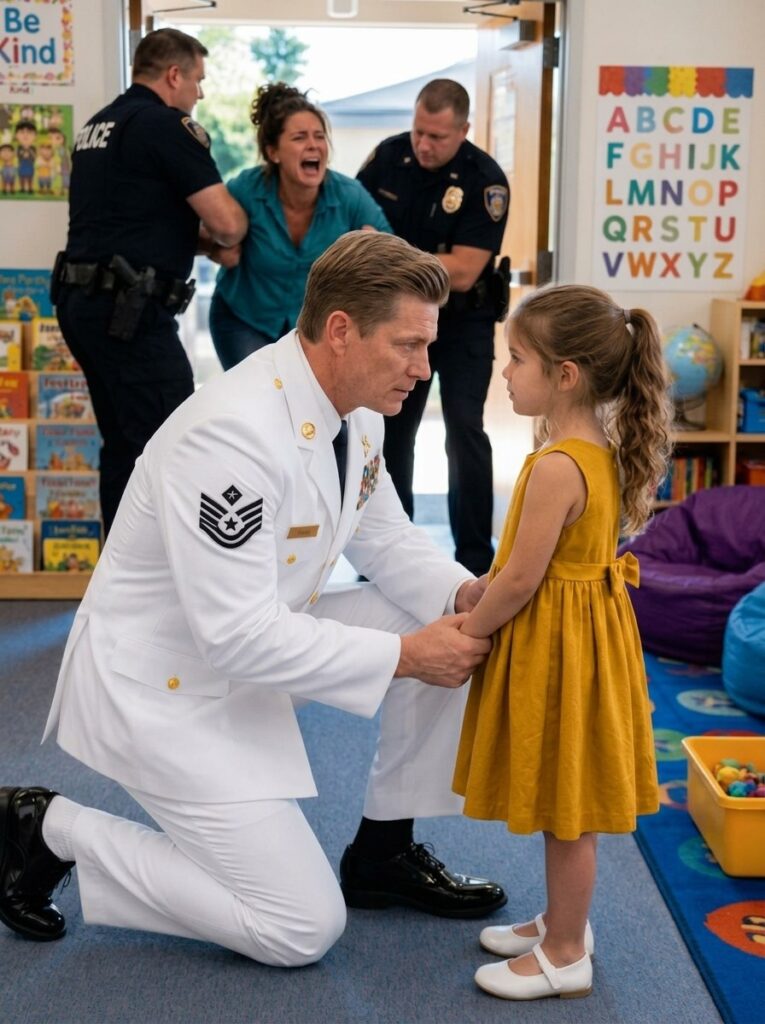
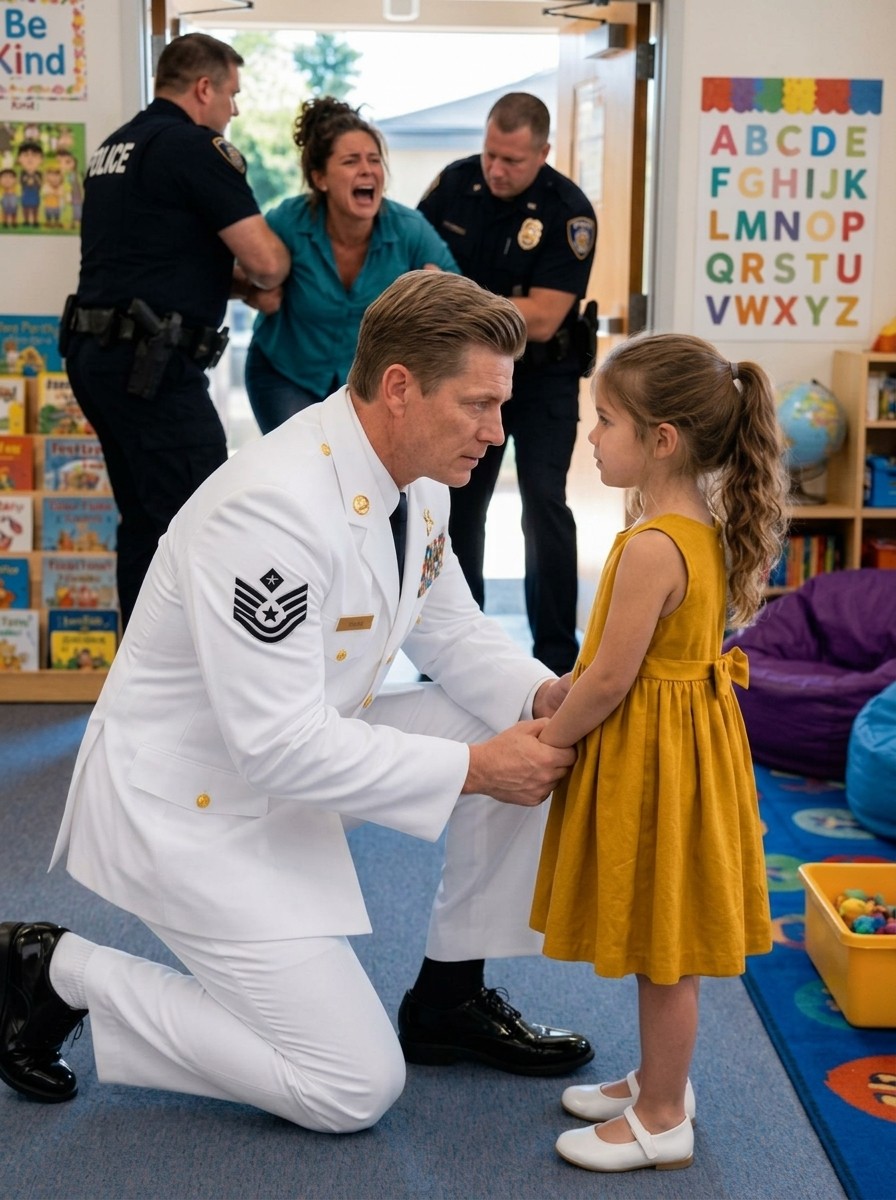
A man in full uniform stepped inside.
His boots were polished. His uniform was flawless. The silver stars on his shoulders flashed under the classroom lights. Behind him, Principal Henderson looked pale and nervous.
The officers straightened immediately.
“Colonel!”
The Colonel ignored them and walked straight toward me — the grease-covered mechanic everyone had underestimated.
“What happened, Daniel?” Colonel Rob Hayes asked quietly.
Mrs. Sharp’s mouth fell open.
She looked from his decorated uniform to my stained jacket, and fear finally crossed her face.
“That child stole money from my bag,” she said, pointing at Lily.
The Colonel turned to the principal.
“Do you have cameras in the hallway?”
“Yes,” Principal Henderson answered quickly. “Full surveillance.”
“Bring a laptop,” Rob ordered. “Now.”
Five minutes later, a laptop sat on a student desk. Every child leaned forward.
The footage was grainy, but clear.
At 10:15 a.m., Lily entered the room carrying the attendance book.
At 10:16 a.m., she left. Her hands were empty.
At 10:40 a.m., the custodian entered with a mop bucket.
At 11:00 a.m., Mrs. Sharp returned holding a coffee cup.
The Colonel leaned back and crossed his arms.
“Forty seconds,” he said quietly, looking at Mrs. Sharp. “You’re saying this child entered the classroom, found your bag, opened it, located your wallet, took the money, put everything back perfectly, and left without leaving any sign?”
His eyes hardened.
“Either this little girl is a magician… or someone in this room is lying.”
Mrs. Sharp’s face lost every shade of color it had left.
“I’m not lying. The money was there this morning.”
“Then let’s keep watching,” the Colonel said.
He scrolled forward.
At 11:04 a.m., Mrs. Sharp set her coffee cup on her desk.
At 11:05 a.m., she opened the closet behind the chalkboard.
At 11:06 a.m., she pulled Lily’s backpack from the row of bags and brought it to her desk.
At 11:07 a.m., she opened it.
She reached inside.
She pulled nothing out.
Because there was nothing inside it that didn’t belong to a nine-year-old girl.
Then she dumped the entire bag onto the floor.
Every child in the classroom watched the footage with wide eyes.
The Colonel pressed pause.
“Mrs. Sharp. At what point in this video do you see Lily take your money?”
Silence.
“Because what I see is a teacher opening a child’s bag four minutes after entering the room. Before any student was present. Before any accusation was made. Before any investigation.”
He leaned forward.
“You didn’t find evidence of a theft. You created a scene.”
Mrs. Sharp’s hands began to shake.
“I was checking—”
“You were checking a nine-year-old girl’s backpack without her present, without a witness, without notifying the principal, and without any reasonable evidence.”
He pointed at the screen.
“And you did it because she was the easiest target. The quiet girl. The mechanic’s daughter. The one you assumed no one would fight for.”
Mrs. Sharp’s eyes darted to Principal Henderson.
He looked away.
“Principal,” the Colonel said without turning. “Has this teacher made accusations like this before?”
Henderson cleared his throat.
“There have been… previous reports.”
“How many?”
Another long pause.
“Three.”
The room shifted.
Three previous reports.
Three other children.
Three other families who sat in this same classroom, listened to the same threats, and were told to pay or face consequences.
I looked at Mrs. Sharp.
She was no longer standing tall behind her desk.
She was gripping the edge of it like it was the only thing keeping her upright.
“Three families,” the Colonel said slowly. “How many of them paid?”
Henderson didn’t answer.
But his silence answered for him.
The Colonel turned to the two officers.
“I want a full report. Contact every parent who has filed a complaint about this teacher. Obtain their statements. Preserve this surveillance footage as evidence.”
He looked at Mrs. Sharp one final time.
“And if it turns out that you have been using false accusations against children to extort money from their parents, ma’am, you will not be dealing with a school board. You will be dealing with me.”
Mrs. Sharp opened her mouth.
No words came out.
She sat down in her chair as if her legs had stopped working.
The Colonel walked over to Lily.
She was still standing by the chalkboard.
She had not moved since the moment I entered the room.
Nine years old.
Thin.
Wearing the same shoes she had worn for six months because I couldn’t afford new ones yet.
Her lower lip was trembling.
Rob knelt down to her level.
“Lily,” he said gently. “You didn’t do anything wrong. Do you understand me?”
She nodded.
“Your dad called me because he knew you needed help. And I came because that’s what we do for family.”
Lily looked at me.
“Am I in trouble, Dad?”
I walked over, knelt beside Rob, and pulled her into my arms.
“No, baby. You were never in trouble.”
She buried her face in my jacket.
The same grease-stained jacket Mrs. Sharp had looked at with disgust thirty minutes earlier.
My daughter didn’t care about the stains.
She never had.
We left the school together.
Rob walked beside me.
The officers stayed behind with Henderson.
In the parking lot, Lily climbed into the truck and closed her eyes. She was exhausted the way children get when the world has been too big for one day.
Rob leaned against the truck beside me.
“How long has this been going on?”
“She’s been picking on Lily since September. Small things. Moving her seat to the back. Skipping her during snack time. Calling her ‘the quiet one’ in a voice that made the other kids laugh.”
“And today?”
“Today she decided quiet wasn’t enough. She wanted money.”
Rob shook his head.
“You know, Daniel, when you called me, I thought maybe it was a misunderstanding. A teacher overreacting. But that footage…”
He trailed off.
“That woman went into a child’s bag before classes even started. She had the accusation ready before the kid even walked in.”
I nodded.
“She saw my jacket and my truck and thought I’d just hand over five hundred dollars to make it go away.”
“Would most parents?”
“Probably. When someone threatens your kid with police and CPS, most people don’t think about cameras. They think about fear.”
Rob crossed his arms.
“That’s what she was counting on.”
He was quiet for a moment.
“How’s the shop?”
“Slow. Transmission work dried up in February. I’ve been taking whatever comes in.”
“And Lily’s mom?”
“Still gone. Three years now. No calls. No letters. No birthday cards.”
He looked at the truck.
At the dent in the fender.
At the cracked tail light held together with tape.
At the car seat in the back that was too small for Lily now but that I hadn’t replaced because the new one cost seventy dollars I didn’t have.
“You know what I see when I look at you, Daniel?”
“A guy who needs a new truck.”
He almost smiled.
“I see a man who showed up.”
He pushed off the truck.
“Most people in your situation would have panicked. Paid the money. Taken the kid home and pretended it didn’t happen. You called a Colonel into a public school and told a teacher to call the cops on you.”
“She was wrong.”
“She was. But it takes a particular kind of man to stand in a room full of people looking down on him and say ‘go ahead, call them.'”
He opened his car door.
“I’ll make sure this gets handled properly. Henderson won’t be able to bury it this time.”
“Rob.”
He turned.
“Thank you.”
“You rebuilt the transmission on my wife’s SUV for free last winter. You told me not to worry about it. You said that’s what friends do.”
He got in his car.
“This is what friends do, Daniel.”
He drove away.
I stood in the parking lot for another minute.
Then I got in the truck and looked at Lily through the rearview mirror.
She was asleep.
Her backpack sat on the seat beside her.
I had repacked it in the classroom before we left.
Every book. Every pencil. Every notebook.
And the bruised apple.
I kept the apple.
I don’t know why.
Maybe because it reminded me that even small things take damage when they are thrown around by people who should have been more careful.
The investigation took three weeks.
Mrs. Sharp was suspended pending a full review.
The surveillance footage was preserved.
The two officers filed a detailed report.
And the three previous families came forward.
One was a single mother who worked at a laundromat. Mrs. Sharp had accused her son of vandalizing school property and demanded two hundred dollars. The mother paid.
Another was a grandmother raising two grandchildren on Social Security. Mrs. Sharp told her that one of the girls had been caught stealing supplies and that a “donation” of three hundred dollars would keep it off her record. The grandmother borrowed the money from a neighbor.
The third was an immigrant father who barely spoke English. Mrs. Sharp told him his son would be expelled unless he paid four hundred dollars in “replacement fees” for damaged textbooks. He paid in cash. He never told anyone because he was afraid of losing his visa.
Four families.
Four children.
Fourteen hundred dollars taken from people who could not afford to lose a single dollar.
All by a woman who stood behind a desk and used her authority like a weapon against the people least able to fight back.
The school board held a hearing.
Mrs. Sharp brought a lawyer.
She claimed the accusations were exaggerated.
She claimed the families were confused.
She claimed the money was voluntary.
Then the board played the surveillance footage.
They played all of it.
Every camera. Every hallway. Every timestamp.
Mrs. Sharp entering the classroom before students arrived.
Mrs. Sharp opening bags that did not belong to her.
Mrs. Sharp making phone calls to parents within minutes, before any formal report was filed.
Her lawyer stopped talking halfway through the second video.
There was nothing left to defend.
Mrs. Sharp was terminated.
Her teaching license was suspended pending a state review.
And the district reimbursed every family the full amount they had been pressured into paying.
The grandmother cried when she received the check.
“I thought nobody believed us,” she told the school board.
“Nobody asked,” I said.
That was the truth no one wanted to hear.
Nobody asked.
Nobody checked the cameras.
Nobody questioned why four low-income families had all made cash payments to the same teacher in the same school year.
Because the families were poor.
And poor people are expected to stay quiet.
Two months later, I was under a Chevy Silverado at the shop when Lily came in after school.
She dropped her backpack on the bench and climbed onto the stool she always sat on while I worked.
“Dad?”
“Yeah, baby.”
“Mrs. Patterson gave me a new seat today.”
“Where?”
“Front row. By the window.”
Mrs. Patterson was the new teacher. Young. Patient. The kind of teacher who learned every student’s name on the first day.
“She also said I have the neatest handwriting in the class.”
I slid out from under the truck.
“She’s right. You do.”
Lily swung her legs on the stool.
“Dad?”
“Yeah.”
“That day with Mrs. Sharp. When she dumped my bag out. All the kids were watching.”
I wiped my hands on a rag and sat down beside her.
“I know.”
“I thought everyone would think I was a thief.”
“Did they?”
“Tommy Reeves called me a thief the next day.”
My jaw tightened.
“But then Marcus told him to shut up. He said his mom told him Mrs. Sharp was the real thief. And then Tommy stopped.”
“Good.”
“Dad?”
“Yeah.”
“When she told you to pay the money, why didn’t you just pay it?”
I looked at my daughter.
Nine years old.
Asking the question that mattered more than any surveillance footage or school board hearing.
“Because you didn’t do anything wrong, Lily. And paying would have told you that when someone bigger than you lies about you, the right thing to do is hand them money and walk away.”
“Is that wrong?”
“That’s the wrongest thing I could have taught you.”
She thought about it.
“But you were scared. I saw your hands.”
She was right.
My hands had been shaking the entire time.
“Yeah,” I said. “I was scared.”
“Then why did you still say call the police?”
“Because being scared and doing the right thing aren’t opposites, baby. Most of the time, they show up together.”
She nodded slowly.
Then she pulled a piece of paper from her backpack.
A drawing.
Two people standing in front of a building with a sign that said “DAD’S SHOP.”
One tall figure covered in black smudges.
One small figure holding the tall one’s hand.
Underneath, in her neatest handwriting:
“My dad is brave even when his hands shake.”
I took the drawing.
I looked at it for a long time.
Then I taped it to the wall above my workbench, right next to the calendar and the old photograph of my father standing in front of this same shop forty years ago.
Grease-stained hands.
Tired eyes.
Same jacket.
Three generations of men who fixed other people’s things for a living and never once thought that made them less.
Lily slid off the stool and walked toward the back where she always did her homework on the old card table.
“Dad?”
“Yeah.”
“Can I have a new backpack? The zipper on mine is broken.”
“Saturday.”
“Can it be purple?”
“It can be whatever color you want.”
She smiled.
The kind of smile children give when the world has been put back in order by someone they trust.
I went back under the Silverado.
The wrench was cold in my hand.
The fluorescent light hummed above me.
And taped to the wall, right where I could see it every morning, a nine-year-old girl had written the only truth that ever mattered.
Bravery isn’t the absence of fear.
It’s a mechanic in a grease-stained jacket standing in a classroom full of people who look down on him, and saying the four words no one expected.
“Go ahead. Call them.”
People think power belongs to the people with titles.
The people with clean hands and pressed suits and offices with nameplates on the door.
It doesn’t.
Power belongs to the person who tells the truth when lying would be easier.
Who stands still when running would be safer.
Who looks at a woman threatening his daughter’s future and says, “Then let’s handle this legally.”
If someone ever uses their authority to make your child feel small — do not shrink.
Do not pay.
Do not let them see you afraid, even if your hands are shaking underneath the table.
Look them in the eye.
And let the truth do what the truth always does when you give it enough time.
It walks into the room wearing a uniform.
And it asks for the footage.
I turned off the shop lights, locked the door, and drove home with a purple backpack circled in the Saturday section of my calendar and a drawing taped to the wall that I would never take down.
Not ever.
Because my daughter wrote it.
And she has the neatest handwriting in the class.