PART 2
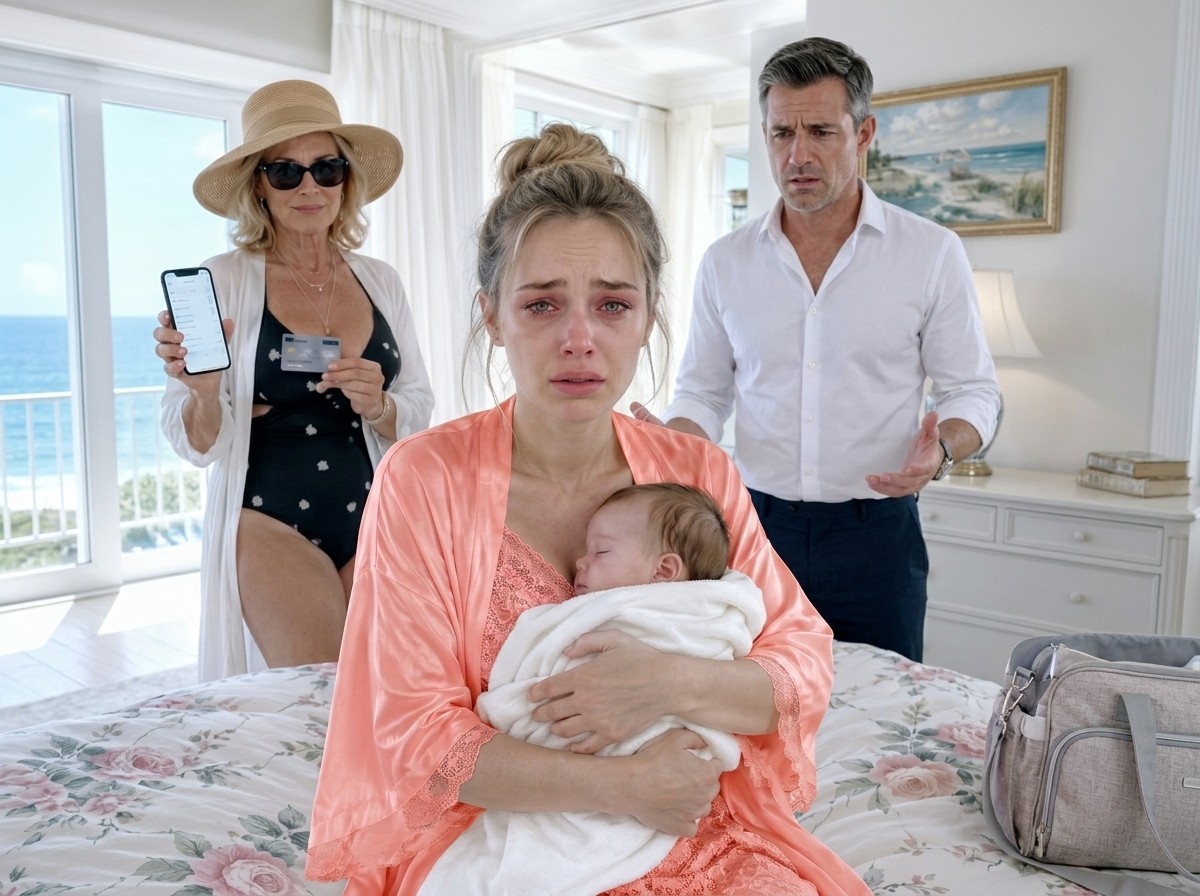
When my son stopped breathing in my arms, the part of me they had so foolishly underestimated finally opened its eyes.
I scoured the living room until I found my phone hidden inside the bottom of the laundry hamper, buried deep under a pile of damp towels. Calista had drained the battery completely and hidden the charging cable in a different room. My hands shook so violently that I dropped the device twice while trying to turn it back on, but I eventually managed to crawl toward the hallway drawer where we kept an old emergency flip phone for backup.
The screen flashed a mocking signal of no service.
I ran outside in my slippers, screaming for help until Mrs. Henderson from the house next door rushed across the lawn to see what was happening. She saw Leo’s face for only a second before she turned pale and whipped out her own phone to dial 911.
“Get an ambulance here right now,” she commanded the operator, her voice steady and urgent.
At the hospital, the world became a frantic blur of bright white lights and running feet. A nurse gently took Leo from my arms while a doctor shouted urgent medical orders to the team. Someone asked me a barrage of questions that I could barely answer through my sobs.
How long had he been turning blue?
When did the symptoms first start appearing?
Why did you wait so long to call for help?
That final question nearly split me open with the weight of its implication.
“I did not wait,” I said through gritted teeth. “They took my phone and prevented me from calling for help.”
A young social worker stood there with a clipboard and lowered it slightly to look me in the eye. “Who exactly took your phone away from you?”
I looked at Leo through the heavy glass of the isolation unit, surrounded by tubes and wires that looked far too large for his fragile body.
PART 3
I looked at Leo through the thick glass of the neonatal intensive care unit.
Machines surrounded him.
Wires.
Monitors.
Tiny tubes taped against skin that should never have known pain.
Three days old.
Three days.
That was all the time my son had spent in this world.
And already he was fighting harder than most adults ever would.
The social worker waited quietly beside me.
Clipboard in hand.
Pen ready.
She had asked me who took my phone.
Who stopped me from calling for help.
Who left a newborn baby struggling to breathe while they boarded a plane for a beach vacation.
For several seconds, I couldn’t answer.
Because saying it out loud made it real.
Because once I said it, there would be no taking it back.
No more excuses.
No more protecting people who never protected me.
Finally, I turned away from the window.
“My husband,” I said.
The words felt like broken glass.
“And his mother.”
The social worker’s expression didn’t change.
Not immediately.
She simply wrote something down.
Then looked up again.
“Tell me exactly what happened.”
So I did.
Every detail.
Every word.
Every lie.
I told her about Leo’s blue lips.
I told her about the gaps between his breaths.
I told her how Calista sat at my kitchen table sipping tea while my son struggled for oxygen.
I told her how Blake looked at Leo for less than three seconds before deciding I was overreacting.
I told her how they laughed about vacation plans while I stood there bleeding from childbirth.
Still wearing a hospital robe.
Still recovering.
Still terrified.
The social worker listened without interrupting.
The only sound was the scratching of her pen against paper.
Then I told her about the phone.
How Calista snatched it from the counter.
How she slipped it into her cardigan pocket.
How she smiled while doing it.
That smile haunted me.
Not because it was cruel.
Because it was calm.
As if preventing a mother from calling for medical help was completely normal.
As if my panic was some kind of inconvenience.
The social worker stopped writing.
“She intentionally took your phone?”
“Yes.”
“And your husband watched it happen?”
“Yes.”
Neither of us spoke for a moment.
Then she asked another question.
“Did he return it?”
I laughed.
Not because anything was funny.
Because sometimes pain reaches a point where laughter is all that’s left.
“No.”
The social worker slowly set her pen down.
For the first time since our conversation began, something shifted in her face.
Concern.
Real concern.
The professional distance disappeared.
She looked toward Leo’s room.
Then back at me.
“Mrs. Carter,” she said carefully, “I need to ask something important.”
I already knew I wasn’t going to like the question.
“Did your husband know there might be a medical issue before he left?”
I frowned.
“No.”
At least, I didn’t think so.
Then something flickered through my memory.
A moment so small I almost missed it.
Two days before.
Blake standing in the kitchen.
Listening to a voicemail.
Looking annoyed.
Deleting it.
My stomach dropped.
The feeling was immediate.
Violent.
The way your body reacts before your brain fully understands.
The social worker noticed.
“What is it?”
I swallowed.
Slowly.
“There was a phone call.”
“What kind of phone call?”
“I don’t know.”
But suddenly I wanted to know more than anything.
Because Blake never deleted voicemails.
Never.
Not work messages.
Not spam calls.
Nothing.
Yet I remembered him deleting that one.
Immediately.
The social worker looked at me carefully.
“What hospital delivered your son?”
I told her.
She nodded.
Then she stood up.
“I’m going to make a few calls.”
I watched her walk away.
And for the first time since arriving at the hospital…
I felt afraid of what she might find.
Not because I thought I was wrong.
Because I was beginning to suspect I was right.
And if I was right…
Then Blake hadn’t ignored a warning.
He had hidden one.
The thought made me physically sick.
Outside the NICU window, Leo’s chest rose and fell beneath the wires.
Slowly.
Carefully.
Fighting for every breath.
While somewhere over the Atlantic Ocean, my husband was probably posting photos from first class.
And for the first time since he walked out that door…
I stopped wondering whether our marriage would survive this.
Instead, I wondered whether I had ever really known the man I married at all.