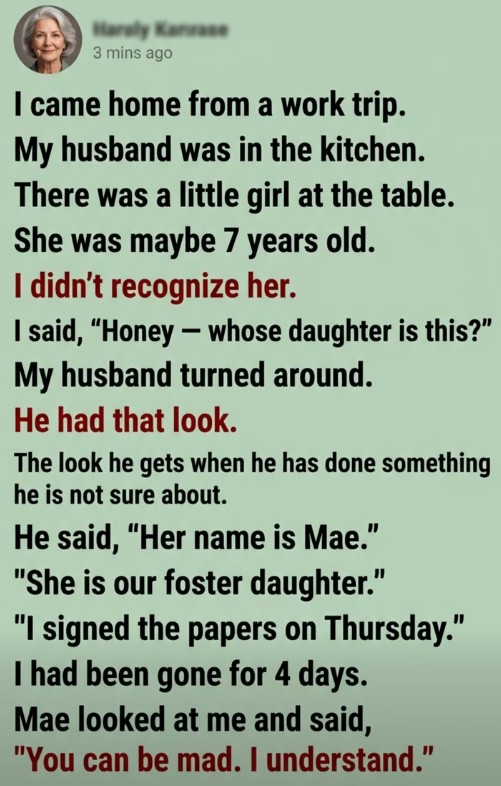
Part 3
I walked back into the kitchen, taking a deep breath to steady the rollercoaster of emotions inside me. Lily was still sitting at the table, her tiny shoulders tense, eyes glued to her sneakers. Her small backpack sat on the chair next to her—the sum total of her entire life, packed into a few zippers.
I pulled out a chair and sat down, not directly opposite her, but at an angle, giving her space to breathe.
“Hi, Lily,” I said, keeping my voice as gentle and grounding as I could. “I’m Sarah.”
She looked up, her eyes wide and cautious. “Are you going to make Mark send me away now?”
The raw honesty of her question caught in my throat. I looked at her, seeing past the defensive posture to the brave little girl underneath.
“No, Lily. I’m not,” I said, looking her straight in the eyes so she knew I meant it. “Mark and I need to work on how we talk to each other, but that has nothing to do with you. You are safe here. And you don’t ever have to apologize for needing a safe place to sleep.”
A tiny, almost invisible sigh escaped her lips, and her shoulders dropped a fraction of an inch.
“Have you had dinner yet?” I asked.
She shook her head.
“Well, then,” I said, standing up and reaching for an apron. “Let’s see what Mark has in this kitchen. How do you feel about breakfast for dinner?”
For the first time, a small, tentative smile broke through her guarded expression.
Part 4:
The next three weeks became a masterclass in adaptation. Our quiet, predictable household of two was suddenly filled with the sounds of morning cartoons, school lunch prep, and the bright, chaotic energy of a seven-year-old.
Mark and I had our long, difficult talks after Lily went to sleep. There were tears and apologies. We established a firm boundary: no more unilateral life-changing decisions. But as the days bled into weeks, a strange thing happened. The anger I held entirely dissolved, replaced by a fierce, protective leadership role I didn’t know I possessed.
Lily was blooming right before our eyes. We learned her quirks:
- She loved extra cinnamon on her oatmeal.
- She kept her shoes perfectly lined up by the door, a habit from moving around so much.
- She was incredibly smart, reading books meant for kids two grades above her.
One evening, while I was helping her with her reading homework, she suddenly leaned her head against my arm. It was the first time she had initiated physical contact.
“Sarah?” she whispered.
“Yes, sweetie?”
“I like it here. It smells like vanilla and clean clothes.”
I swallowed the lump in my throat and squeezed her shoulder. “We like having you here, Lily.”
But even as my heart swelled, a quiet dread began to settle in the back of my mind. We were a temporary placement. Eventually, the phone would ring.
Part 5:
The call came on a rainy Thursday afternoon, exactly one month after Lily had first arrived. I was at my desk, wrapping up a virtual strategy meeting, when Mark walked into my office. His face was entirely pale.
“Rachel just called,” he said, his voice hollow.
My heart did a violent flip. “What did she say?”
“They found a permanent foster placement for Lily. A family with two other kids, closer to her original school district. They want to transition her by the end of the weekend.”
I stood up so fast my office chair rolled back and hit the wall. The thought of Lily packing her single backpack again, of her looking at another set of strangers and saying, “You can be mad, I understand,” made a wave of fierce, unyielding rejection rise up inside me.
“No,” I said, my voice steady, carrying the full weight of a woman who had found her purpose.
Mark blinked, startled. “Sarah, we’re just the emergency contact—”
“We were the emergency contact,” I interrupted, walking over to him and taking his hands. “Mark, look at me. She belongs here. We built a routine. She trusts us. I am not letting her go to another temporary house when she already has a home right here.”
Mark’s eyes filled with tears, a mixture of shock and profound relief washing over his face. “Are you sure? It changes everything.”
“I have never been surer of anything in my life,” I said. “Call Rachel back. Tell her we aren’t transitioning Lily anywhere. Tell her we want to apply for long-term fostering—and adoption, if the opportunity comes.”
Part 6:
Breaking the news to Lily was a moment I will carry with me for the rest of my life.
We sat her down on the living room couch that evening. Mark and I sat on either side of her, holding hands across her lap.
“Lily,” I started, keeping my voice soft but filled with absolute certainty. “Your caseworker called today. They found another house for you.”
Lily’s face immediately fell. She closed her eyes and nodded, her little hands gripping the fabric of her jeans. “Okay. When do I pack my backpack?”
“You don’t,” Mark said, his voice thick with emotion.
Lily opened her eyes, looking between the two of us in confusion.
“We told them no,” I explained, leaning in close. “We told them that if it’s okay with you, we want you to stay right here. With us. For as long as you want, and hopefully, forever. You don’t ever have to pack that backpack again.”
Lily stared at us, processing the words. A single tear rolled down her cheek, but this time, it wasn’t out of fear. She threw her small arms around my neck, burying her face in my shoulder, and reached her other hand out to pull Mark into the hug.
Holding her tight, I looked over at my husband. The way our journey started was messy, unauthorized, and chaotic. But as I held our daughter in my arms, I knew that true leadership wasn’t about waiting for the perfect conditions—it was about recognizing a beautiful destiny when it landed in your kitchen, and having the courage to claim it.
We were no longer a household of two. We were a family.
The End