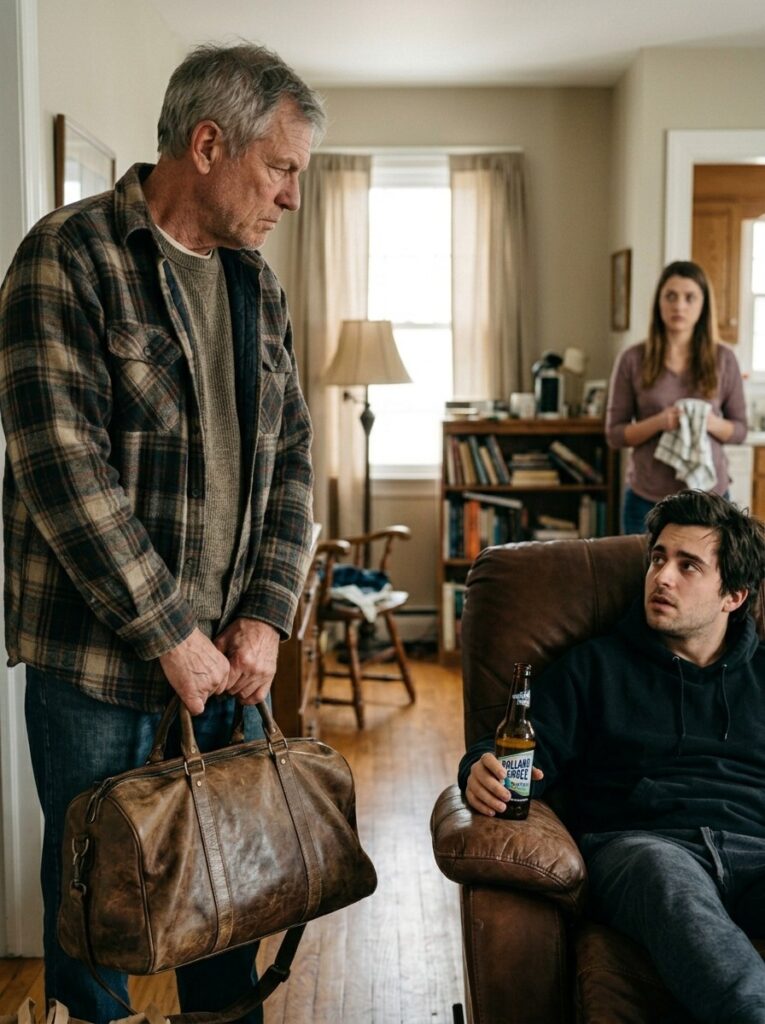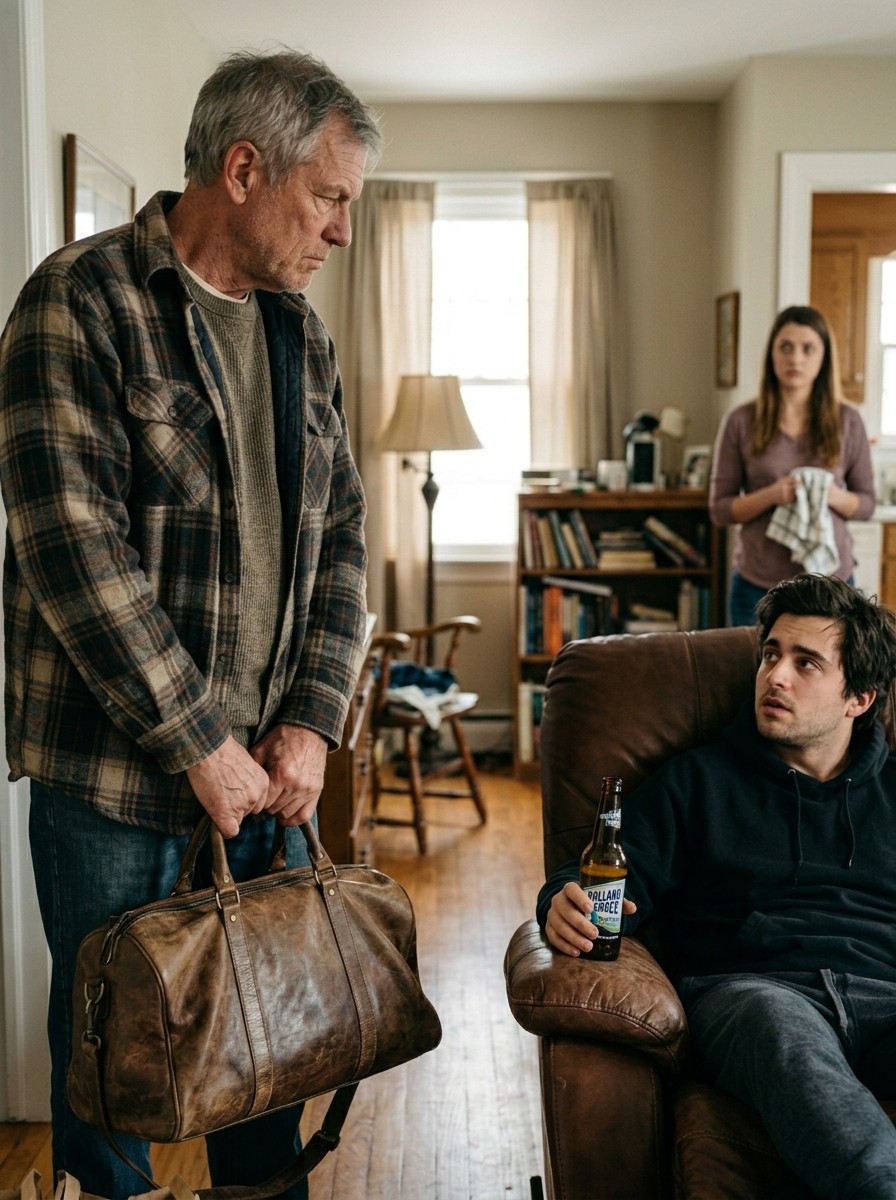
Tiffany followed me into the hallway, her expression caught somewhere between confusion and the first flicker of real doubt, the kind that hadn’t fully formed into worry yet but was clearly working its way there.
“Dad, you’re being dramatic,” she said, leaning against the doorframe with her arms crossed. “Just pack a bag for the weekend if you need to cool off. You’ll be back by Monday, and we can talk about this once everyone’s calmed down.”
I pulled my old leather duffel bag down from the closet shelf, the same one I’d carried on business trips for thirty years of working in banking, and started folding shirts with the kind of slow, deliberate calm that only comes after a decision has already settled into place rather than before one. My hands weren’t shaking. That surprised me more than anything else that afternoon.
“I’m not cooling off, Tiffany,” I said, not looking up from the shirt I was folding. “I’m leaving.”
“For how long?”
I zipped the duffel bag closed and finally met her eyes. “I don’t know yet.”
She stood in the doorway, her arms still crossed, but something in her posture had shifted, the disappointment in her face slowly giving way to an edge of something sharper underneath it. “Dad, you can’t just leave. This is your house. You’ve lived here for twenty-six years.”
“I’m aware,” I said evenly. “Which is exactly why I’m allowed to leave it whenever I choose.”
From the living room, Harry’s voice carried down the hallway, still riding the high of having apparently won an argument he didn’t fully understand was already lost. “Hey Clark, while you’re in there, grab me a fresh towel too, the good ones, not the scratchy ones in the hall closet. And maybe think about what you actually want to do here, because we both know how this ends.”
I didn’t answer him. I didn’t owe him an answer anymore.
Tiffany trailed behind me as I carried my bag toward the front door, her voice climbing slightly with each step, the way it used to climb when she was sixteen and certain she was right about something she hadn’t thought through completely. “Dad, this is ridiculous. Where are you even going to go? You’re sixty-eight years old. You can’t just disappear because Harry asked you for a beer.”
“I have friends,” I said, my hand already on the doorknob. “I have a brother in Missoula who’s been asking me to visit for two years. I have sixty-eight years of a life that exists outside the walls of this particular house, Tiffany, even if somewhere along the way you forgot that your father had a life before he became your built-in housekeeper.”
That landed harder than I expected it to. I saw it cross her face, the brief flash of recognition before she pushed it back down beneath her irritation.
“Dad, please,” she said, her voice cracking slightly now, the first real crack I’d heard in it all afternoon. “Just apologize to Harry. It’s one beer. It’s not worth blowing everything up over one beer.”
I opened the front door. The same soft spring sunlight that had greeted me an hour earlier with grocery bags digging into my wrists now watched me leave with nothing but a duffel bag and the strange, unfamiliar lightness of finally setting down something I’d been quietly carrying for far longer than one Saturday afternoon.
“Dad,” she called after me as I walked toward my truck, her voice rising into something closer to panic now. “Please. Just come back inside. We can fix this.”
I turned back once, my hand resting on the truck door.
“I’m not the one who needs to fix anything,” I said. “When you’re ready to understand the difference between what happened in there and one beer, you know exactly where to find me. I’m not hiding. I’m just not staying somewhere I’m treated like staff in my own home.”
I drove two hours west to my brother Frank’s house in Missoula that evening, the mountains turning gold and then purple in my rearview mirror as the sun went down, and I didn’t look back at the house Martha and I had spent two decades building our entire life inside of. The house where I’d refinished hardwood floors on my hands and knees beside my wife, where I’d held her hand through chemotherapy treatments in the very living room Harry now treated like his personal throne room, where I’d raised a daughter I genuinely believed I had taught better than what I’d just watched her become for one terrible afternoon.
What I didn’t know yet, sitting on Frank’s back porch that first night with a cup of coffee going cold in my hands, was that Tiffany would call me twenty-two times over the following week, each missed call landing on my phone like a small stone dropped into still water, ripples spreading out further each time I chose not to answer.
And that the message finally waiting for me when I worked up the nerve to check my phone seven days later would have absolutely nothing to do with an apology for a beer.
I let my phone sit face-down on Frank’s kitchen counter for most of that first week, the screen occasionally lighting up faintly beneath the dish towel I’d unconsciously draped over it, like even my own hands understood I wasn’t ready to look yet.
Frank didn’t ask many questions during those days. He’d lost his own wife six years before I lost Martha, and something about that shared grief had taught both of us, separately, how to simply share a porch and a pot of coffee without needing to fill every silence with conversation. He’d pour two cups every morning, set one in front of me without a word, and we’d sit watching the mountains change color as the day moved through it, and that was enough.
By the fourth day, I noticed the missed call count climbing every time I glanced at the phone face-down on the counter. Twelve. Then fifteen. By the sixth day it sat at nineteen, and still I didn’t call back, because some part of me, the part that had spent thirty years in banking learning patience as a survival skill, understood that whatever Tiffany needed to say, she needed to sit with the discomfort of not having me available long enough to actually mean it.
On the morning of the seventh day, I finally sat down at Frank’s kitchen table with my coffee and worked through the voicemails in order, oldest to newest, the way you read a letter from the beginning instead of skipping straight to the signature.
The first three were short, irritated, Tiffany asking when I planned on “getting over this” and reminding me that Harry hadn’t meant anything by what he’d said, that I was being oversensitive about something that wasn’t worth the drama. By the middle of the week her tone had started shifting, the irritation softening at the edges into something that sounded almost like fear, though I couldn’t tell yet what exactly she was afraid of. The eighth voicemail was different entirely. Her voice cracked through most of it, asking me to please, please just call her back, that something had happened, that she needed me.
The final message wasn’t a voicemail at all. It was a text, sent that same morning, arriving after twenty-two missed calls had already piled up behind it like evidence of how long she’d been trying to reach me.
Dad. Harry’s gone. He left three days ago and took most of what was in our joint savings account, almost forty thousand dollars. I found out yesterday from his old coworker that he did the exact same thing to a woman in Billings before me, married her, drained her accounts over about a year, left when things got difficult financially. I don’t know what to do. I’m so sorry, Dad. I should have listened to you a long time ago about him, about all of it. Please call me back. I need you.
I read it twice before I trusted myself to pick up the phone.
She answered before the first ring had even finished, like she’d been sitting with the phone in her hand for hours, waiting. “Dad.”
Her voice was smaller than I’d heard it in years, stripped down past the confidence she usually carried into something that sounded uncomfortably close to the little girl who used to climb into my lap during thunderstorms and whisper that she was scared of the sky breaking apart.
“I’m here,” I said, and I meant it in every sense of those two words.
“I’m so sorry,” she said, the words tumbling out in a rush, like she’d been rehearsing them for days and finally had somewhere to put them. “For all of it. The beer. The way I talked to you in front of him. Making you choose between staying in your own house and being treated decently. I don’t know what I was thinking, Dad. I think I was so afraid of him being unhappy with me that I stopped paying attention to whether I was being fair to you at all.”
I sat with that for a long moment, looking out Frank’s kitchen window at the mountains, thinking about thirty years of quiet sacrifices, every grocery bag and every bill and every piece of my own comfort I’d set aside without complaint, and how somewhere along the way my daughter had apparently learned the wrong lesson from all of it entirely. Not that her father had loved her enough to give everything freely. That giving everything was simply what fathers were owed to provide, automatically, without limit, without respect required in return.
“I’m not going to pretend that week didn’t happen, Tiffany,” I said carefully. “I’m not going to pretend it didn’t hurt, watching you stand beside him in my own living room instead of standing beside me.”
“I know,” she said, crying openly now, the sound carrying clearly through the phone. “I know, Dad. I’m so sorry. I keep replaying it and I don’t even recognize myself in that moment.”
“But I’m also not interested in punishing you forever for one terrible afternoon,” I said. “I raised you better than what I watched happen in that living room, even if you lost sight of it for a while under whatever fear Harry had you living inside of.”
We talked for almost two hours that morning, the coffee in front of me going cold and then cold again as Frank quietly refilled it without saying a word. We talked about Harry, about the woman in Billings whose name Tiffany had tracked down and spoken with directly, about money and fear and the particular kind of desperation that convinces people to abandon the values they were raised with in exchange for someone else’s approval, someone who, it turned out, had never actually deserved that much power over either of our lives.
I moved back into the house two weeks later, though things felt different walking back through that front door than they had walking out of it. Tiffany and I sat down together that first evening and had the kind of long, uncomfortable, necessary conversation we probably should have had years earlier, about boundaries, about what genuine respect actually looks like inside a family, about the real difference between contributing to a household out of love and being treated like hired help inside the very walls you built with your own hands and your late wife’s hands beside you.
I sat in Martha’s recliner again that first night home, the leather worn soft in exactly the places it had always been worn soft, and for the first time in months, nobody’s feet were propped up in it but mine.
Tiffany sat across from me on the couch, quiet, working through her own slow reckoning with what the last few weeks had actually cost her, not just financially but in every other way that mattered more.
“I forgot who actually built this entire life,” she said eventually, her voice steady now in a way it hadn’t been on the phone. “I’m not going to forget it again, Dad. I promise you that.”
I believed her. Not because the apology had arrived perfectly polished, but because thirty years in banking had taught me, better than almost anything else could have, the difference between someone simply performing remorse to smooth things over and someone genuinely changed by finally seeing clearly what they’d nearly thrown away.
This was unmistakably the second kind.
Share this for every parent who finally stopped accepting less than they deserved, and every child who learned, in time, exactly what that quiet sacrifice had always actually been worth. ❤️👇
— Update: Tiffany started family counseling on her own last month, completely separate from anything involving Harry or the divorce proceedings now underway. She told me she wants to understand why she let things get that far before her own father had to leave his own house just to be treated with basic decency. I told her that’s exactly the right place to start, and that I’d be right here, in Martha’s recliner, whenever she needed to talk it through.