Part 1
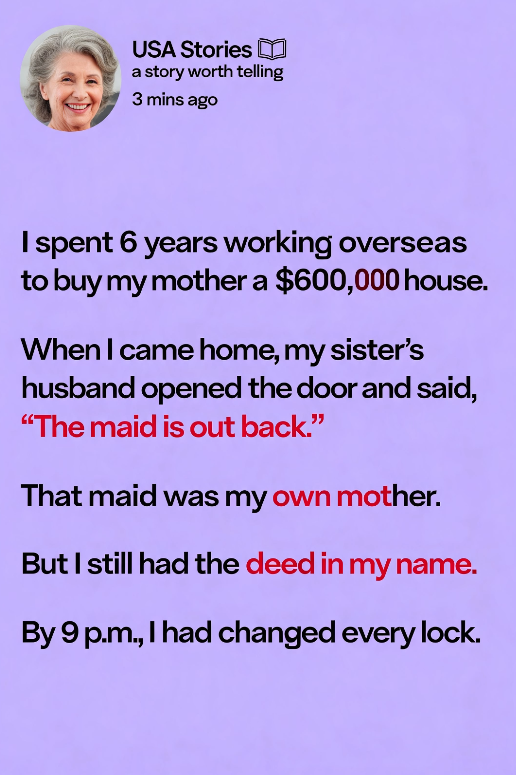
I spent 6 years working overseas to buy my mother a $600,000 house.
When I came home, my sister’s husband opened the door and said, “The maid is out back.”
That maid was my own mother.
But I still had the deed in my name.
By 9 p.m., I had changed every lock.
Part 2: What Six Years Looks Like
Six years is a long time to be away from the person you are working for.
I want to say that plainly before anything else, because the story doesn’t make sense without understanding what those six years actually cost. Not financially — I’ll get to the money — but in the specific, daily currency of absence. Six years of phone calls instead of dinners. Six years of watching my mother age through video screens and photographs. Six years of missing the ordinary things — her cooking, the particular way she laughed at her own jokes before she finished telling them, the sound of her moving around in the morning before the rest of the house was awake.
My name is James Whitfield and I left for Singapore in the spring when I was twenty-nine years old because my mother was living in a rented apartment in Greensboro, North Carolina that was costing her most of her social security check every month, and I had decided that this was not acceptable and that I was the person who was going to change it.
I am an engineer. I am good at my work and I was good enough to get a contract with a firm in Singapore that paid considerably more than anything available to me in Greensboro, and I took it with the specific intention of saving enough to buy my mother a house outright — no mortgage, no monthly payment, no landlord, nothing that could change or be taken away. A house that was hers.
I sent money home every month. Not all of it — I was practical enough to keep a reserve, to save for the purchase itself — but a substantial portion, enough that my mother’s daily life improved considerably within the first year. She ate better. She saw the doctor when she needed to. She was not counting days to the end of the month.
My sister, Carol, and her husband Derek had moved in with my mother two years into my time overseas.
Carol told me it was temporary — Derek had lost his job, they needed to get back on their feet, our mother had offered because our mother always offered, because offering was what she did, and it would only be for a few months.
Two years later they were still there.
I had started to have concerns about this by year four. The concerns were specific: Carol had mentioned, casually, in a phone call, that their mother was “helping out around the house,” which was a phrase that landed differently depending on context. When I asked what that meant, Carol said Mom liked to keep busy, that she cooked sometimes, that she helped with the cleaning because she enjoyed it.
My mother, at seventy-one, enjoyed cleaning someone else’s house.
I had filed this under things I would address when I got home, which was a category I had been adding to for six years and which had grown considerably larger than I had anticipated.
I bought the house in Greensboro in the spring of my sixth year overseas. $600,000 — a four-bedroom craftsman on a quiet street, close to the church my mother had attended for thirty years, close to the grocery store she preferred, with a garden that got good afternoon light and a porch where you could sit in the evening and hear the neighborhood settle into night.
The deed was in my name because I was the one purchasing it and because I had learned enough about property law to understand that putting it in my mother’s name immediately created complications I wasn’t equipped to handle remotely. I planned to transfer it properly when I arrived home and could sit with an attorney and do it correctly.
I flew home on a Thursday.
I had not told anyone the exact date — not Carol, not Derek, not even my mother entirely, because I had wanted the return to be a surprise, had wanted to walk through a door and see my mother’s face without the performance that advance notice creates.
I took a car from the airport.
I arrived at the house I had purchased at four thirty in the afternoon.
Derek opened the door.
He was wearing a polo shirt and holding a beer and had the comfortable, slightly glazed expression of a man who had been watching television and had been mildly inconvenienced by having to answer the door. He looked at me the way you look at someone you recognize but weren’t expecting — a brief recalibration, the replacement of one set of assumptions with another.
“James,” he said. “You’re back.”
“I am,” I said. “Where’s Mom?”
He jerked his thumb toward the back of the house.
“The maid is out back,” he said.
He said it casually. With the comfortable, unthinking ease of someone using a word that had become ordinary through repetition, that had stopped feeling like a word that required consideration because it had been used enough times that it had become simply accurate description.
The maid.
My mother.
I walked past Derek without responding.
Through the kitchen — which was clean, I noted, cleaner than anything Derek was responsible for — and out the back door.
My mother was in the garden.
Seventy-one years old, on her knees in the dirt, weeding the flower beds along the back fence. She was wearing the old housedress she’d had for years, the blue one with the small white flowers, the one she wore when she was doing work she didn’t want to ruin good clothes for. Her hands were dirty. Her knees were on a folded piece of cardboard she’d put down to protect them from the ground.
She hadn’t heard the back door.
I stood on the porch for a moment and looked at my mother kneeling in the garden of the house I had spent six years buying her, doing the work of someone employed by the people living inside it.
“Mom,” I said.
She turned around.
What happened to her face in that moment is something I will carry for the rest of my life. The surprise first — wide eyes, the sharp intake of breath of someone who has been startled by something good. Then the recognition. Then, flooding in behind the recognition, the specific joy of a mother seeing her child after a long absence — the unguarded, uncalculated joy that belongs only to that moment and cannot be performed or approximated.
She was on her feet before I reached the bottom of the porch steps.
I held her for a long time.
She smelled like garden dirt and the hand lotion she had used my entire life and underneath it something I could only call home, the particular combination of a specific person that means more than any single element of it.
“You’re here,” she kept saying. “You’re actually here.”
“I’m here,” I said. “I’m sorry it took so long.”
We stood in the garden for a while.
Then I went back inside.
Derek was in the living room. Carol had apparently come downstairs — she was in the kitchen doorway, watching me with the careful expression of someone who has realized, in the thirty seconds since her husband said something he shouldn’t have, that something significant is about to happen.
“Hey,” she said. “James. Welcome home. We didn’t know you were—”
“The maid,” I said. “That’s what he called her.”
Carol looked at Derek.
Derek had the expression of a man who was reassessing whether the thing he’d said casually at the door was going to turn out to have consequences.
“He didn’t mean—” Carol started.
“I know what he meant,” I said. “The question I have is how long that’s been his word for her.”
Nobody answered.
“Carol,” I said. “How long has Mom been cleaning this house?”
My sister looked at the floor briefly.
“She likes to help,” she said. “She’s always liked to—”
“How long has she been cleaning this house while you and Derek lived in it?”
Carol pressed her lips together.
The silence told me everything I needed to know about the answer.
Part 3: By 9 PM
I made three phone calls in the first hour after I arrived home.
The first was to a locksmith. I had looked up local locksmith services on the drive from the airport — not because I had planned this specific sequence of events, but because I had spent six years having concerns about the situation at home and had, somewhere in the back of my mind, understood that arriving might require prompt action rather than extended deliberation.
The locksmith said he could be there by seven.
The second call was to an attorney named Patricia who had handled the house purchase remotely and who I had also consulted, in the last few months before my return, about the process for establishing a life estate — a legal arrangement that would give my mother the right to live in the house for the rest of her life, protected regardless of what happened to the deed itself.
“I’m home,” I told Patricia. “I need to move on the life estate as soon as possible. And I need to understand what my rights are as deed holder regarding the current occupants.”
Patricia was efficient. She confirmed what I already knew: the deed was in my name, the current occupants had no legal tenancy — no lease, no formal agreement, nothing that established their right to be in the house beyond an informal family arrangement. They had thirty days notice, by law, before I could compel them to leave. But there was nothing preventing me from changing the locks immediately as long as I was present as the property owner.
“I’m present,” I said.
“Then you can change the locks,” she said. “Tonight if you want.”
The third call was to my mother.
I had sent her to the neighbor’s house — Eleanor, who had been her friend for twenty years and who had, my mother told me later, been watching the situation at home with increasing concern and was not surprised to open her door and find my mother on her porch with a cup of tea and the particular expression of a woman who has been waiting for someone to come home and fix something for a long time.
“Mom,” I said. “I need you to stay at Eleanor’s for a few hours. There’s some things I need to handle at the house.”
“James,” she said. “You don’t have to—”
“I know I don’t have to,” I said. “I want to. Will you stay?”
A pause.
“Okay,” she said quietly. “I’ll stay.”
I went back inside.
Carol and Derek were in the living room. The television was on — Derek had turned it back on, which told me something about his read of the situation, which was apparently that this was a conversation that was going to resolve itself into something manageable if he looked unconcerned enough.
I turned off the television.
“I need to talk to both of you,” I said. “About what’s been happening here.”
What followed was not a short conversation.
Carol was defensive in the way that people are defensive when they know their defense is weak — not confidently, not with the calm certainty of someone who believes they are right, but with the brittle, escalating energy of someone building a case they don’t entirely believe in. She talked about how hard things had been. About Derek’s job situation. About how Mom had wanted to help, had insisted on helping, had felt useful doing the cooking and cleaning and they hadn’t wanted to take that away from her.
“She’s seventy-one years old,” I said. “She’s on her knees in the garden weeding your flower beds.”
“She planted those flowers herself,” Carol said. “She wanted to—”
“Carol,” I said. “I have been sending money home for six years. Enough that Mom didn’t need to be anyone’s cleaning woman. Where did that money go?”
The room went quiet.
Derek looked at the television he could no longer watch.
Carol looked at her hands.
The money, it emerged in the extended and uncomfortable conversation that followed, had been absorbed into the general household expenses in a way that Carol described as pooling resources and that I understood as my sister and her husband living off the money I had sent home for our mother while our mother cleaned their house to feel, as Carol put it, useful.
I did not shout. I want to be clear about that because it would be easy to imagine this conversation as a shouting match and it was not. It was quieter than that and more deliberate and in some ways harder, because the quiet is what made it clear that I was not responding in the moment from emotion but from the specific settled understanding of a person who has thought about this for a long time and arrived at a position they are not going to be talked out of.
“I’m going to need you to start making arrangements to leave,” I said. “You have thirty days by law. I am giving you thirty days.”
Carol stared at me.
“This is Mom’s house,” she said.
“This is my house,” I said. “I purchased it. My name is on the deed. Mom lives here because I bought it for her. You live here because she allowed it and because I was overseas and unable to address it sooner.” I looked at Derek. “The word you used for her at the door. I’d like you to think about that word for the next thirty days while you make your arrangements.”
Derek said nothing.
The locksmith arrived at seven.
He changed every lock in the house — front door, back door, garage — efficiently and without comment, the professional discretion of someone who had clearly changed locks in family situations before and understood that his job was the locks and not the story behind them.
By nine o’clock, I had the new keys.
I called Eleanor.
“You can bring her home now,” I said.
My mother came through the front door at nine fifteen.
She stood in the hallway of the house I had spent six years buying her and looked at the new key in my hand and then at my face.
“James,” she said. “You didn’t have to—”
“Mom,” I said. “I bought you a house. You are going to live in it. You are not going to clean it for anyone except yourself, and even that only as much as you want to.” I held out the new key. “This is yours.”
She took it with both hands.
She looked at it for a moment.
Then she looked up at me and her face did the thing it had done in the garden — the unguarded, uncalculated thing that belongs only to certain moments — and I understood that the six years had been worth it in a way that went beyond the house and the deed and the locks and all the practical things.
Worth it in the way that matters.
Carol and Derek were gone within three weeks.
They moved to a smaller apartment across town, which Derek got through a job he had apparently had available to him for some time but had not pursued aggressively while a four-bedroom craftsman with his mother-in-law’s labor was available as an alternative.
Carol called me twice in the month after they left.
The first call was angry — the particular anger of someone who has been living comfortably and has been required to stop. I let her say what she needed to say.
The second call was different. Quieter. She said she knew things had gotten out of hand. That she hadn’t meant for it to become what it had become. That she was sorry about the word Derek had used, specifically — that she had told him it was unacceptable and that he understood that now.
I believed the apology about the word.
I am still working on the rest.
My mother’s garden is the best it has looked in years.
She tends it herself, on her own schedule, in the housedress with the small white flowers, because she genuinely likes gardening and it turns out the difference between doing something you love and doing something you are expected to do is entirely a matter of who is watching and what they call you while you work.
On Sunday afternoons I sit with her on the porch and we drink coffee and she tells me about the neighborhood and the church and Eleanor and all the things that have been happening in the world forty minutes from the airport while I was living on the other side of it.
Six years is a long time to be away from the person you are working for.
I will not be away again.
Share this for every parent who deserved a home of their own, and every child who spent six years making sure they had one.